
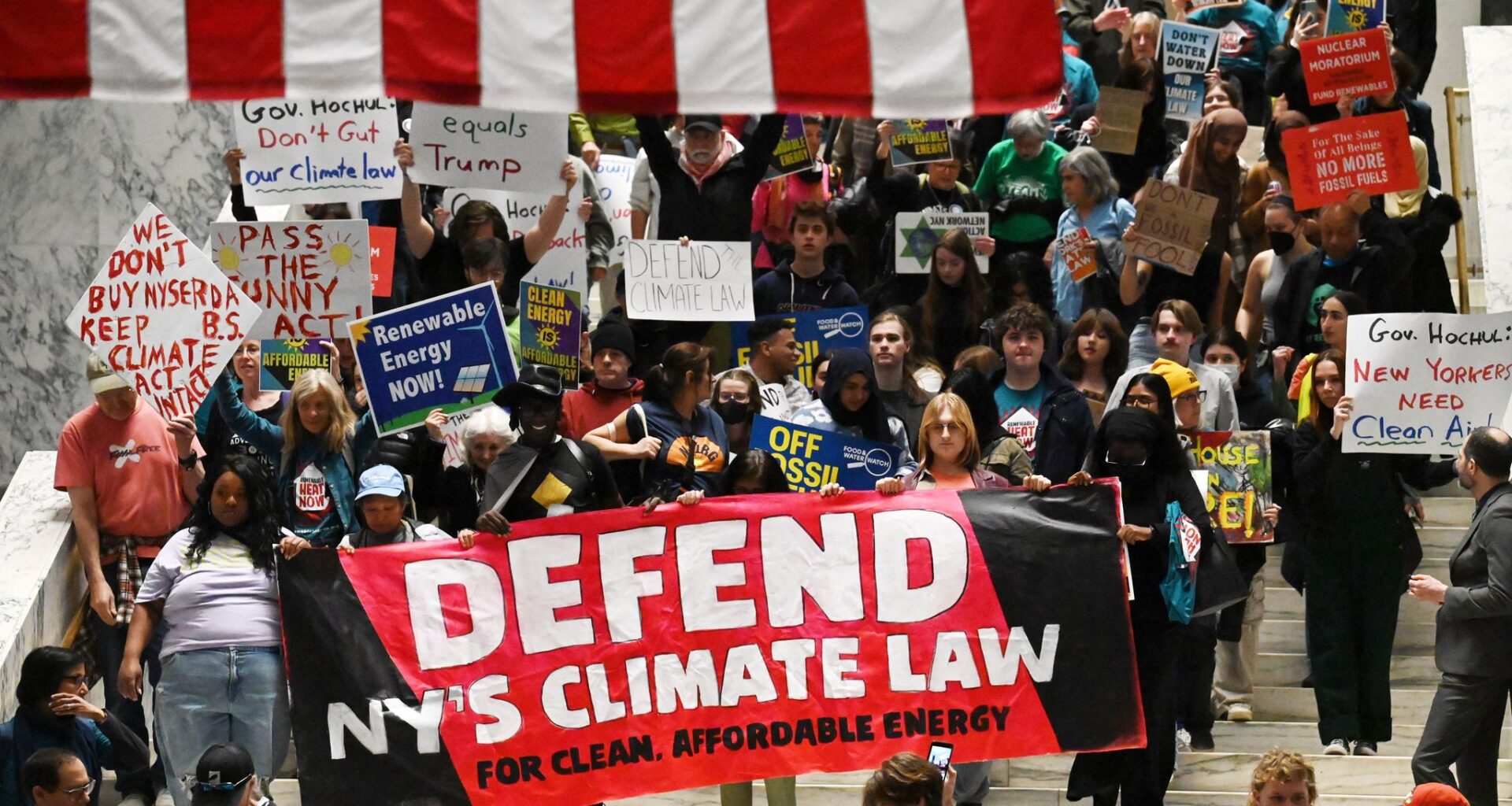
Hundreds of environmental advocates flooded the state capitol last week to fight against any changes to the Climate Act.
Will Waldron/Times Union
Environmental advocates blocked entrances to Gov. Kathy Hochul’s office recently to push for swifter adoption of renewable energy.
Will Waldron/Times Union
Attendees of the Independent Power Producers of New York’s annual clean energy conference discussed ways to keep electricity system reliable as it faces growing challenges.
Will Waldron/Times Union
State Senator Liz Krueger, a Manhattan Democrat, joined environmental advocates during a Wednesday protest held in opposition to Gov. Kathy Hochul’s plan to adjust the Climate Act.
Will Waldron/Times Union
The Independent Power Producers conference featured a panel discussion on modernizing aging gas plants in New York City and on Long Island.
Will Waldron/Times Union
Environmental advocates say delaying aggressive action on climate change will lead to disastrous public health effects.
Will Waldron/Times Union
ALBANY — Gov. Kathy Hochul says New York’s Climate Act needs to be adjusted to prevent a spike in future utility costs. She has blamed a changing economic landscape due to the pandemic as well as federal energy policies that have been retooled by President Donald J. Trump’s administration.

But concerns about New York’s ability to meet the mandates, and at what cost, predate Trump’s second presidency and extend beyond supply-chain issues that have subsided.
Article continues below this ad
The 2019 law set ambitious targets of reducing greenhouse gas emissions 40% by 2030 and 85% by 2050. Those mandates aren’t changing under Hochul’s plan, which she announced in an op-ed, published in Empire Report.
What would change under her proposal, which needs legislative approval, is how quickly her administration needs to implement policies promoting things like the electrification of buildings and vehicles to meet the targets.
Immediately rolling out policies to meet the 2030 emissions reduction requirements could raise upstate households’ energy costs over $4,000 annually, according to a memo issued last month by Doreen M. Harris, president and CEO of the New York Energy Research and Development Authority.
Make the Times Union a Preferred Source on Google to see more of our journalism when you search.
Add Preferred Source
Harris also cautioned that gas prices would rise more than $2.23 per gallon with “comparable increases to other fuels.”
Article continues below this ad
It marked a turnaround from four years ago, when Harris endorsed the final scoping plan issued by New York’s Climate Action Council, declaring that “climate action is not only necessary, but that delay is to be avoided.”
But citing “updated, conservative estimate” from Harris, which Hochul said would be financially perilous for many New Yorkers, the governor has proposed pushing back the requirement to implement lower-emission policies until 2030. Those rules will have to reduce emissions to reach the 2050 deadline and show positive progress by 2040. If Hochul is reelected in November, that due date won’t come until the end of her second full term.
The proposal would essentially nullify any legal requirement for the state to reach its 2030 emission reduction milestone. Though state agencies will have to consider it when reviewing things like air quality permits.
The changes are “solely out of necessity — to protect New Yorkers’ pocketbooks and economy,” Hochul wrote in the op-ed.
Article continues below this ad
Changing the Climate Act isn’t a retreat, Hochul frequently insists.
“Leading the fight against climate change and protecting our environment is deeply personal for me,” she wrote in the op-ed, highlighting the nearly $90 billion of investments into clean energy since she became governor in 2021.
A lack of support for renewable energy from the federal government makes the Climate Act’s 2030 target all the more difficult to achieve, Hochul wrote.
Trump’s administration has paused offshore wind energy projects, which it considers to be an intermittent resource and national security threat. Hochul has repeatedly fought the administration in an effort to keep the state’s two planned wind projects on track.
Article continues below this ad
Last week she said anyone with a “rational brain” can see where she is coming from given the affordability challenges and policy shifts in Washington.
Despite federal challenges, solar fields’ contribution to the U.S. grid is expected to grow nearly 50% over the next two years, according to the Energy Information Administration. And during the post-pandemic period of high inflation and interest rates, other states, including Ohio, Indiana and Texas, have had swift build outs of large-scale renewable energy projects. New York saw less growth, with most development limited to small-scale and rooftop solar.
Climate Act advocates claim Hochul is relying on phony cost estimates to create a “manufactured crisis” over the consequences of following through on the law. New York could lose up to $18 billion in rebates to households over the next five years if measures to reduce greenhouse gas emissions are delayed under Hochul’s proposal, according to NY Renews, an environmental advocacy organization.
Some also aren’t taking any solace in the 2050 target remaining unchanged. That goal is in the distant future, which lets current policymakers “completely off the hook,” said Michael Gerrard, the founder and faculty director of the Sabin Center for Climate Change Law at Columbia University.
Article continues below this ad
In the lead-up to Hochul’s op-ed, Democrats demurred from offering support to any changes.
State Sen. Liz Krueger, a Manhattan Democrat, and 28 of her colleagues signed a letter committing to fight for the Climate Act mandates as written.
‘We still believe’
But since Hochul’s op-ed, some lawmakers who spoke to the Times Union have expressed an openness to adjustments, as long as they’re limited and accompanied by a renewed focus on fighting climate change. Still, the specifics of the governor’s plan remain unclear because no legislative language has been released — something that’s frustrating lawmakers as Wednesday’s deadline for passing a state budget approaches.
Article continues below this ad
“We have to adjust the facts on the ground and things that have happened since (the Climate Act was passed),” said Senate Deputy Majority Leader Michael Gianaris. “If we’re making changes, they (need to be) the minimally necessary changes so that we don’t slow down what is a nation leading law to deal with the climate crisis.”
Hochul’s pitch includes changing the emissions accounting method to match global standards. That amendment is so far what’s facing the fiercest opposition from Democrats in the state Legislature
Under the Climate Act, greenhouse gases are counted based on their impact on the atmosphere over 20 years, rather than the typical approach of measuring their effects over 100 years. This makes the levels of methane — emitted from natural gas — appear worse in New York because the potent greenhouse gas only lasts a short time in the atmosphere.
While adjustments to the accounting method will only be reflected in spreadsheets and projections, they will have a meaningful impact on the actions New York must take to fulfill the law.
Article continues below this ad
If the accounting methodology is changed — with no other amendments to state policy — New York could hit the 2030 emissions reduction target as early as 2031, according to New York State Energy Research and Development Authority data. If the methodology isn’t changed, it would take until 2037, according to the same data set.
Assemblywoman Deborah Glick, a Manhattan Democrat and chair of the Environmental Conservation Committee, is open to changing some of the law’s deadlines, but said, “retaining the focus on accounting for methane is vital.”
Assemblyman Al Stirpe, a Syracuse-area Democrat, agreed, saying changing the way emissions are calculated would be “troubling.”
Changing the calculations has its supporters, though, including state Sen. Jeremy Cooney, a Rochester Democrat.
Article continues below this ad
There can’t be “one without the other,” Cooney said. But he wants assurances that Hochul will roll out meaningful emission reduction measures if the state Legislature goes along with her proposals, because “we still believe that we are in a climate crisis.”
‘Made above them’
Looming over negotiations with the state Legislature is potential action from Hochul’s own administration to curb parts of the Climate Act.
The Public Service Commission, which regulates New York utility companies, can “temporarily suspend or modify” the law’s requirement to utilize 70% renewable energy by 2030 and make the grid emission-free by 2040.
Article continues below this ad
The commission opened public comment on a petition from a coalition of business groups urging it to use that authority. Changing the 2040 mandate could allow downstate fossil fuel plants to be modernized with improved, lower-emission technology rather than shut down.
Several Hochul administration officials and prominent figures in the energy industry have said the state needs to consider extending the lifespan of downstate gas plants to meet growing grid reliability challenges.
“Upgrading the generation fleet … would be really beneficial to consumers, both from a reliability standpoint and from a cost standpoint,” said Richard J. Dewey, president and CEO of the New York Independent System Operator, which manages the state’s electric system.
Krueger, the Manhattan Democrat, said she thinks the commission’s decision to consider changes to the clean energy requirements was “made above them.”
Article continues below this ad
“Instead of decreasing our dependence on fossil fuels, we’re actually pouring (in) ridiculous amounts of money that will then take decades to get paid back,” Krueger said of modernizing gas plants rather than closing them.
The governor had no role in the decision to accept comments because the Public Service Commission “is an independent body,” said Ken Lovett, a Hochul spokesman.
“The governor has said in order to keep the lights and heat on and costs down for New Yorkers, she is open to all forms of energy plan(s) that meet applicable state and local laws,” Lovett said, when asked whether Hochul supports modernizing aging gas plants.
Even some who are pushing to change the clean energy mandates weren’t expecting their request to be taken seriously.
Article continues below this ad
Donna DeCarolis, who signed onto the business groups’ petition and is a senior policy advisor at National Fuel Gas, said she was “surprised” the commission decided to accept comments — especially because a letter sent by DeCarolis to the commission in July outlining grid reliability concerns didn’t yield any conversations.
“The (commission) issued the petition for public comment to gather different perspectives and information,” said Kim Mashke, a commission spokeswoman. Mashke noted that public comment is accepted on many proposals.
For the commission to make adjustments, it has to determine that the clean energy targets are driving people into debt with their utility company or that a significant number of New Yorkers are having their service shut off. The mandates can also be changed if they’re found to hinder grid reliability.
New Yorkers are nearly $2 billion in debt with their utility companies, with over 1 million households more than 60 days behind on their energy bills.
Article continues below this ad
There is sparse evidence tying the law’s clean energy requirements to that crisis, although utility costs are rising.
The Climate Act accounts for about 10% of the average electric bill, according to studies conducted by the commission. The New York Independent System Operator has repeatedly cited the rising cost of natural gas — New York’s most-used electricity source — as the key driver of price hikes.
The business groups’ case focuses mostly on convincing the commission that the clean energy requirements threaten reliability.
“The inability to timely develop renewable energy generation risks the reliability of New York’s electric grid, especially as an increasing number of existing fossil-fuel generation resources deactivate due to decarbonization goals and greenhouse gas emissions reduction policies,” the petition reads.
Article continues below this ad
Stephan Edel, executive director of NY Renews, said the argument laid out in the petition, that “speculatively, there may down the road be an impact,” does not pass muster for the commission to utilize its authority. Meeting the clean energy targets would have to presently cause reliability shortfalls for them to be temporarily suspended, Edel contends.
New York City could face grid reliability challenges as soon as this summer, the independent system operator reported in October. Even if major clean energy projects come online on schedule in the next year, the risk of several decades-old gas plants shuttering puts New York City’s grid at risk by the end of the decade.
Upgrading the plants so they can run through 2040 is legally challenging, unless the clean energy requirements are pushed back.
Investing billions of dollars to replace 70-year-old gas turbines just to be forced to shut down in 2040 once the state is required to utilize all clean energy is not a realistic economic decision, said John T. McManus, an experienced energy attorney in Albany. Pushing back that deadline makes upgrades more “economically feasible and thus more likely,” he continued.
Article continues below this ad
National Grid Ventures, an arm of the utility company that owns several natural gas plants on Long Island, is in the early stages of seeking approval to upgrade its facilities, which in some cases are more than 70 years old.
State officials need to provide “clarity” that modernizing plants would be supported, said Will Hazelip, president of National Grid Ventures U.S.
Hazelip wouldn’t delve into exactly what “clarity” would be, but pointed to positive comments from officials in Hochul’s administration as an “encouraging trend.”
Article continues below this ad
Climate Act advocates contend that building renewable energy is cheaper than natural gas, but also argue that focusing solely on the dollars and cents undercuts the rationale for taking action on climate change.
“People who oppose activities to address climate change only talk about the cost of putting in a heat pump, the cost of installing solar,” said Glick, the assemblywoman from Manhattan. “They never talk about the other side of the ledger, which is the cost of not doing it, and there are serious costs.”