
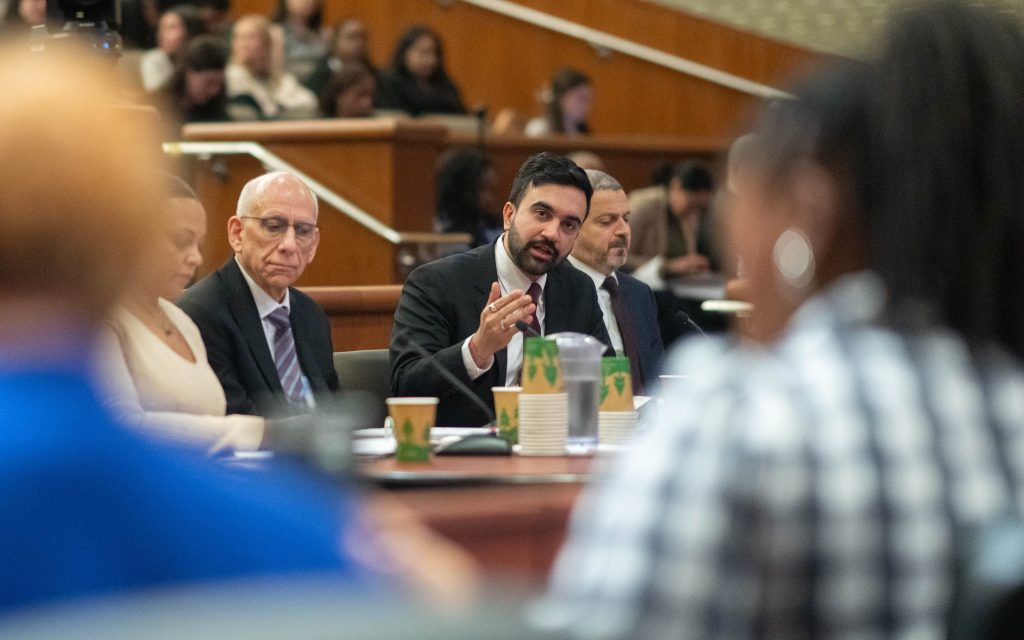
With budget negotiations all but certain to blow past a Wednesday deadline, New York lawmakers are still hashing out central issues to city schools.
On the table are proposals that would give the city relief from legally-required class size reduction or allocate more funding toward disadvantaged students. The legislature is also considering an extension of mayoral control over city schools, though some lawmakers would prefer to take up the issue after the budget process.
The debate comes against the backdrop of a multibillion New York City budget gap that Mayor Mamdani is seeking help from Albany to close.
“We’re encouraged by the nature of the negotiations and the conversations we’re having with the state legislative leaders,” Mamdani said at an unrelated news conference on Monday, citing a $5.4-billion financial shortfall in the city’s overall budget.
“That is still a significant fiscal deficit,” he added, “that we want to meet in partnership, with our partners at the state.”
Class size relief
To help bridge the divide, the New York Times reported last Thursday the Mamdani administration was “banking on savings” from delaying the full implementation of a law requiring that all classes serve a maximum of 20 to 25 students, depending on their grade level.
The 2022 class size law gave the city until the 2027-28 school year for all classrooms to comply with the costly mandate, which involves hiring of new teachers and adding physical space. The school system is obligated to hit a milestone of 80% compliance this fall, which Chancellor Kamar Samuels said at a recent City Council hearing will be “very difficult” to reach.
Under the proposal being debated, the state would lower that benchmark to 70% this fall, adding 10% each year until full implementation by the 2029-30 school year — contingent on Mamdani putting forward a more detailed progress report this year than plans submitted under his predecessor Mayor Adams.
But State Sen. John Liu (D-Queens), chair of the NYC education committee, cautioned that school aid cannot be used to fill the city’s coffers.
“An extension of that six-year timetable to eight years is seriously being discussed, based on the city coming up with a solid plan to reduce class sizes citywide,” said Liu, who co-sponsored the law. “But nowhere was there any mention that the city thought this would be a form of fiscal relief.”
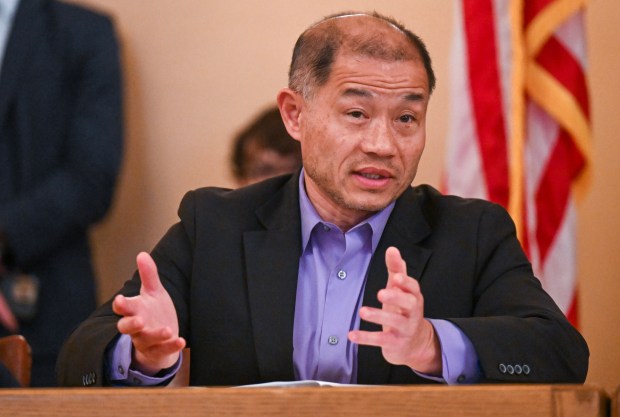 Sen. John Liu , D-Queens, is pictured during a Senate Judiciary Committee hearing Monday, April17, 2023, in Albany, N.Y. (AP Photo/Hans Pennink)
On the other side of the New York legislature, the Assembly is explicitly pushing for $600 million to provide fiscal relief for the class size mandate.
“I am in favor of the ultimate goal of reducing class size, for obvious reasons. You make the classes smaller, you can get better results, more individual help for the kids,” said Assemblyman Michael Benedetto (D-Bronx), chair of the education committee.
“But to get there, it’s not that easy, and we’ve got to give New York City some time to do it,” he added.
Foundation Aid
The majority of New York’s school aid is funneled through a needs-based formula known as Foundation Aid, which was adjusted last year in ways that resulted in city schools receiving a smaller funding increase than expected.
Now, the Mamdani administration is pushing for additional changes that would readjust the formula to the city’s benefit.
“How much exactly is that going to be? I am not certain yet, but we’re looking at half a billion dollars more,” Liu predicted.
Once negotiations are complete, the committee chair said he’s “confident” there will be a “substantial amount of additional state funding” to better serve students in temporary housing, foster care, or learning English, which are all priorities for Samuels.
But another change the chancellor has been advocating for — the recognition of the city’s higher cost of educating students, known as a “regional cost index” — could be dead on arrival.
“I’m less confident that that element will be part of the final budget,” said Liu, who has separate legislation on that specific issue.
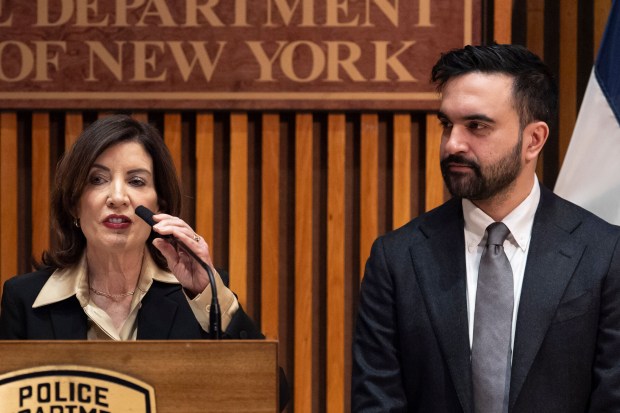 New York Gov. Kathy Hochul speaks during a press conference with New York Mayor Zohran Mamdani and NYPD Commissioner Jessica Tisch, Tuesday, Jan. 6, 2026, in New York. (AP Photo/Yuki Iwamura, File)
The governor’s office said Hochul has increased Foundation Aid to New York City by $2.2 billion from the 2021-22 school year to her executive budget proposal.
“The Governor will continue to negotiate in good faith with the legislature to finalize the budget and ensure all New York students have access to a quality education,” said the governor’s spokeswoman Emma Wallner.
Mayoral control
Lawmakers are also debating whether or not to keep giving the New York City mayor the power to run the schools, or set the issue aside until after the budget is done. Mamdani ran for mayor on ending mayoral control but quickly backtracked after he was elected — now leading a full-court press for a lengthy renewal.
Last Tuesday, Samuels was in Albany to push for an extension. Trusted messengers are also flooding the airwaves and opinion pages to ensure the legislature does not replace mayoral control with a new system.
“That is not something that is being considered right now: abandoning mayoral control,” Liu said. “But I’m sure that question will reappear in future years.”
“The question mainly is how long to extend mayoral control for, and that’s a function of the level of confidence in this administration’s ability to run schools and comply with state law,” said Liu. But such an extension is “unlikely to be four years,” he added, as proposed by Hochul in January.
Benedetto, himself in favor of a four-year extension with tweaks that would return more power to the mayor, said there are still conflicting opinions on the issue within his conference.
“I’m trying to do my best to convince everybody that we should take that out of the budget,” said the assemblyman, “and discuss that on its own later on, and have a spirited and robust dialogue on it.”