
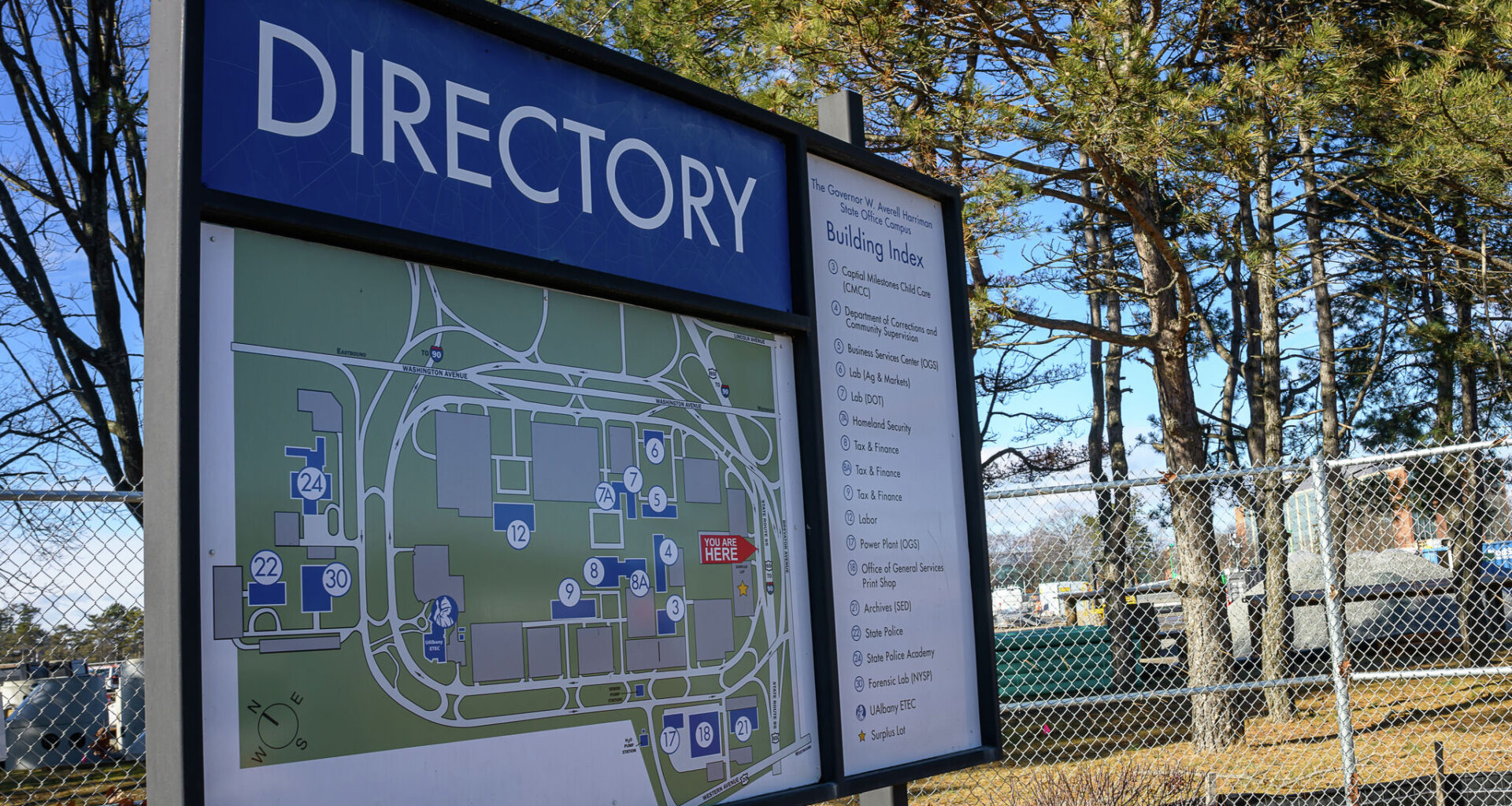
For decades, the Harriman State Office Campus has been one of Albany’s biggest eyesores — and one of its greatest missed opportunities. It is larger than many upstate cities’ downtowns. Yet despite its size and its location in the heart of uptown Albany, the campus functions like a relic of 20th-century Robert Moses-inspired planning: an office complex built around cars, ring roads and surface parking.
Shovels are in the ground at Harriman on a transformative project we’ve long supported: the new $1.7 billion Wadsworth Center public health laboratory. The project is consolidating several aging labs into one modern facility.
But this project is about more than a new building plopped into the corner of Harriman. It must be a catalyst for transforming the entire campus.
This year, we have the opportunity to get the campus out of the 1960s. Both the Senate and Assembly one-house budget proposals include $1 million to create a master plan for the Harriman Campus and begin reimagining it.
Thousands of state workers who commute to Harriman each day park, work and then leave, without ever getting the opportunity to enjoy a green walking path or set foot in a coffee shop in nearby neighborhoods. In 1960, this vision was considered forward-thinking and futuristic. In 2026, it is downright offensive, leaving a figurative black hole in the middle of uptown Albany and blocking neighborhoods from seeing any economic benefit from this tax-free property.
Across the capital city, we’re seeing renewed optimism and momentum as Albany’s downtown is infused with $400 million, with new housing and small businesses already bringing life back to historic buildings.
The Harriman Campus should be part of that same story. Instead, it remains Albany’s “uptown parking lot district.”
Even dedicating a small portion of the site to mixed-use development could unlock enormous potential. New housing could help address Albany’s housing shortage while allowing researchers, scientists and students to live near their workplaces, as studies have shown they prefer. Restaurants and small businesses could serve thousands of workers, and walkable streets and green space could reconnect neighborhoods that for decades have been separated by asphalt and fencing.
Just as importantly, reimagining Harriman would help address one of Albany’s longstanding challenges as New York’s capital city: our tax base. Reclaiming land just from the infamous ring roads and the behemoth parking lots would free up acres of land. They should be harnessed for spinoff development, multiplying the effect of the public investment.
Albany hosts an extraordinary amount of tax-exempt property. More than 60% of the city’s property is off the tax rolls. The Harriman Campus alone covers hundreds of acres and currently generates no local tax revenue. Strategic mixed-use development would allow portions of that land to return to the tax rolls while strengthening the regional economy.
Securing $1 million for a master plan in the final budget to reimagine Harriman Campus would bring together state agencies, the city of Albany, residents and economic development experts to map out a long-term strategy for the site, one that prioritizes housing, transit access, sustainability and community integration alongside the state’s operational needs. Importantly, none of this would interfere with the construction or operation of the new Wadsworth laboratory. The lab will remain a secure facility and a world-class public health asset.
This funding would finally allow us to plan the Harriman Campus as part of Albany, rather than apart from it.
We’ve already begun revitalizing Albany’s downtown and reconnecting it with the Hudson River waterfront. Now it’s time to bring that same ambition uptown.
Sen. Patricia Fahy of Albany represents the 46th state Senate District. Assemblymember Gabriella A. Romero of Albany represents the 109th state Assembly District.