
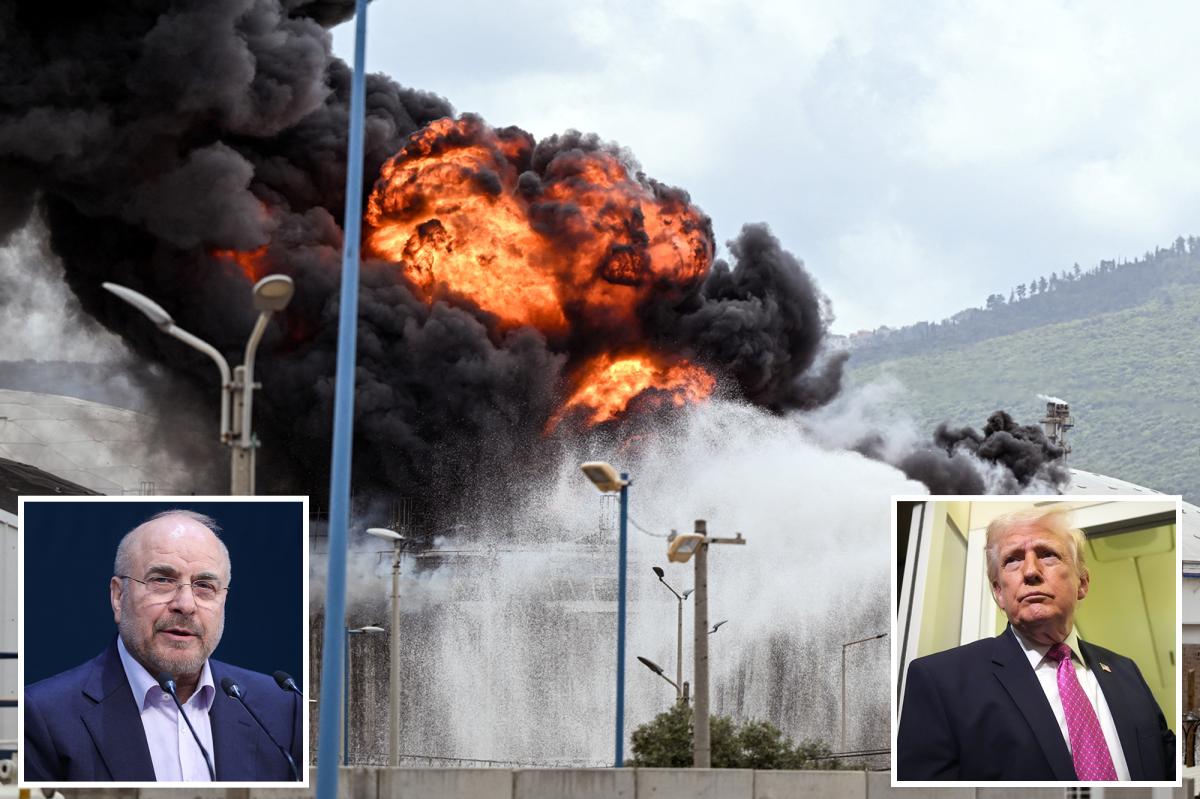
WASHINGTON — President Trump on Monday put Iran and the speaker of the Islamic Republic’s parliament on notice after Tehran attacked Israel’s biggest oil refinery and told The Post his response is coming “shortly.”
Iran escalated its attack on infrastructure by striking a water and electrical plant in Kuwait, and an oil refinery was set ablaze in the northern Israeli city of Haifa after the Iranian missile attack. Asked for his response on the strike, he told The Post: “You’ll see shortly.”
As Trump brings more military might to the region that could inflict catastrophic damage on Iran, he encouraged what’s left of Iran’s regime to make a deal before it’s too late and said he would hit them where it really hurt: their energy infrastructure.
Trump spoke exclusively with The Post and put Iran on notice. AP
He exclusively told The Post that the US will find out whether the speaker is willing to work with Americans –soon.
“We’re gonna find out,” Trump told The Post when asked about Iran’s Mohammad Bagher Ghalibaf. “I’ll let you know that in about a week.”
Ghalibaf issued his own warning in response, writing on social media that attacking Iran’s infrastructure would be a “big mistake.”
“The enemy promotes its desires as news while threatening our nation at same time. Big Mistake. If they hit one,they’ll take several back. God willing, the people of Iran,under the leadership of the Supreme Leader,will make the enemy regret the aggression and reclaim their rights,” he wrote.
The president described a dramatic shake-up inside Iran, claiming the old guard has effectively been wiped out and replaced by a new group he said has so far been easier to work with.
“There has been total regime change because the regimes of the past are gone and we’re dealing with a whole new set of people,” Trump said. “And thus far, they’ve been much more reasonable.”
Pressed on whether these are new figures compared to past US adversaries in Tehran, Trump didn’t mince words.
A blaze after Israel’s Fire and Rescue Service said that an industrial building and a fuel tanker at Israel’s Oil Refineries were hit by debris from an intercepted Iranian missile. REUTERS
“Pretty much,” he said. “The other people are all dead.”
Trump also pointed to uncertainty surrounding the health of Iran’s new Supreme Leader, Mojtaba Khamenei — the son of the now-dead Ayatollah Ali Khamenei.
The son has not been seen publicly since the US and Israel began their attacks on Feb. 28.
“Nobody’s heard from him,” Trump said of the leader, whom The Post previously reported that US intel officials believe to be gay. “He’s very seriously injured.”
Asked if Mojtaba Khamenei is still alive, Trump added, “We don’t know. We think probably yes, but in extraordinarily bad shape.”
Several major figures in Iran’s leadership have died under the US-Israeli bombing campaign including the ayatollah, the defense minister, the country’s top security official, and the commander of the Islamic Revolutionary Guard Corps. Several top military leaders and intelligence officials have also died.
Trump’s decision to give Ghalibaf a week could be tied to his April 6th deadline for Iran to come to a peace deal with America. It’s unclear how safe the Iranian speaker is or if he’s on any type of kill list. The White House did not respond to an inquiry on the matter.
Iranian leaders have not publicly confirmed that they are participating in talks with the US. Meanwhile, their blockade of the Strait of Hormuz, a vital waterway for cargo and oil shipments, has shaken stock markets around the world.
The Post’s interview with the president came hours after Iran targeted an Israeli oil refinery — the latest strike on energy infrastructure in the monthlong war.
Oil prices spiked in early trading on Monday, as Iran went on the attack and Trump threatened his response.
Prices hit $115 per barrel and, in the US, the average price for a gallon of gas is now $3.99, according to AAA, which is the highest since 2022.
The president started Monday on a tough note, warning Tehran the US would obliterate the regime’s power plants, oil wells, and its main export hub, Kharg Island, if negotiations fell through.
“Great progress has been made but, if for any reason a deal is not shortly reached, which it probably will be, and if the Hormuz Strait is not immediately ‘Open for Business,’ we will conclude our lovely ‘stay’ in Iran by blowing up and completely obliterating all of their Electric Generating Plants, Oil Wells and Kharg Island,” he wrote on Truth Social.
The tough talk came as the war hit the 30-day mark. Trump originally set a four-to-six week deadline for the war to come to an end.
White House press secretary Karoline Leavitt said that the time table still held.
“The President, Commander in Chief, the Pentagon has always stated four to six weeks estimated timeline for Operation epic fury. We’re on day 30 today. So again, you do the math on how much longer we the Pentagon needs to fully achieve the objectives,” she said in response to a question from The Post.
Trump pointed to uncertainty surrounding the health of Iran’s new Supreme Leader, Mojtaba Khamenei, saying if he’s alive, he’s likely in bad shape. via REUTERS
Trump has a lot of options to win the war, some of which he has discussed publicly.
He told the Financial Times that the US had about 3,000 targets it would still like to hit in Iran — after having “bombed 13,000 targets” since Feb. 28.
Another option he’s weighing would be to send US soldiers inside Iran to extract nearly 1,000 pounds of uranium.
He’s open to the idea but also considering the risks to American soldiers, US officials familiar with the plan told the Wall Street Journal.
The majority of Iran’s enriched uranium is believed to be held in Isfahan, located 270 miles south of Tehran. Little is known about it, but there are reports it could be about 330 feet below the mountain base.
The mission would be dangerous. With the site so deep inside Iran, US forces would need to dodge the country’s remaining drones and missiles to reach it.
Soldiers would also likely face mines and booby traps while trying to get engineers with excavating equipment to reach the nuclear material.