
[upbeat music]
The Sip and Guzzle is a American Japanese
hybrid cocktail bar.
We got number one burger in North America,
voted by world’s best steakhouses.
My title is Executive Chef.
I did 10 years at three Michelin, Alinea, as Executive Chef
and I’m taking all of my creativity
and applying it to the bar.
It’s a cocktail bar.
A lot of the food wouldn’t work in all environments.
Here, having a 13-inch mochi fry, that’s chewy
and it’s a French fry with a couple of cocktails and a beer
makes absolute sense and it’s fun.
[upbeat music]
Hey, what’s up? Welcome to Sip and Guzzle.
I’m Mike Bagale, Executive Chef. Come on in.
[bright music]
This is actually Guzzle Bar.
Downstairs is Sip Bar.
Upstairs focuses on classics
and classic cocktail-making, prohibition style.
And then downstairs is a little bit more technique driven
and the kitchen supports both programs.
So, come into the kitchen and let’s get started.
[bright music]
♪ Hey ♪
We’re checking in on some morning production.
Chef here is getting ready to grind our A5 Wagyu
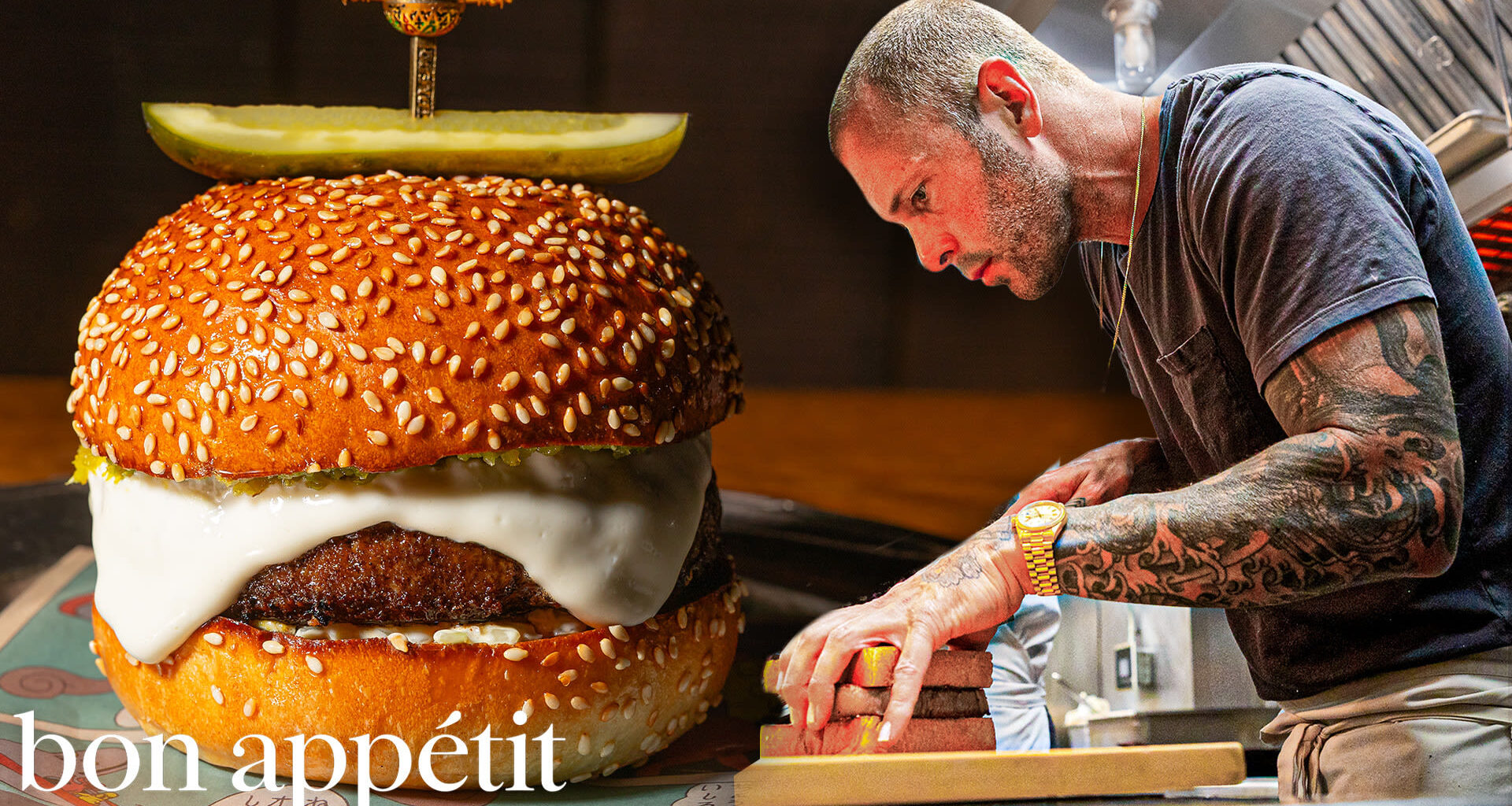
for our signature Tavern Burger.
This Tavern Burger is a byproduct of another iconic sandwich
that we do, the Royale with Cheese.
We take all the trimmings from that
and we grind it into patties.
That was how this dish was birthed.
We use A5 Miyazaki specifically
’cause the Royale with Cheese sandwich is an iconic sandwich
in Japan called the Katsu Beef Sandwich.
And our version is a little bit Americanized.
We put minced onions
similar to how big fast food brands do it.
We make our own Japanese ketchup, our own version
of cheese sauce on it.
Specifically, this is tenderloin.
This isn’t just A5 Wagyu, it’s the most tender cut on top
of it already being tender.
And the reason for which is when you bite
into this really thick sandwich, it needs to disintegrate
and eat almost like a marshmallow.
But for the burger, we do 12 a day, very specifically
because that’s our yield of our byproduct.
So, it is sustainable.
This is like a nose to tail, if you will,
of our in-house production.
There’s a lot of fat here.
It’s not traditional for a Tavern Burger,
so we need to strengthen it.
So, we add a little bit of gelatin
and then we add Japanese Jidori egg yolks
to give it a little bit of a binder as well.
It’s a Japanese chicken that’s actually a fertilized egg.
It is chicken eggs they use in Yakitori.
We start this in the morning, let them really,
really firm up ’cause we’re gonna pan base those
in a lot of French butter and caramelize ’em.
And we need to make sure that it’s fresh ground daily,
that it’s bound properly
and that it has time to rest
so the meat softens even a little bit more,
but it’s still compact.
And then we assemble the burger by adding
what I call Parmesan singles to mimic like a craft single
where we take Parmesan and cream and lay it into a sheet
and cut it into perfect square so we can drape that over
and steam it over the final product.
And then we do our own fermented shishito relish,
napa cabbage slaw, fermented pickles, just a light brushing
of tare on it and the Breads Bakery sesame buns.
This looks great, chef.
I’m gonna head upstairs and check in with Chef Isaac.
[upbeat funky music]
I like to start my day with Chef de Cuisine Isaac here.
Isaac runs not only the day-to-day operations,
he helps me streamline the systems
to make sure every dish is consistent.
Let’s check out this caviar.
You gotta see how it’s gonna work.
This is Golden Osetra caviar.
We get it farmed from Greece.
It’s just a rare quality egg.
It’s a little bit richer,
a little bit more buttery
than you would typically get from a caviar.
Any luxury ingredient,
there needs to be a form of education
from the product to the guest.
The best way to serve it is in abundance.
That way the guests feel not only are they getting
the quantity of which they want,
but they’re able to make their own assessment
into why they like it.
[Isaac] Dealing it in with ice cream a lot.
So, thinking maybe we just do a special with a fat dab
of caviar on the Hakata milk saucer.
Mm-hmm. Really good. It’s delicious.
This batch is super nutty.
Alright, we’re gonna check some of the deliveries
that are coming in now.
[upbeat music]
Some of our deliveries come up to the bar.
This is our Breads Bakery delivery.
A very prestigious list
that rated us number one burger in the country,
is partially due to this amazing
partnership with Breads Bakery.
Every day, deliver in the morning between 12
and 15 buns just baked like an hour ago.
[Mike] We don’t make it in-house
because we don’t have the time commitment,
the proofing, the ovens.
One thing coming from Michelin kitchens
is there’s like a stigma of not making everything in-house.
And if you’re not making your own bread
or your own cured meats or whatever-
Then you’re a hack.
Yeah, then you’re an idiot and you should go home
and never come back.
Bread looks awesome and we have a few other deliveries
that we need to check on.
[upbeat music]
Come on in. Thank you.
Straight to the kitchen. Alright.
This is our bluefin tuna.
Really high quality, as you can tell.
Clean, beautiful product that we use a lot of.
Typically what we’ll do is we’ll separate this loin
and use the loin specifically
for putting into our volcano roll.
We like to give it a little taste, determine if we want
to age it on the skin a little bit downstairs
to impart a little bit more umami and flavor.
Or sometimes it’s kind of ready to go now.
What do you think?
I think it’s great.
I think sit on it for a couple days
and let it kind of concentrate, just on the skin.
Okay. And we’ll break
it down and get it ready.
It could go right now.
I’d be happy with it right now.
But yeah, let’s give it a few days and we’re okay.
Let’s pack it up and keep on moving.
[bright jazz music]
So, a big part of my day is checking in on production.
All of the production happens behind the scenes
before we start service.
Right now I’m checking in on our volcano roll,
which this is an homage to the Japanese hand roll.
This is a unique recipe of macerating nori
with sugar and soy and an invert sugar and then drying.
This is a perfect example of a dish that’s just hyper,
hyper minimalist, but it took about four months
of constant R and D.
This is actually two sheets of nori
that we’ve pressed together.
The next thing is to fry it quickly
and what we’re doing is we’re letting the sugars
that are in the soy caramelize, you take this bar
and you have to work very, very quickly
because as the sugar cools, it hardens.
So, what we’re doing is rolling this
and pressing it so that I’m getting it very, very,
very tight and structural.
And then the sugar temperature is dropping drastically
and as it cools,
[nori roll whooshing]
it forms a tube.
And we set it right here and we make 150 of those
and then we move on to the next project.
So, we’re almost done here.
Let’s go check on some more of the production.
[gentle music]
So, we saw some production upstairs.
A lot of the rest of the production happens down here
in our receiving kitchen.
You saw upstairs, me rolling the tubes and finalizing ’em
and then they get dehydrated.
Down here is where the production starts.
We lacquer and brush and macerate all the nori,
and then it gets air-dried before the final steps.
So, this happens every day, first thing in the morning,
as well as drying our chicken skins that we will puff later.
This is our Bikini production.
It’s the Bikini sandwich designed for my love
of the Spanish Bikini sandwich.
We call it the world’s thinnest sandwich.
The idea of this dish is that we fill it
with luxurious ingredients
that embody ham and cheese sandwich.
We use Comte cheese from France
and we kind of make like a Comte cheese ganache.
And then we layer that with fresh shavings
of Cinco Jotas Jamon Iberico,
which for me is the greatest jamon in the world.
This is the base of the sandwich
and as you can tell, it’s super, super airy.
It’s like a wafer. We need two of these per order.
We can sell over a hundred of these a night.
So kind of like everything else, it’s a huge production
that has to continually work with extreme efficiency.
These machines here, they have to continually go for hours
and hours to fill this.
It’s not a traditional stroopwafel machine.
It’s basically a flat iron press with non-stick surfaces
that I’ve used for a variety of techniques,
but it’s the only one I know that proves this technique.
The batter’s really special
because it’s a combination of the right amount of starch
and how those starches are introduced with flour
and how it’s rested and sits over time
to give it the resiliency it needs to be paper thin
and light without being overly heavy.
And over here, we have our chicken production,
Chef Will here, has been with us since day one
and he’s a monster.
Will can single-handedly prep almost all of it by himself
and we’re super lucky to have him.
This is a signature Electric Chicken.
It’s called Electric
because it has a heavy amount of Sichuan oil
and a little bit of Sancho, which is Japanese,
that has a numbing effect on the pallet.
It’s kind of like our version of Nashville hot chicken,
but we debone it for maximum surface area for crunch-
Crunch. For consistency.
It also helps speed up the cooking process.
Then we brine the legs overnight.
It makes a juicier piece of chicken.
For me, you cannot fry chicken if you don’t brine it.
We air-dry it, it takes a little bit
of that moisture out of the skin
so that when we fry it, it gets even extra crispy.
Off the air-dry into buttermilk, out of the buttermilk
and into our dredge.
Out of the dredge into the fryer,
every single chicken gets fried for exactly seven minutes,
no more, no less.
Out of the fryer into our amazing Sichuan oil.
It goes in and outta that oil, which just allows
that textural crunch layer to be saturated
with all that chili.
But then we let it drip and dry
so that the chicken’s not overly saturated.
And then we finish it with a heavy dusting
of a lot more chili powder and Sichuan powder.
And you let the guests use a pair of scissors.
We instruct them to put a glove on
so they can handle the heat.
If we cut up the chicken, it immediately starts
to lose heat and also moisture.
All of the dishes are izakaya-style.
So, it’s all things to share.
And this is how we can make something that is a single leg
of chicken shareable for, you know, the whole table.
But that’s it for our chicken. Keep this thing moving.
We have a little bit more production to do.
[upbeat music]
[singers vocalizing]
We got about an hour before doors open,
get ready for service, do any final tastings,
any final garnish work
and make sure the stations are set the way
they need to be for service.
Here’s our nori rolls.
The cutting boards are coming out,
salamanders going on, ovens are going on.
Cotton candy machines getting warmed up.
This is another bit of garnish for one of the dishes.
This is our chicken skins, which we make chicken stock
and puree the chicken stock
with koshihikari rice from Japan.
It kind of puffs like a chicharron.
These are the skins that we had drying
on the speed rack downstairs.
We go through a lot of these.
We do a chicken chips and salsa.
So, this actually acts as like a potato chip.
The guests get to crack the chips that are seasoned
with the powder and dip it into avocado, pineapple
and salsa verde.
So, part of service is getting these last minute.
They stay super crunchy.
We’re gonna put up the chicken chips and salsa.
This is kind of a Ferran Adria trick
way, way, way, way back in the day.
He used to put salt air on his margaritas,
which is super ahead of its time.
Sometimes people will look at airs and foams
and they’ll criticize it as being sciency and molecular.
It’s no different than any other technique.
Making a foam, making a puff chip, making an anglaise
for ice cream base.
These are all science techniques.
You can either dip it or you can sip it.
It’s almost designed to be like a gazpacho.
Guests have a lot of fun with it.
We need to check the foie gras,
which is our signature Mont Blanc recipe,
which is toasted shokupan, sour cherry jam.
And make sure we’re tight there. Did you reblend that?
This is new. That’s new?
Yeah- It still needs
to be blended silkier.
This is a pato foie, a classic French pato foie
using cherry juice.
It’s kind of like a jam, which still gives it bite
and really holds up texturally to the foie gras.
We’ve lost a few chefs to this dish.
[chef laughing]
He’s our third chef to attempt this-
Today. Today.
Foie gras’s obviously really, really dense, right?
It’s pure fat.
And when fat gets cold, it gets really, really firm.
We stabilize ours with a little bit of gelatin,
so it’s flexible, but we don’t do a whole lot else to it.
So, inherently he’s working with a very,
very dense firm duck fat.
And he probably should start going to the gym soon.
He’s gonna fix the cherry.
So, I think we’re pretty much there, unless I’m surprised.
[laid-back music]
There’s also like a peanut butter and jelly thing going on.
Not in actual flavor, but in texture and design.
The sour cherry and the super fatty foie gras
and, of course, the bread your mind takes you
to a place, you’re like,
something’s very familiar about this.
And it’s done in a little bit more of an elegant fashion.
For service, like I’ll typically expedite
or Chef Isaac will expedite.
We have 110 people on the books,
but we could easily have 150 walk-ins tonight
that we’re not ready for.
And with that comes surprises.
That’s the nature of the beast.
We are all set up in here with tastings.
Now, we just need to finalize
getting the expo station set up
and fine-tuning everything
so we can get ready to go for service.
[upbeat music]
It’s four o’clock.
We’re about to get busy,
so I’m gonna have to kindly ask you to leave.
Thank you.
[gentle music]