
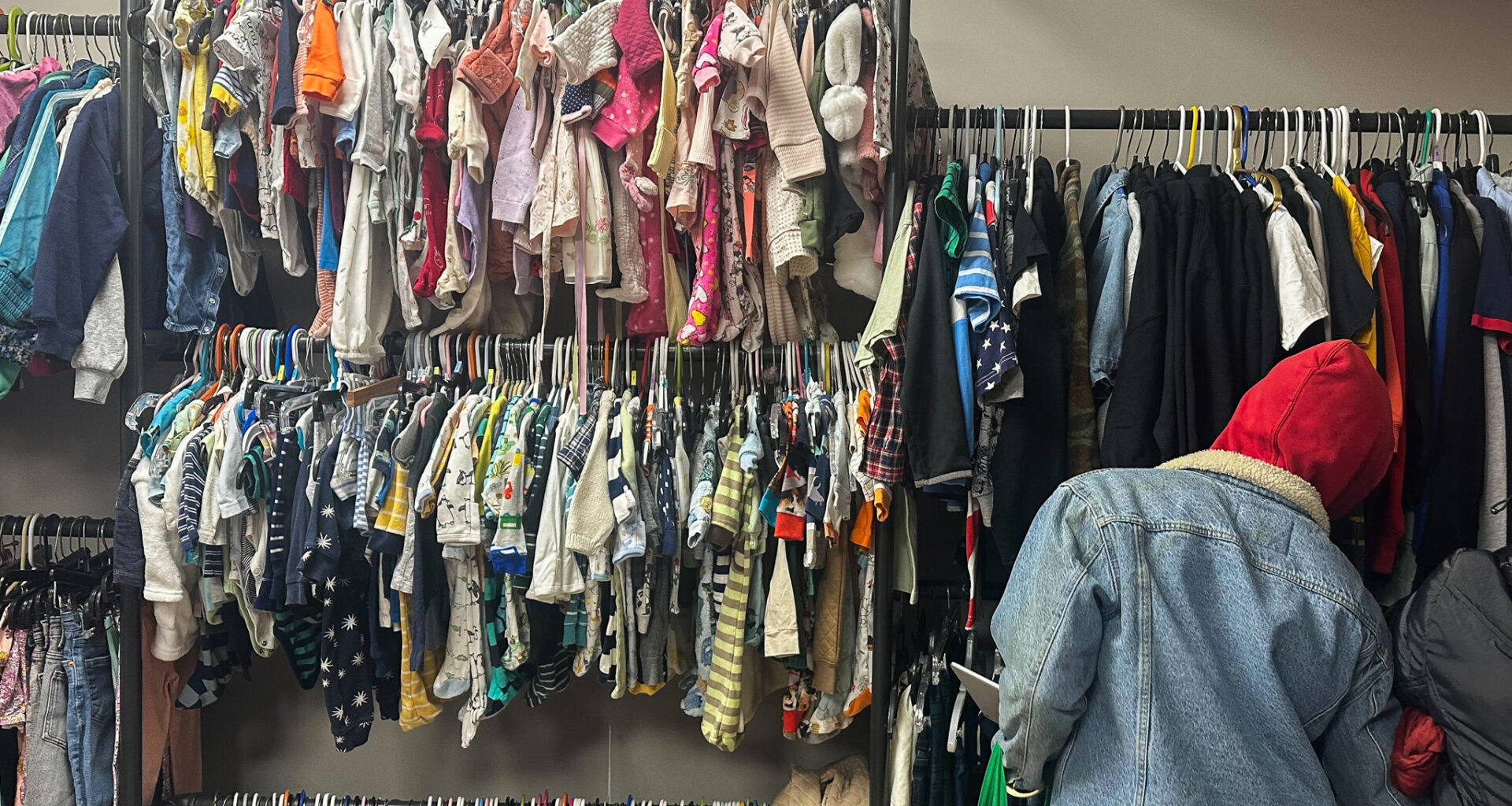
Spring is finally here — a time for letting the light in, especially on the dark corners of your (overstuffed) closet.
The average New York City household throws out 92 pounds of textiles per year, so before you toss those old sheets or out-of-style pants in the trash, take a pause.
There are many ways to give your clothing and other textiles a good shot at a second life rather than adding to the waste stream. Whether they go to a New Yorker in need, on a rack at a secondhand store or are converted for a new purpose, there are probably better uses for them than sitting in a landfill.
THE CITY spoke to experts on how to donate and recycle your clothes, fabrics and textiles rather than chuck them away, and what happens after you do:
What can I donate and recycle?
Everything worn on your body can be donated — so not just shirts and pants, but accessories made of textiles like belts, handbags, backpacks and footwear, experts said. The same goes for many household fabrics and textiles, like curtains, blankets, table linens, throw rugs, pillows, towels and stuffed toys.
“In general, we are trying to keep things in the system as long as possible. We do not want to throw clothing, garments, sheets, towels out,” said Ann Cantrell, a professor of fashion business management at the SUNY College of Fashion and Technology. “When they go to landfills, they are sitting there rotting.”
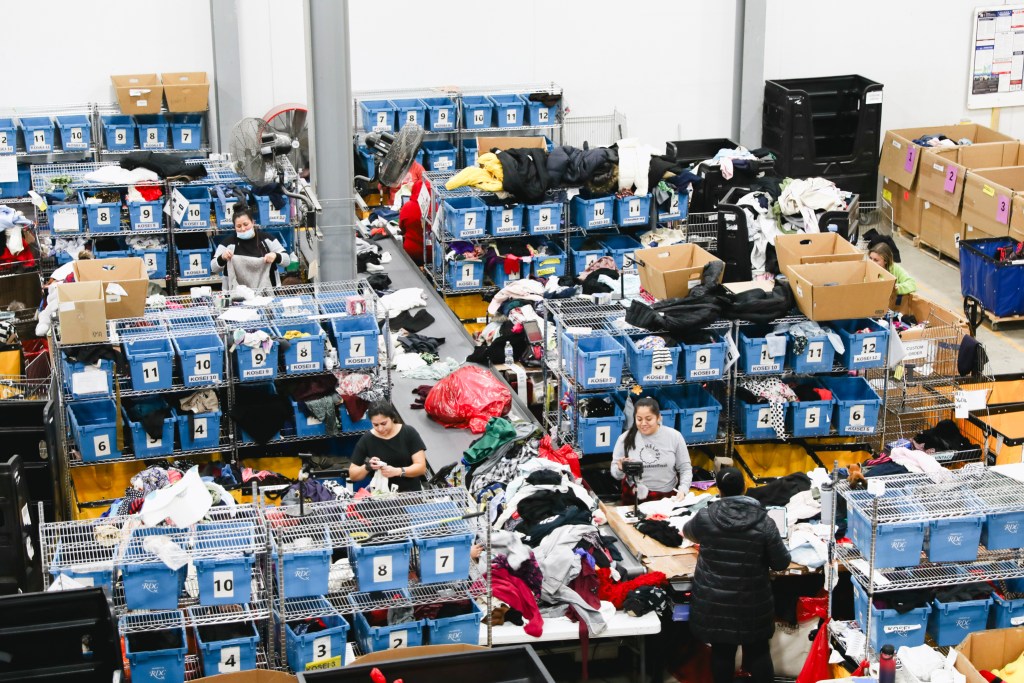 Employees sort clothing by material and color at Helpsy’s facility in Eatontown, NJ. Credit: Courtesy of Helpsy
There are a few things that cannot be donated, including items that are wet and moldy, or stained with blood, oil and grease, according to guidelines from the New York State Department of Conservation (DEC).
When it comes to textiles you are considering donating, the DEC recommends asking yourself:
Are you sure you will not wear it again?
What condition is it in?
Can it be repaired?
If the clothes are not in good shape — covered in stains or no longer wearable — they can be recycled as long as they are dry and free of odors (more on this below).
What if my clothes are broken or ripped?
Not everyone has the time, patience or money to do this, but: If an item is missing a button or has a broken zipper, try to mend it before donating it, said Cantrell. That will make it much more likely that it will stay usable for someone else for longer.
“Let’s try to increase the product’s visibility and quality before we pass it on,” she said. “Don’t just hand something off before it’s in good shape.”
Not sure how to work a needle or fix a finicky zipper? Volunteers at your local Repair Cafe who specialize in mending can help. The New York City Repair Cafe hosts repair events at varying locations in the city, and Repair Cafe El Barrio in East Harlem and Brooklyn Repair Cafe will also help with clothes and household items that need fixing.
Camille Tagle, co-founder of FABSCRAP, a nonprofit that diverts commercial fabric waste from landfills, recommends checking out your local dry cleaner for mending and repairs.
“Most people used to be able to know how to sew a button back on, or if a zipper was broken, they would know how to switch out a new zipper,” Tagle said, but fast fashion — the rapid production of high volumes of clothes made with low-quality materials — has changed this.
“Because things have been made so cheap, there’s less investment on the skill building that most people used to have.”
Where can I donate my textiles and clothes in NYC?
Dozens of places across the boroughs accept clothing donations: Have your pick by using donateNYC, the city’s online directory for places that accept donations. (Best practice: Call ahead of time with any questions and to double-check hours.)
The Department of Sanitation (DSNY) also provides a map of places that accept clothing and textiles for recycling and hosts textile drop off sites for clothing, shoes, accessories, linens and fabric across the boroughs every Thursday, Friday and Saturday from 8 a.m to 4 p.m.
If you are looking for a convenient way to donate, organizations like Helpsy and Wearable Collections have made it as easy as stepping outside your home, where a collection bin awaits, and some services, like St. Mary’s Church Clothing Drive, will pick up clothing for you.
St. Mary’s uses those clothes to run a free store for New Yorkers who need it from the church’s basement.
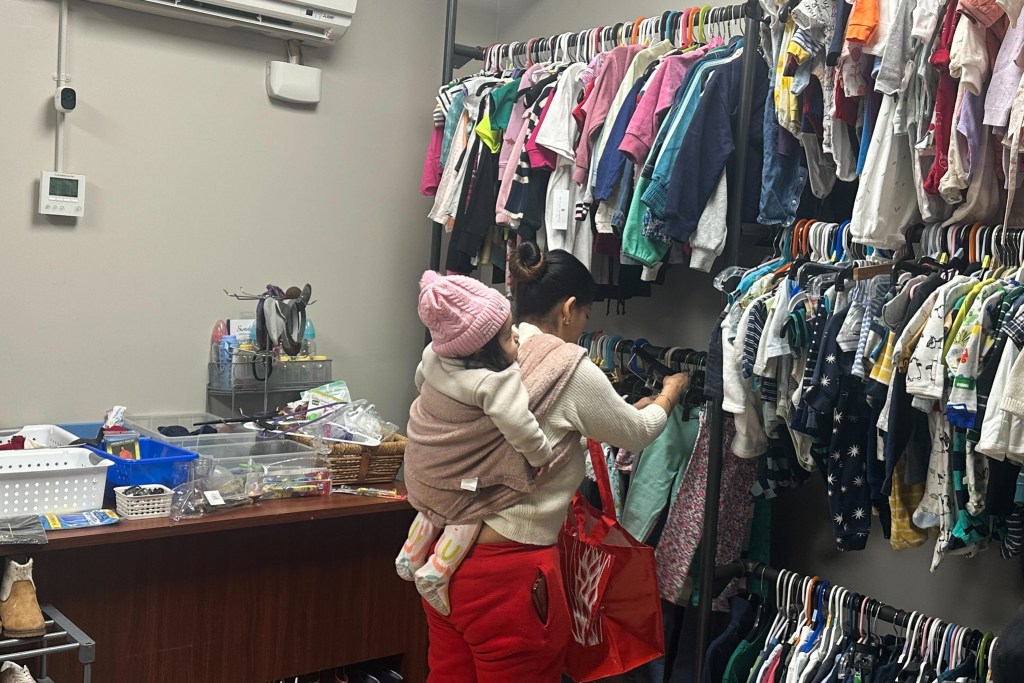 St. Mary’s Episcopal Church in Brooklyn collected and distributed free clothing for families, March 18, 2026. Credit: Lilly Sabella/THE CITY
Sammie Matola, 22, recently left the shelter system and moved into an apartment in The Bronx — but said that during the move, shelter staff threw out her clothing and she lost everything.
“It’s helped me more than anything, especially because I have no clothes at the moment,” she told THE CITY. A St. Mary’s employee even pointed to a pair of black Jordans Matola had been looking for. “They got the shoes I wanted!”
DSNY partners with Helpsy, a public benefit corporation that keeps clothes out of the trash, to place textile collection bins outside of buildings for recycling and secondhand use. If your building does not have one, you can make a request here for apartments with 10 or more units, office buildings, commercial industries like fashion and apparel businesses, storage facilities, gyms, laundromats, hotels, schools and nonprofit institutions.
Remember: Collection bins that will recycle your clothing will also sort through the items for secondhand use, so do not separate your good, reusable clothing from your tattered or stained clothing.
Wearable Collections, a clothing recycling company based in New York City, offers a similar service. It collects clothes from bins at buildings, weekly greenmarkets and clothing drives with local organizations.
Cantrell also recommended ways to pass items along within your own community, like local Buy Nothing Facebook groups, Freecycle and leaving items outside your homes with the help of “stooping” Instagram accounts that will post pictures of what you have left on the sidewalk for others to grab.
What happens to reusable clothes when I donate them?
Approximately half of donated clothes are sold for secondhand use to support the clothing recycling operation after it gets sorted and is deemed suitable for handing down as is. Helpsy and Wearable Collections sell their clothing to secondhand retailers like vintage clothing stores.
Unlike other waste streams, humans must collect the clothing materials and sort through them by hand, looking for items suitable for secondhand use.
“You’re creating a lot of jobs without using up more resources,” said Dan Green, Helpsy’s co-founder and CEO.
For Helpsy, this includes hiring people with disabilities to do the sorting through its partnership with the New York State Industries for the Disabled.
“I think a lot of folks tend to think of clothing reuse as this kind of costless activity that’s like powered by unicorn farts or whatever, but the way Helpsy works — our blue-collar employees, which are the vast majority of our employees — all earn living wages,” Green told THE CITY.
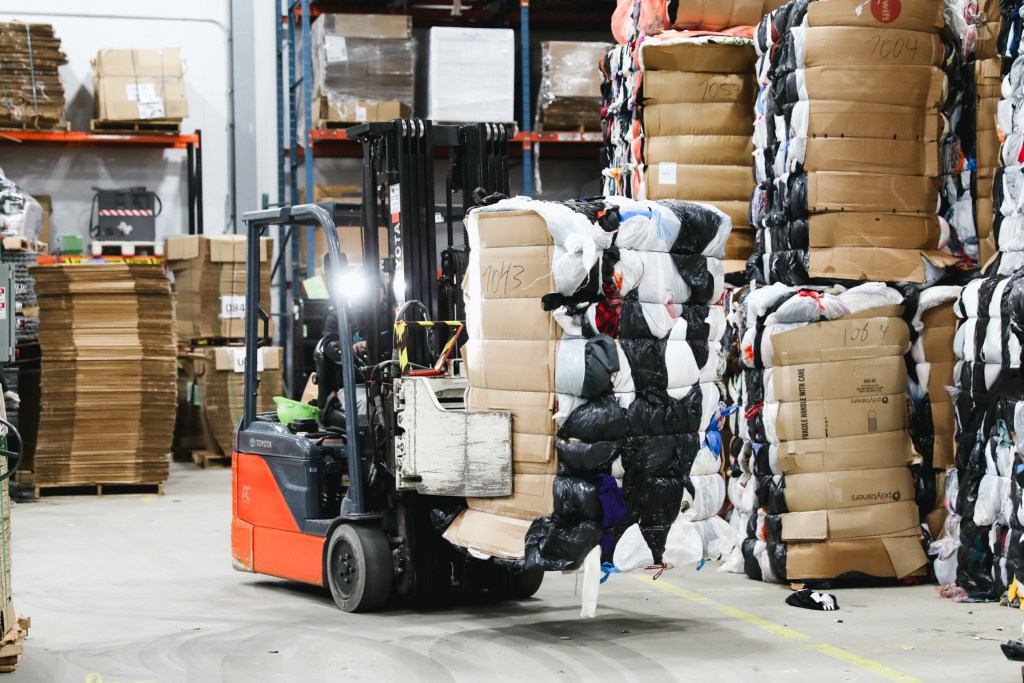 Employees sort clothing by material and color at Helpsy’s facility in Eatontown, NJ. Credit: Courtesy of Helpsy
At clothing drives like the one at St. Mary’s, a small staff sorts through clothing for the more than 300 people a day who use the free clothing giveaway when it is open, according to Dacne De Los Santos, who works as a social media manager for the clothing drive.
Right now, they are open only three days a week because that’s all their staff can handle.They need time to sort and organize the donated items they do have.
“Right now, there’s not much clothes,” De Los Santos said in late March, explaining how donations start to pick up in the springtime, but the need is year-round.
How do unwearable textiles get reused?
This is where clothing recyclers come in to avoid landfill waste. If clothing is not desirable enough for secondhand use, it may become something else entirely.
About three-quarters of these textiles are cut into wiper rags used in factories and the hospitality industry, if they cannot be turned into another category of clothing.
The rest of the old textiles that have little positive value and are downcycled — turned into low-value material called “shoddy” that is used for insulation purposes like carpet padding, playground surfaces and car seats.
“The systems that see clothes being reused or downcycled are not perfect, but are way ahead of the trash,” Green said.
When a garment is made out of more than one material — like a dress with plastic beading, or jeans with metal detailing — clothing reuse gets complicated. The different materials make it difficult to recycle.
“When you have to separate, it’s the metal zipper on a cotton sweatshirt that makes it not able to reach cost effectiveness,” said Adam Baruchowitz, Wearable Collections’ CEO. “When something is made from one material, it reduces the steps in which it can be converted.”
Monofabric garments, like a 100% cotton shirt, are ideal.
Baruchowitz said garments no longer suited for secondhand use are not the only pieces people should drop off in collection bins from companies like Wearable Collections and Helpsy that recycle garments — they need good quality items in the clothing stream they can sell to pay for the costs of clothing reuse on an industrial scale, like transporting the clothes, sorting them and downcycling the items.
“Sometimes people may be uninformed thinking, I’ll bring my good stuff somewhere and my bad stuff to you,” Baruchowitz told THE CITY.
But the industry standard dictates that at least 50% of a given clothing load is suitable for secondhand wear. That means Wearable and Helpsy need their donors to give their lightly used jackets and pants in the same bag as their socks with holes.
“If we do not keep up with the industry standard, the sorting facilities we send our clothing to wouldn’t want to accept our loads,” he said.
“In a perfect world, consumers would give us pristine, wonderful clothes,” Green said. “But we specifically don’t ask people to be picky about what they give us, because we don’t want them to be hesitant.”
What about those collection boxes I see at retail clothing stores?
Lately, big-box clothing stores have set up take-back programs for customers who want to recycle their products.
But Green at Helpsy advised consumers to stay away from those programs sponsored by fashion retail brands — because it makes things much harder for clothing recyclers like his company.
“If you take your brand-name, newer items and bring them to a take-back box, and then bring your ordinary clothes to Helpsy, we’re now losing money on that because the more valuable clothes have been taken from the stream,” he said.
According to Green, these boxes hold fewer clothes than the collection bins and “a lot of those programs that are more publicized are really about getting clothes out of circulation so the brand can sell more new clothes.”
“It’s really about making people feel good about buying more clothes,” he added.
Green is unaware of any take-back programs by brands that he would characterize as sustainable. “As a general rule, the stuff that goes into the take-back programs is getting destroyed, not reused,” he said. “To them, that’s a feature of these programs rather than a bug.”
Related