
Published on March 31, 2026
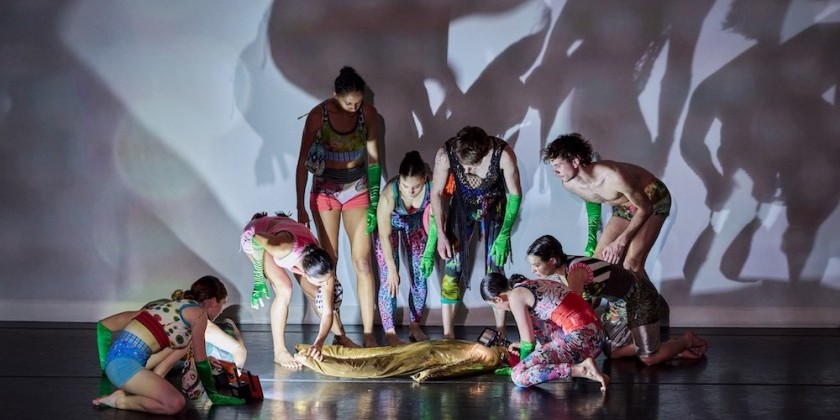
Robyn Orlin’s work; Photo: Romy Kirchauer
Featuring Performances of Leïla Ka’s “You’re the one we love” and Robyn Orlin’s “and when we change the landscape…” Presented by Dance Reflections by Van Cleef & Arpels and L’Alliance New York
Dancers of the Choreographic Ensemble of the Paris Conservatoire:
Sasha Boccara, Noah Bosquaux, Mila Delangue, Lilas Georg, Juliette Ghebache, Chiara Huet-Tournier, Lino Jaricot, Kim Delage Mourroux, Margot Ngosso Silo, Noa Vecrigner
March 12-13, 2026 at Florence Gould Hall, L’Alliance New York
There is a beautiful mix of hope and brilliance in watching the next generation of dancers hold legacy through the works of contemporary choreographers Leïla Ka and Robyn Orlin. The Choreographic Ensemble of the Paris Conservatoire, made up of ten pre-professional dancers, performed two imaginative works at L’Alliance New York’s Florence Gould Hall as part of the 2026 Dance Reflections by Van Cleef & Arpels Festival.
Opening the evening is Ka’s vigorously striking “You’re the one we love.” The Paris-based choreographer strategically reconceptualizes her intimate duet, which she herself has previously performed, by expanding it into a work for ten dancers. Dressed in airy light gray shirts and white pants, the dancers’ limbs collapse and crumble to the floor like dysfunctional marionette dolls, flooding the room with an undeniably abrupt wave of grief that continues through the work’s duration.
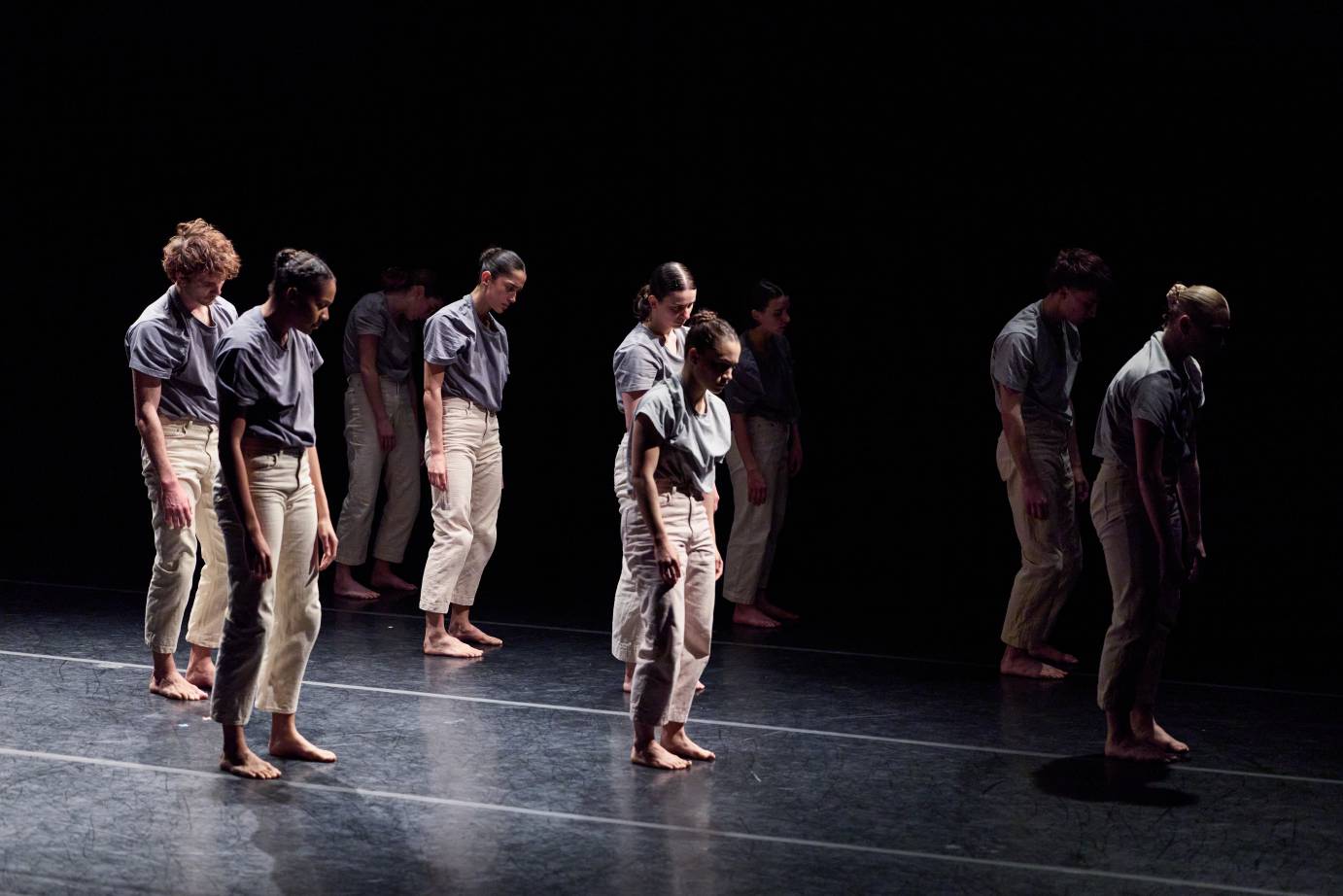
The Choreographic Ensemble of the Paris Conservatoire in Leïla Ka’s You’re the one we love; Photo: Romy Kirchauer
As the dancers stretch, lunge, and swipe, their bodies become increasingly magnetized to the ground, like an involuntary wrestling match between the choreographic demands and gravity. The volume of their forceful breath and the sound of their bones slamming into the floor jolts the audience to attention at the edge of our seats. The sorrow in Ka’s movement isn’t gentle; there is no effort to hide the physical and emotional pain layered in her relentless choreography. As the dancers revisit phrases, they become motifs, creating vivid pictures that echo in my memory, particularly the image of all ten dancers lying tenderly in a clenched fetal position.
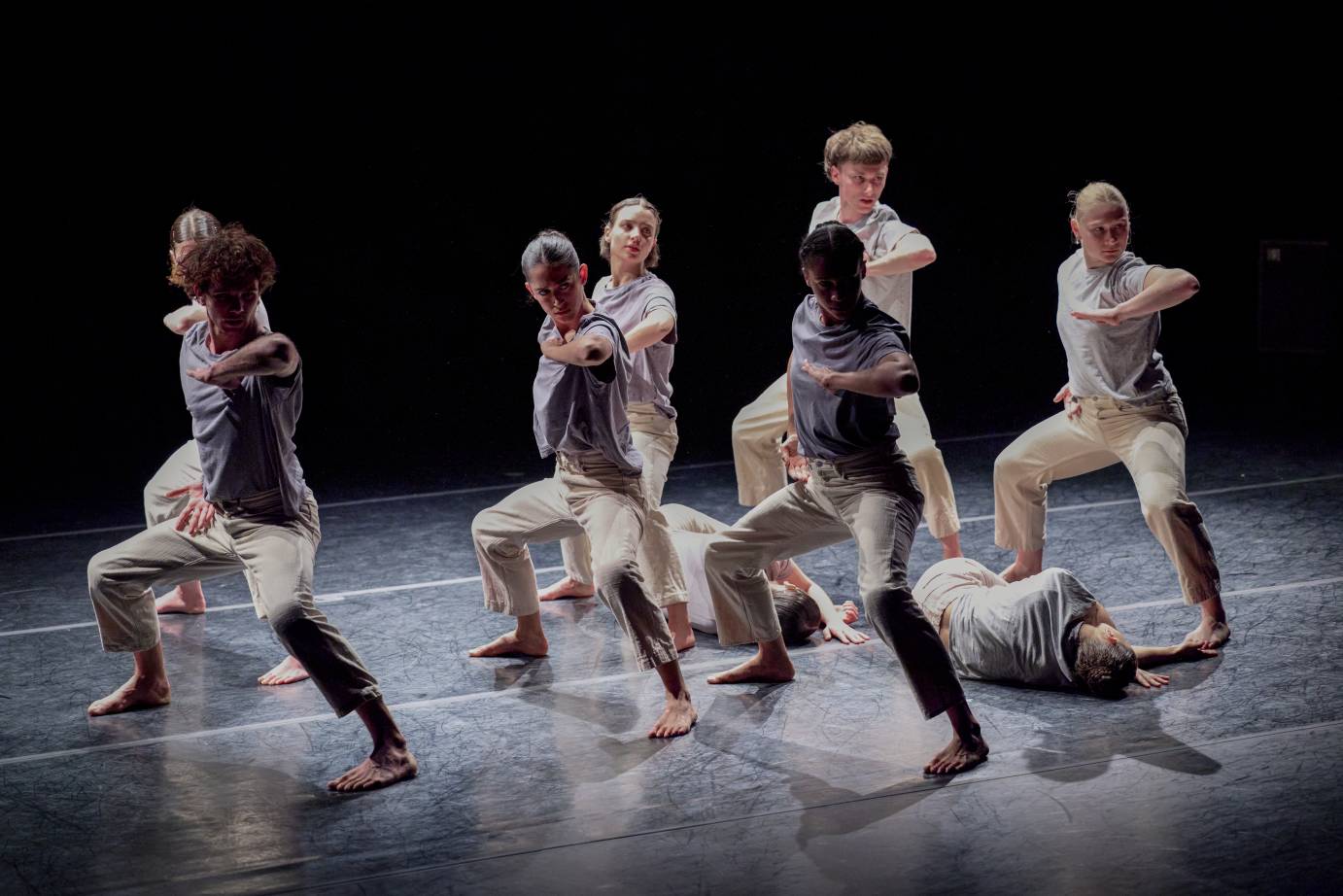
The Choreographic Ensemble of the Paris Conservatoire in Leïla Ka’s You’re the one we love; Photo: Romy Kirchauer
The tumultuous unison movement and thrashing floorwork eventually soften when the dancers stand still, looking out to us in agony. As the recurring strains of baroque music fade, the stage lights catch glistening tears welling up in the dancers’ eyes and falling down their cheekbones as they blink. The image is at once elegant and heartbreaking. While they stand as a collective, the question arises in my mind: Are they each grieving the same loss?
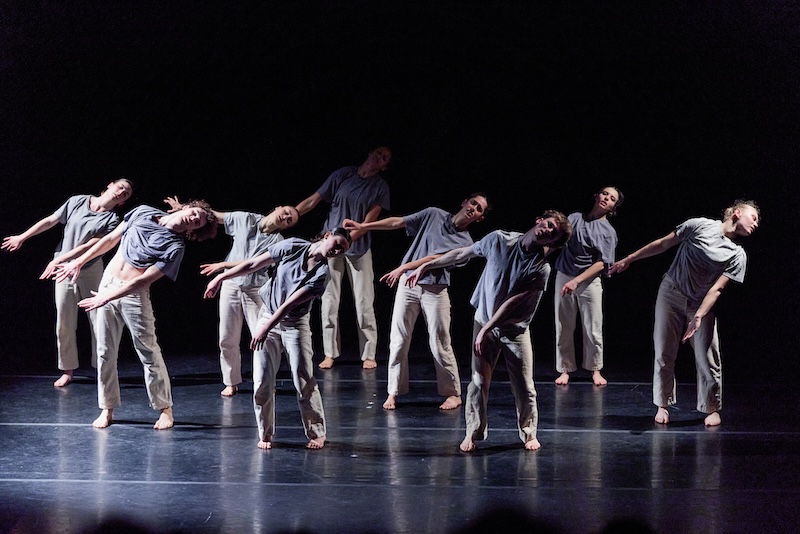
The Choreographic Ensemble of the Paris Conservatoire in Leïla Ka’s You’re the one we love; Photo: Romy Kirchauer
It’s easy to forget the dancers’ young age, given their sensitivity and whole-hearted emotional assurance in the work. There is no weak link in the cast; their bravery stems from the inside out, confronting us head on. The dancers remain onstage for the duration of the work until the final lights go dark, disappearing into the wings without a bow. “You’re the one we love” is like an open wound placed under a microscope: an experience equally heartaching and sensational.
By contrast, Orlin’s “and when we change the landscape…” offers an exploration of the cultural and political realities of her native South Africa. Known for her multimedia work and use of technology, Orlin incorporates live-streamed video projections from an ever-moving camera to magnify details of the performance on the large upstage cyc.
The opening camerawork takes shape as one of the dancers holds the lens and a flashlight, following an unsettling green-gloved hand that creeps and crawls onto each dancer’s body. One by one, the hand eerily inches into their faces, ears, or mouth. Is it a parasite? Is it a trespasser? While we may question what the hand symbolizes, there’s no questioning how uncomfortable it is to watch.
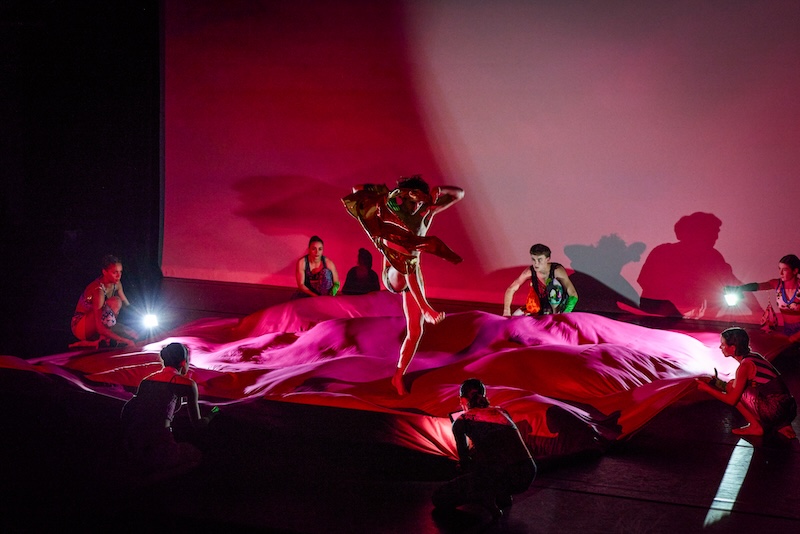
The Choreographic Ensemble of the Paris Conservatoire in Robyn Orlin’s and when we change the landscape…; Photo: Romy Kirchauer
In addition to the livestream, Orlin adorns the stage with an array of textiles, tutus, masks, and fabrics, including a stuffed gold bodysuit that unexpectedly drops from the ceiling. In a grotesque ritual, the dancers begin gutting the golden “body,” eventually pulling out a lengthy, dark reddish fabric from its seams.
The red fabric, now transformed into a large parachute, appears as a hungry, moving organism that slowly swallows each dancer, including the camera. Like an ominous, slow-motion game of hide and seek, the dancers take turns emerging from the billowing fabric as their arms, legs, and heads morph into positions like gooey statues, masks covering their faces. At the same time, the livestreaming inside the fabric continues, with the lens coming unnervingly close to the dancers’ faces as they drool, roll their eyes, and open their mouths. Orlin takes visceral intimacy to the next level, as we feel like we are almost inside the hot, breathing, virus-like creature with the dancers.
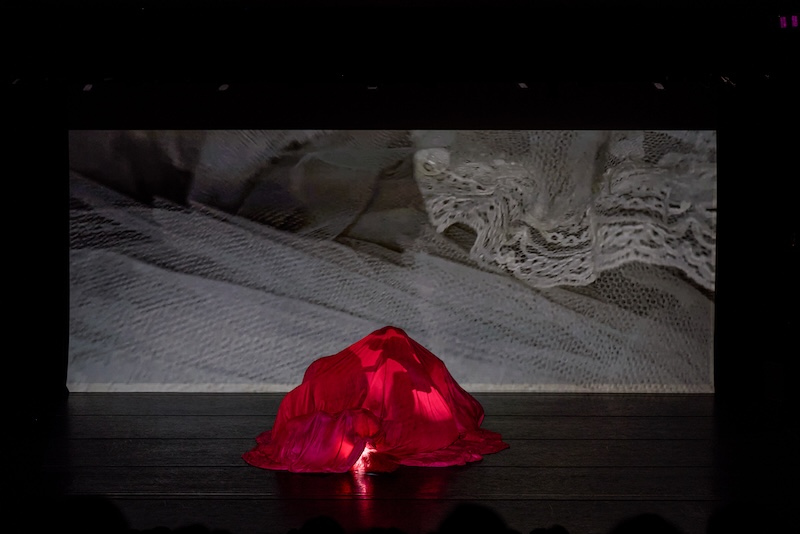
The Choreographic Ensemble of the Paris Conservatoire in Robyn Orlin’s and when we change the landscape…; Photo: Romy Kirchauer
While the dancers’ movement is generous and limber, the continuously moving fabric and camerawork can at times distract from the movements of the dancers themselves. Orlin’s focus appears to be on building the surrounding world of “and when we change the landscape…” rather than constructing or sequencing choreographic movement together as a linear narrative. In a final sequence, the dancers flip the camera onto us in the audience, now watching our own faces and reactions to their work as they skim past the front row toward the theater’s exit, gently blowing kisses goodbye. Aspects of this work left me uncertain in terms of its storyline and symbolism, though Orlin’s bold use of props and media keep the structure of the work engaging and unpredictable.
Despite the stark stylistic contrast between Ka and Orlin’s works, parallels can be traced in the young dancers’ commitment to their visions rather than attachment to the concrete narrative. Beyond their personal reflections of grief or their portrayal of the South African political landscape, I am left in awe of this next generation of dancers whose voices so fervently elevate the choreographers’ expressive innovations.
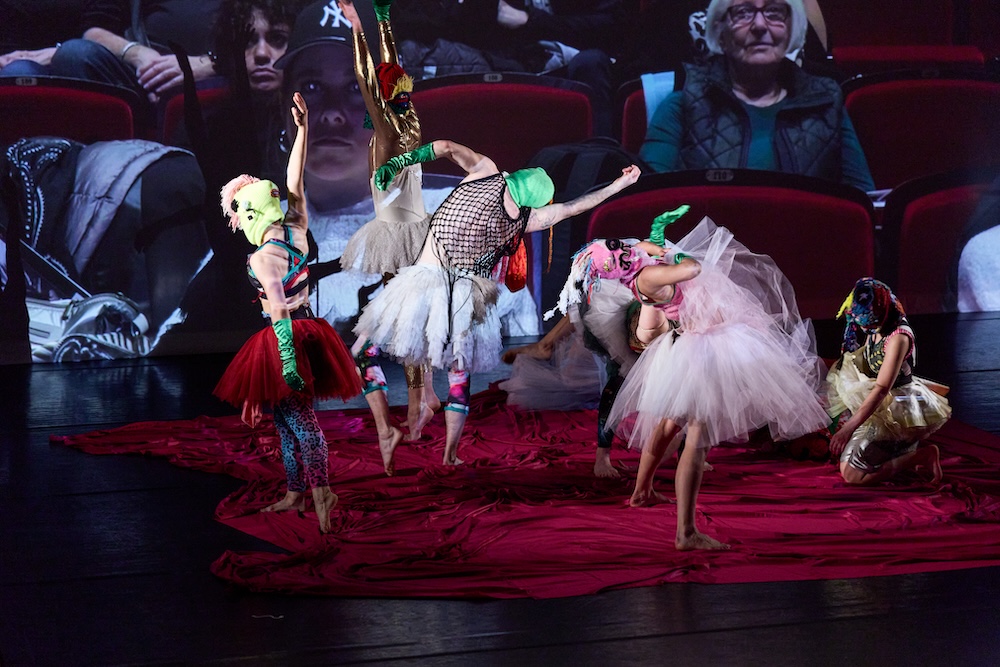
The Choreographic Ensemble of the Paris Conservatoire in Robyn Orlin’s and when we change the landscape…; Photo: Romy Kirchauer
The Dance Enthusiast Shares IMPRESSIONS/our brand of review, and creates conversation.
For more IMPRESSIONS, click here.
Share your #AudienceReview of performances. Write one today!
The Dance Enthusiast – News, Reviews, Interviews and an Open Invitation for YOU to join the Dance Conversation.