
By Reuven and Blau Kennedy Sessions, The City
March 31, 2026, 5:00 a.m.
After visiting her son on Rikers Island last June, Benjamin Kelly’s mother dialed 311 in a panic.
Find out what’s happening in New York Cityfor free with the latest updates from Patch.
He was hallucinating about an insect crawling up his nose, dead bodies in the walls and something reaching up from the floor to grab him, Angela Kelly told the operator.
She urged the jail’s medical staff to change his medication.
Find out what’s happening in New York Cityfor free with the latest updates from Patch.
That never happened, according to a report by the city’s Board of Correction.
Two weeks later, a correction officer found Kelly, 37, hanging from a bedsheet inside the Eric M. Taylor Center, one of 10 jails on the island.
No paywall here. THE CITY is a free-to-read, independent newsroom covering the stories that help you understand NYC. Sign up to get our headlines in your inbox.
The desperate call was one of 40,483 complaints logged to the city’s 311 hotline about the troubled jail system in 2025, according to city records, which show more than 30,000 calls a year since 2021.
The 311 system was launched during the Bloomberg administration as a state-of-the-art way for New Yorkers to communicate with city agencies about everything from potholes to social service benefits to noise complaints.
But grievances about conditions inside the jails don’t function like typical 311 “service requests,” which are publicly recorded online, forwarded to the appropriate agency and closed out when the agency says they have been tackled.
Instead, they are routed to the Department of Correction as “customer comments,” funneled to the agency through an online form sent to the commissioner’s office.
Some detainees and their loved ones say their calls for help go unanswered, contending the hotline allows frontline officers and supervisors to deflect or ignore direct complaints and requests for assistance.
“It’s like their biggest cop-out is to just say call 311,” said Natalie Fiorenzo, a corrections specialist with New York County Defender Services. “An officer or captain will tell you to have your client put in a 311 complaint. And everyone knows those complaints don’t go anywhere.”
The number of 311 complaints about Rikers began to increase in 2015 when the city made phone calls free for detainees.
According to the city’s tech agency, which operates the hotline, the 311 calls are forwarded to the Department of Correction’s office of constituent services and grievance services. Jail staff in that unit are supposed to forward the complaints to the relevant jail officials.
The medical complaints are sent to the city’s Correctional Health Services, which oversees treatment for people behind bars.
Because they are not classified as formal service requests, they do not appear in the city’s online 311 Open Data portal.
Additionally, the types of complaints and how long it takes to close them out are typically not made public.
A small handful of calls do actually land on the public portal each year and are usually forwarded to agencies like the Health Department, NYPD and Buildings Department. City officials did not explain why those calls weren’t directly forwarded to the DOC.
Those complaints were closed within 18 days on average without any finding of wrongdoing or need for correction, according to the city data.
Overall, detainees and their loved ones say the 311 calls can range from reports over frigid jail units, pleas to transfer to a different facility, questions about Rikers’ visitation process and requests for specialized diets. They also sometimes flag inadequate medical care.
Some 311 calls lead to action.
Crystal Steward, 39, said her 21-year-old son, who has been held at Rikers Island for close to a year, was denied outdoor recreation, laundry services and mental health services multiple times.
After she called 311 on three different occasions, she said things changed.
“They usually get things done when I call,” Steward told THE CITY as she waited in line Wednesday afternoon to visit her son on Rikers Island.
Jazzy, who is based in Brooklyn and declined to include her last name because she feared her boyfriend could face retaliation from correction officers at Rikers, agreed.
She said she calls 311 regularly after her boyfriend tells her about the lack of hot water in the showers, poor food and the staff treating incarcerated people poorly.
“He’ll call me about the heat being fixed, and I’m thinking, ‘That’s a coincidence, I just called them,’” she said while on the Fulton Street shuttle headed to Rikers.
Kaylim Holmes, 34, a former detainee, said he called 311 multiple times while he was incarcerated. His complaints included mice, excessive heat and mold in the showers, he told THE CITY just as he was released from jail Wednesday.
After he made the calls, he said he was transferred from the Otis Bantum Correctional Center to the George R. Vierno Center within the island.
But the problems persisted.
“I was freezing in the cell,” Holmes recalled.
Diva Mackenzie, 42, Harlem, told THE CITY she called 311 asking for information on where her boyfriend was incarcerated after his January arrest.
“I called and they acted like they couldn’t help me,” Mackenzie said.
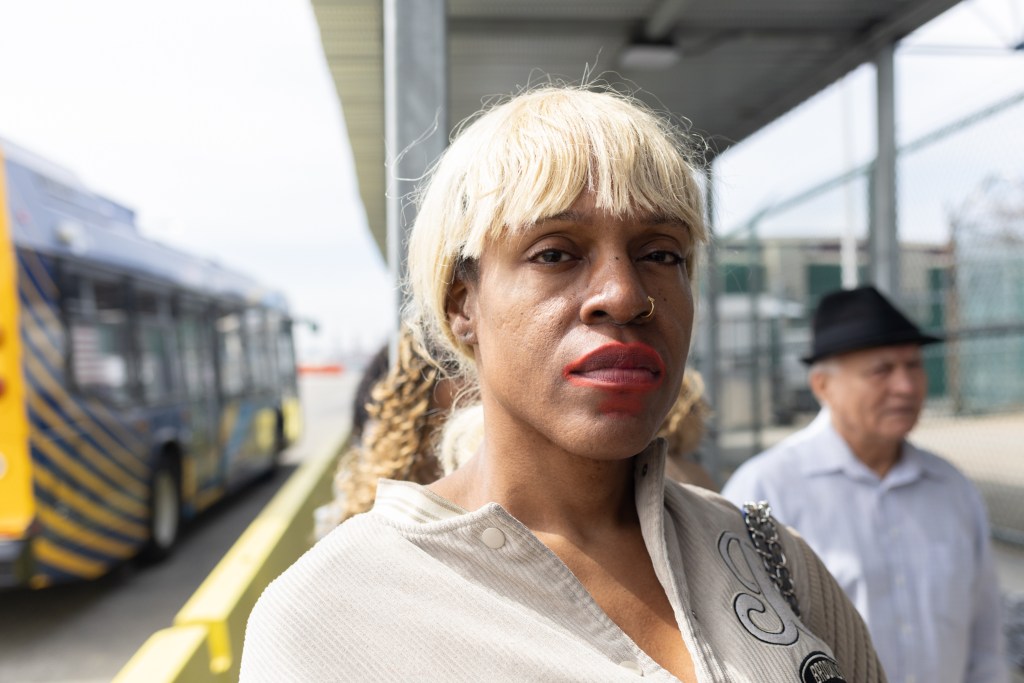
Diva MacKenzie waits to visit a loved one on Rikers Island, March 25, 2026. Credit: Ben Fractenberg/THE CITY
Alex Rotar, who is currently locked up on a gun possession charge tied to a mental health breakdown, said he desperately tried to block a transfer to another facility on Rikers. He was afraid that moving to another unit would put him more at risk with high-classification detainees in the area.
But his multiple 311 calls weren’t enough to convince jail officials to block the transfer, he said.
During a phone interview from Rikers on Friday, Rotar told THE CITY that he also recently called 311 to report a fight between detainees that left one injured. “They never followed up,” he said.
Detainees placed in restrictive housing units — similar to solitary confinement — have a particularly difficult time using the hotline, according to Fiorenzo from the New York County Defenders, which represents clients who can’t afford a private lawyer.
Detainees start in a more restrictive Level 1 unit and can move to a less restrictive Level 2 and are eventually supposed to return to the general population.
But those in Level 1 face the steepest barriers, she said.
“They used to have the same access to phone calls as anyone else on the island — something like 20 minutes every few hours,” Fiorenzo said. “Now it’s been cut to about six minutes a day.”
That restriction can make it nearly impossible for detainees to seek help, even as those units generate some of the most serious complaints.
“That’s where we hear about a lot of issues, because it’s essentially solitary,” she said. “The conditions can be much harsher.”
The city’s Board of Correction, which oversees the department, also has a hotline for people in custody. Some of those calls are played during the board’s monthly meeting. But the total number of calls made to the board each year and how they are handled is not posted online.
As for Benjamin Kelly, a Board of Correction investigation found that his mother had warned jail officials her son was on the wrong medication. She called 311 to tell them he should be on the antipsychotic Clozaril, not mood-stabilizing drugs like Depakote, which she said had never helped his symptoms.
Records show 311 operators transferred her directly to Correctional Health Services, where she again pleaded for help, saying her son was in distress and crying. Records reveal that a medical clinician was sent to speak with him at his cell, but he refused, shouting for the staff member to leave.
The 311 complaint was only closed — without documenting any action taken — after Kelly died on June 20, 2025, the board review said.
No further follow-up was recorded.
This press release was produced by The City. The views expressed here are the author’s own.