
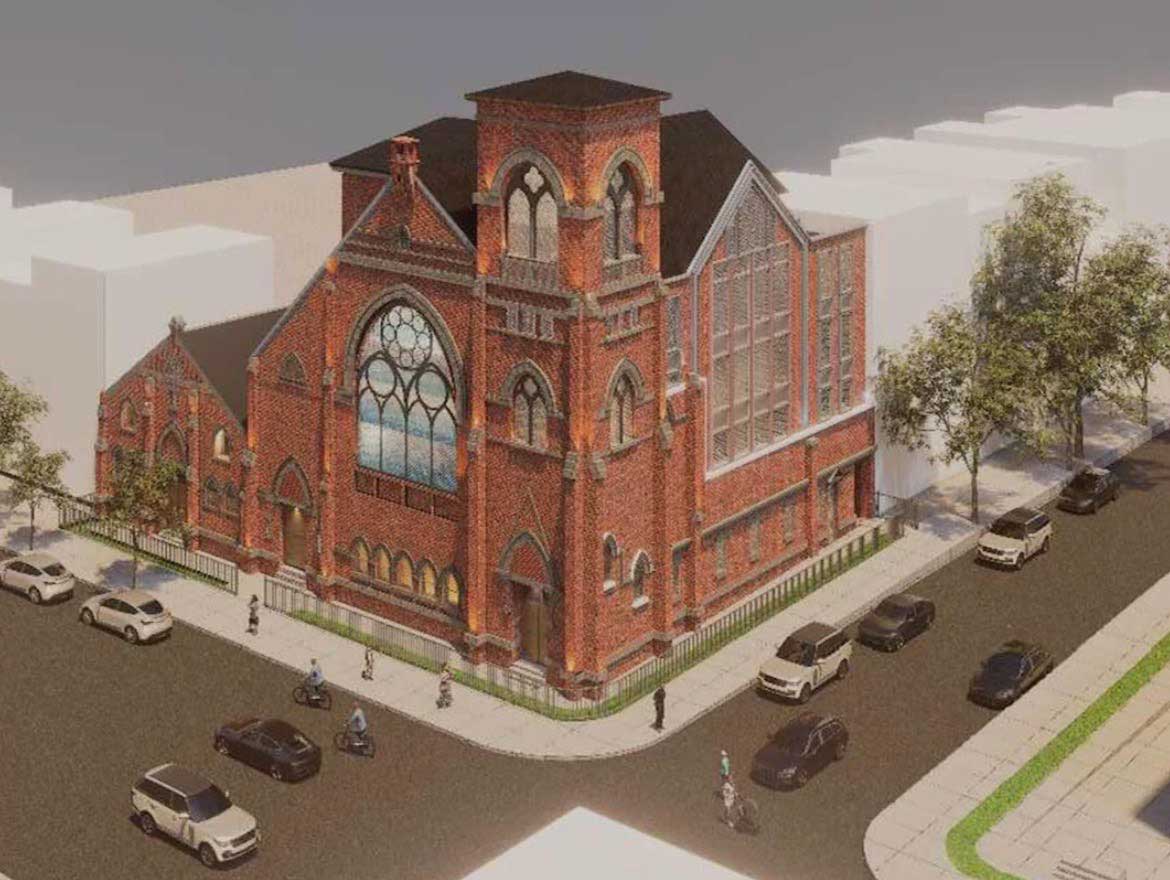
 The North Baptist Church has been vacant since a fire in the 1970s. Pereiras Architects Ubiquitous.
Amid fears of collapse, a plan to revive Jersey City’s North Baptist Church gained long-awaited approval from the Historic Preservation Commission. Along with the St. John’s Church, the work at this historic house of worship in the Harsimus Cove neighborhood is one of the most challenging preservation projects in the city due to its heavily deteriorated state. The historic house of worship sat abandoned after suffering a fire in the 1970s.
Manny Pereiras, principal of the Union City firm, Pereiras Architects Ubiquitous, was the lead architect on the project and had prevailed over a previous, unrequited plan in 2020 to rebuild the church.
“What remains of this site is primarily the Jersey Avenue facade with only a small portion of the Fourth Street facade still present,” he said. “Our approach restores the surviving historic fabric on Jersey Avenue, where evidence and material remain, and it treats Fourth Street as a new construction that is honest and respectful, rather than pretending to be original.”
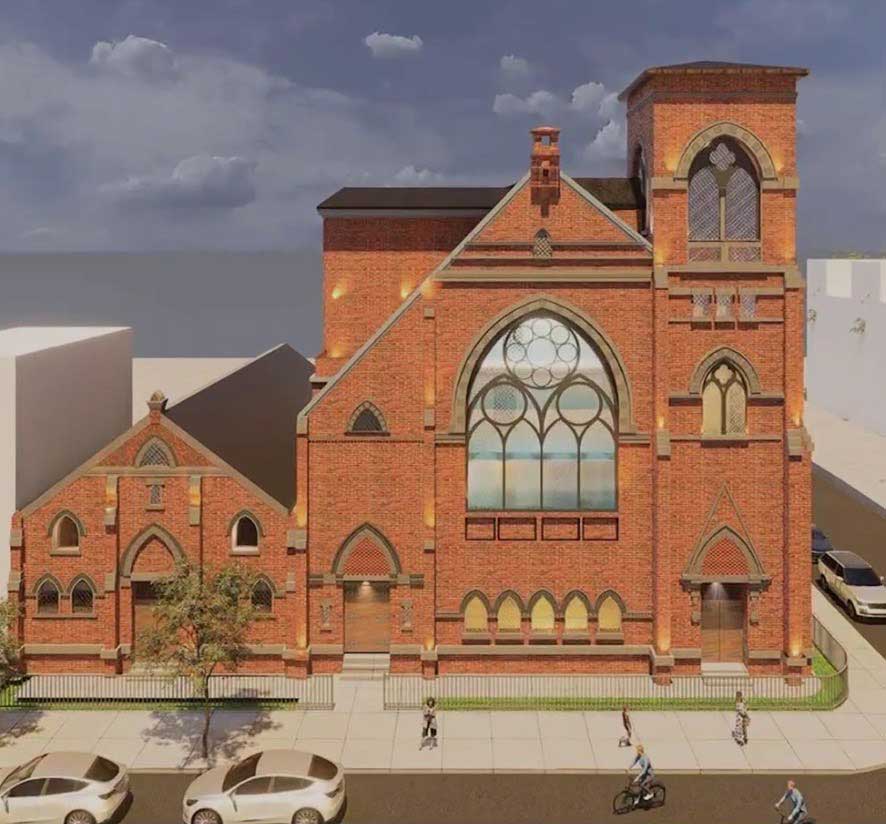 In the latest plan, the rose window, which shattered in 1937, will be recreated. Pereiras Architects Ubiquitous.
In the last decade, the city has seen a favorable trend toward the restoration of historic churches. Most of these plans are made possible through converting them into apartments and condos, which can be challenging for architects. But the result can be breathtaking at times. One of the apartments in North Baptist Church will include the bell tower in its master bedroom.
However, in a previous HPC hearing, there was some debate among the commissioners about whether Pereiras should design the rebuilt portion of the facade along Fourth Street to match the church’s original appearance, restoring it rather than reinterpreting it. This is a long-standing debate in the field of historic preservation. However, for new construction at historic sites, federal standards generally recommend that new additions be differentiated from the historic architecture.
“The Secretary of the Interior standards for rehabilitation do not require that new work look old,” he said.
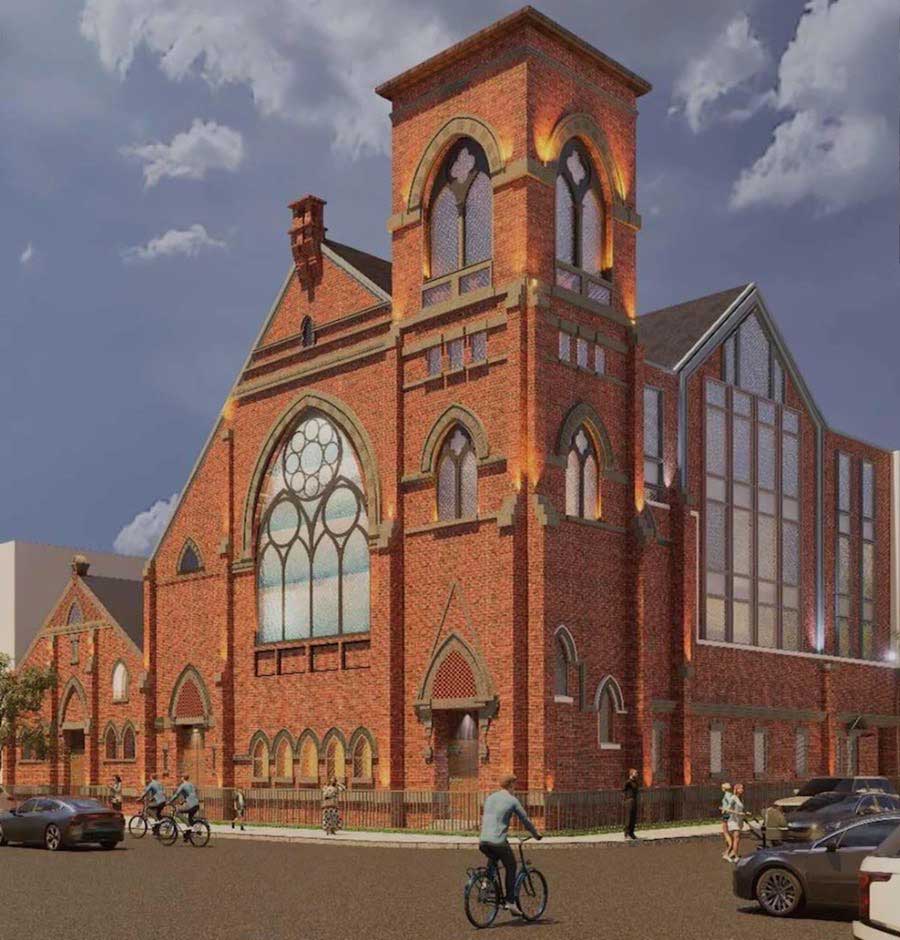 A rendering of the North Baptist Church at 598 Jersey Avenue. Pereiras Architects Ubiquitous.
This subject is an ongoing riff in architecture. Although most in the preservation field adhere to federal standards, there are instances when architects prefer to replicate historical styles.
When the Notre Dame Cathedral caught fire and lost its wooden spire, there was fierce debate about whether those lost features should be reproduced. There is an interesting article in the Guardian that asks six different professionals this exact question, and there is no consensus. The irony beneath these questions is that most early American architecture at the center of this fundamental preservation question is based on revival styles such as Gothic and Tudor. There is also a growing disillusionment with modern architecture and a longing for the lost ornamentation of old-school styles.
Ultimately, Pereiras argued that designing a building that is “of its time,” rather than recreating the historical style, was the way to go. One commissioner, Brian Blazak, agreed with his approach. One of the most notable reinterpretations is the modern riff on a rose window. “Along Jersey Avenue, the intent is restoration,” Pereiras said. “Then along Fourth Street, the intent is a contemporary interpretation.”
At the February hearing, Pereiras went to great lengths to point out the minute details of his design include easily overlooked accents like the cornice. “It makes you understand what the differentiation is and exposes the difference between the historic and new building.”
One highlight of the project will be the reuse of some of the historical materials, including the bluestone, and the restoration of the original wrought-iron gate. “This is a preservation project first,” Pereiras said.
However, due to the condition of the church and its potential for collapse, Daniel Wrieden, an officer in the city’s Historic Preservation Office, cautioned the commission not to let “good become the enemy of perfect.”
“I am aware that the building is in terrible shape,” said Wrieden at the last meeting. “I was surprised at the degradation that has taken place in the past, less than 18 months, on the inside.”