
Plans for New AI-Focused High School Conflict with Expansion of Respected Middle School
A coalition of Lower Manhattan parents and community leaders is mobilizing to stop a plan by the Department of Education (DOE) to create the City’s first new high school with a curriculum focused on computer science and artificial intelligence, and place it in the Financial District – rather than expand an existing, highly regarded middle school, as many local families want.
The plan revolves around the 26 Broadway Educational Campus, which currently hosts three DOE facilities: the Lower Manhattan Community Middle School (known as LMC), the Urban Assembly School of Business for Young Women, and the Richard R. Green High School for Teaching. The Urban Assembly School is slated to close at the end of this school year, according to DOE, “due to persistent challenges with enrollment and demand despite repeated and sustained interventions.”
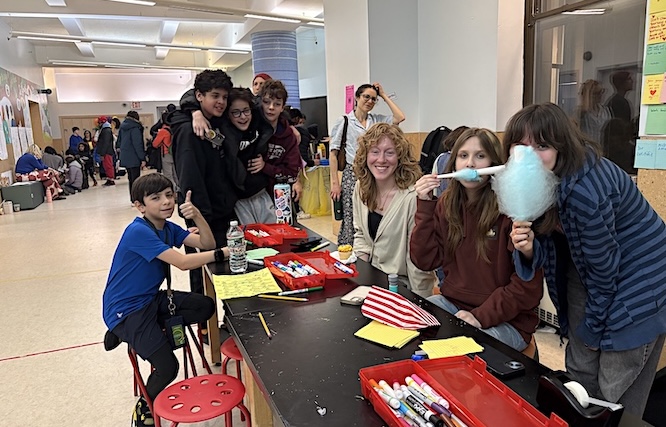
This leaves open the question of what will become of the space occupied by that school. Parents at LMC have been urging the DOE since at least 2020 to expand that school from the current offering of grades six, seven, and eight to a combined middle school and high school.
“There are many reasons to expand our school,” says Anne Hager, an LMC parent. “It is extremely diverse, including many kids with disabilities. It is racially and economically reflective of district. And 100 percent of survey respondents trust the school and its administration, which is nearly unheard of. This school is uniformly loved by the community, which is part of why we have a waiting list.” Indeed, since opening at 26 Broadway in 2010, LMC has grown from approximately 200 to approximately 350 students, and has become a highly sought-after middle school option within the District 2 “choice” system.
Part of LMC’s strategy for accommodating that growth has been to use five classrooms assigned to the Urban Assembly School, which the latter school had no need for, due to years of declining enrollment. But under the DOE’s plan for a new “Next Generation Technology High School,” the former Urban Assembly School space would no longer be available to LMC. This would not only preclude expanding LMC, but could mean that the school will have to shrink – or at least grapple with sudden overcrowding.
“Kids benefit from attending a middle school with a high school attached, which we can’t currently offer,” Ms. Hager notes. “We would do more and draw more students if we continued through grade 12. And one administration covering a larger student body not only provides better services – it also avoids redundancies and additional costs.” (There are currently no six-through-12 schools located in Lower Manhattan.)
The DOE plan, which says the Next Generation Technology High School will offer, “ethical technological literacy,” anticipates bringing 400 to 500 additional students to 26 Broadway, starting next September. An online portal has already begun accepting applications.
But there may be procedural flaws to this plan. Legally, a new school cannot be opened without approval from the Panel for Educational Policy (PEP), a 24-member panel of overseers who have the final say over major decisions by the DOE. That body is scheduled to vote on the proposal to create Next Generation Technology High School at 26 Broadway on April 29.
There are indications of significant opposition to the plan. The Community Education Council (CEC) for District 2 (which advises the PEP) considered a resolution opposing the plan for 26 Broadway at its March 25 meeting. That resolution failed to pass, but only by a technicality. Six members voted in favor of a measure opposing the Next Generation Technology High School, while three voted against, and two abstained. But CEC procedure requires seven votes to enact a resolution, so even though supporters of the measure outnumbered the combined total of votes against and abstentions, it failed to pass.
“The DOE officials who spoke at the March 25 CEC meeting presented this as a done deal,” Ms. Hager says, “but it’s not. How they can be accepting applications for a school that has not yet been approved doesn’t make sense. And their claim that the plan will do no harm is false – it will not only push our kids out of the Urban Assembly classrooms they’ve been using, but also mean that we have to share the gym with hundreds of additional students.”
An online petition at Change.org has thus far collected 1,560 signatures opposing the DOE’s plan for the Next Generation Technology High School at 26 Broadway.
Community Board 1 hosted a discussion of the proposal at its March 24 meeting, where eight LMC parents spoke against the plan, and no one spoke in favor of it. At that meeting, CB1 enacted a resolution urging the DOE “to reconsider the proposed co-location of the Next Generation Technology High School with Lower Manhattan Community Middle School due to concerns regarding shared facilities, space constraints, and operational challenges that could affect student safety,” and asking the agency to “approve the expansion of Lower Manhattan Community Middle School into a six-through 12 school within the existing facility.”
A DOE spokesman did not respond to a request for comment.