
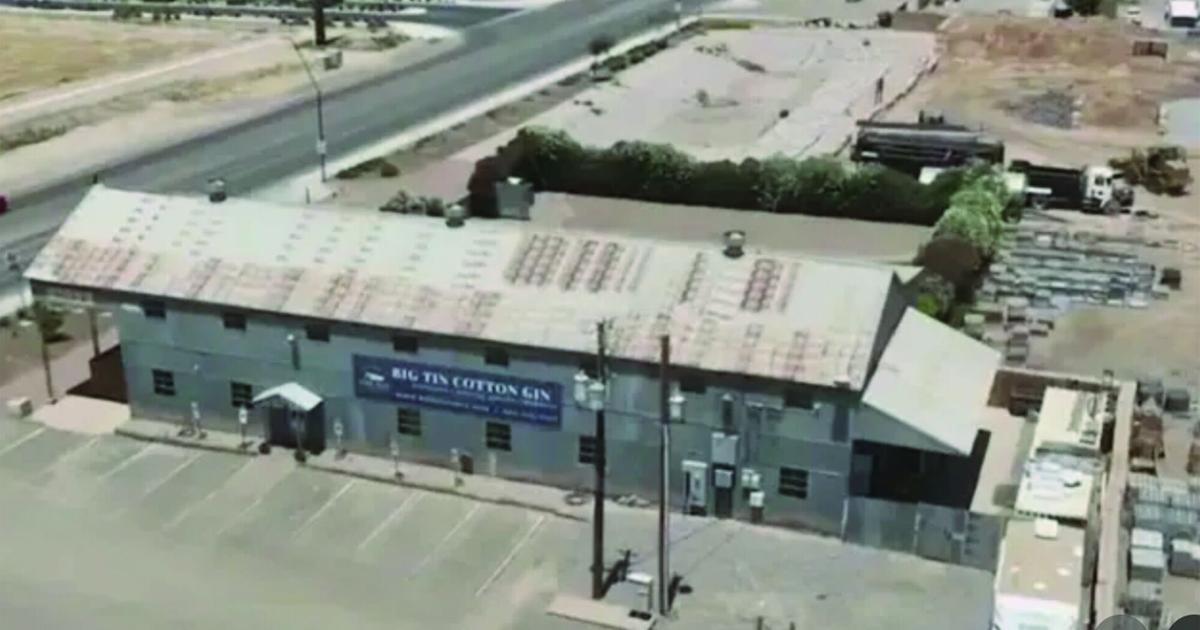
Don Quixote had his windmills; James Ballentyne has his cotton gin.
But while the 17th century fictional character had only his sidekick Sancho Panza, the Mesa businessman has the support of his family and a growing Queen Creek contingent to help in his historical-preservation quest.
And, when you listen to Ballentyne, his dream to take apart, move and reassemble an old cotton mill building doesn’t sound all that impossible.
The building, which Ballentyne’s business has leased and operated as the Big Tin Cotton Gin for about six years, sits on the northeast corner of Ocotillo and Meridian roads in Queen Creek. It’s one of five commercial properties that have closed after the landowner sold the corner to the Quik Trip Corp. for a reported $6 million.
Quik Trip plans to begin construction in the winter 2027, said Aisha Jefferson, corporate communications manager.
Those other businesses that have been displaced by the coming of a QT convenience store are:
•Americano Ammunition & Coffee, one of the Ballentyne businesses.
•Sweet Creek boutique, which is moving to Ellsworth Road in downtown Queen Creek.
•Maritza’s Pupusas.
•MDI Rock.
The Ocotillo-Meridian intersection section promises to become Convenience Store Central as Circle K is planning to build across Meridian from the QT. The Queen Creek Town Council recently recommended that the state grant Circle K’s liquor license request.
While the convenience stores will be close, they will be in different counties. Meridian Road serves as the county line with Maricopa County on the west and Pinal County on the east.
A higher partner
Ballentyne aptly describes the project as “colossal.”
“It’s a massive project between me and God,” said Ballentyne, who says he’s working 12 to 15 hours a day, six days a week. “When there are decisions, I just say ‘I defer to my partner.’”
Plans call for disassembling that building and nearby coffee shop, transporting the pieces to a yet-to-be-finalized San Tan Valley site and reassembling them.
While finalizing a San Tan Valley site, Ballentyne said the project has received a warm reception from officials in that recently incorporated town.
Ballentyne estimates it will cost $80,000 to $150,000 to take down the two metal structures and $2 million to $2.5 million to put them back together. He figures the project will take 2 to 2 1/2 years to complete.
“We need a corporate sponsor,” he said.
Those cost estimates factor in the non-paid help of “two pages” of volunteers, including 15 businesses and people who have vital equipment and expertise.
Crews are finishing taking fixtures out of the building as well as removing such physical assets as pavers and planters. Next, QT will take over the building to assess and remediate any asbestos, a process that Ballentyne says takes two to six weeks. Then his crew will have 60 days to take it apart.
A giant Erector Set
That process should be deceptively easy, he said.
“This building has a modular construction. It’s all put together with bolts,” Ballentyne explained. “It’s like a giant Erector Set. You take it apart by pieces.”
Valuable help on that part of the project appeared in what Ballentyne would classify as a not-by-chance encounter.
“Two guys drove in here a couple of weeks ago and they have started a business that puts together buildings like this,” he said. “They said they would help us, even shut down their business for a week to work here. We talked about our religion for about a half-hour and the project for about 15 minutes.”
Ballentyne is effusive in his praise of the QT Corp., which gave him access to the two buildings he had leased.
“The QT people have been extremely cooperative — very gracious working with the Ballentyne family,” Ballentyne said. “We couldn’t ask for more.”
The Ballentyne family includes wife Julie, their two grown children and several “informally adopted” kids. “We were always the catch-all house,” he said.
In a prepared statement, Quik Trip’s Jefferson said: Over the past several months, we have worked with multiple partners to ensure the historic cotton gin currently located on our Queen Creek property can be preserved and relocated for its continued use on a new site.”
Arizona’s 5 C’s
The cotton gin at Ocotillo and Meridian operated from 1950 to the mid-1980s, ginning high-grade Pima (long-staple) cotton.
After its closure, it was site to many businesses, including a tire shop, food pantry and lighting business, Ballentyne said.
He and Julie took over the building about six years ago as a wedding venue. “It had been empty for quite a while and I worked 16-hour days for nine months to get it ready because we had weddings scheduled,” Ballentyne recalled.
The Big Tin Cotton Gin also hosted such events as gun shows, high school proms and arts and craft fairs.
That business was never a money maker with the Ballentynes’ other family businesses underwriting it, he said.
The cotton mill project is an attempt to preserve part of Arizona’s disappearing history. And, in the interest of history, the project is being filmed for a documentary.
“To most people, Arizona doesn’t have a history. They are from somewhere else,” said Ballentyne, 60, who was born in Mesa and lives four miles from his childhood home.
“We were taught about Arizona’s “Five C’s” that drove the economy. People today have no idea what they are.”
Cotton is one of those C’s as years ago, gins dotted the farmlands in central Arizona. (The others C’s are citrus, cattle, copper and climate).
Cotton acreage shrinks
But as houses started sprouting up in cotton fields, gins started closing. The closest working gin to Queen Creek is 21 miles away at Eleven Mile Corner east of Casa Grande.
According to the Arizona Farm Bureau, the state once had 500,000-600,000 acres planted in cotton. It’s down to about 110,000 acres today.
Evidence of cotton’s demise can be seen near the project site. About a half mile south on the east side of Meridian, two construction projects are underway – one beginning and the other wrapping up – that are supplanting cotton fields with about 1,200 houses.
“Once gentrification starts, nothing is saved,” Ballentyne said.
“Growth is happening so fast here, it runs you over, no matter who you are. That’s progress.”