
Peter Saul’s Art History
Gladstone Gallery
March 7–April 18, 2026
New York
Though Peter Saul had gained recognition in the 1960s and ’70s, it was not until the 2010s that his re-emergence took institutional form, as museums and a younger generation of artists, critics, curators, and dealers came to understand Saul’s wedding of high to low art, which he had stubbornly pursued for decades as a postmodern project. In the space of a few years, retrospectives and major surveys reframed him not as a bad-boy outlier, but as a crucial link to politically saturated figurative painting. Early on, he was loosely identified with the Chicago Imagists and “wild style” painting, though he had no real association with either. In the late 1950s and early ’60s he was living in Europe—France, Italy, and the Netherlands—where he developed his lurid Pop-Surrealist hybrid style though his Vietnam War, Civil Rights movement, and satirical caricatures that clearly aligned him with the anti-authoritarian mood of the 1960s counterculture, positioning him less as an outlier than a provocateur.
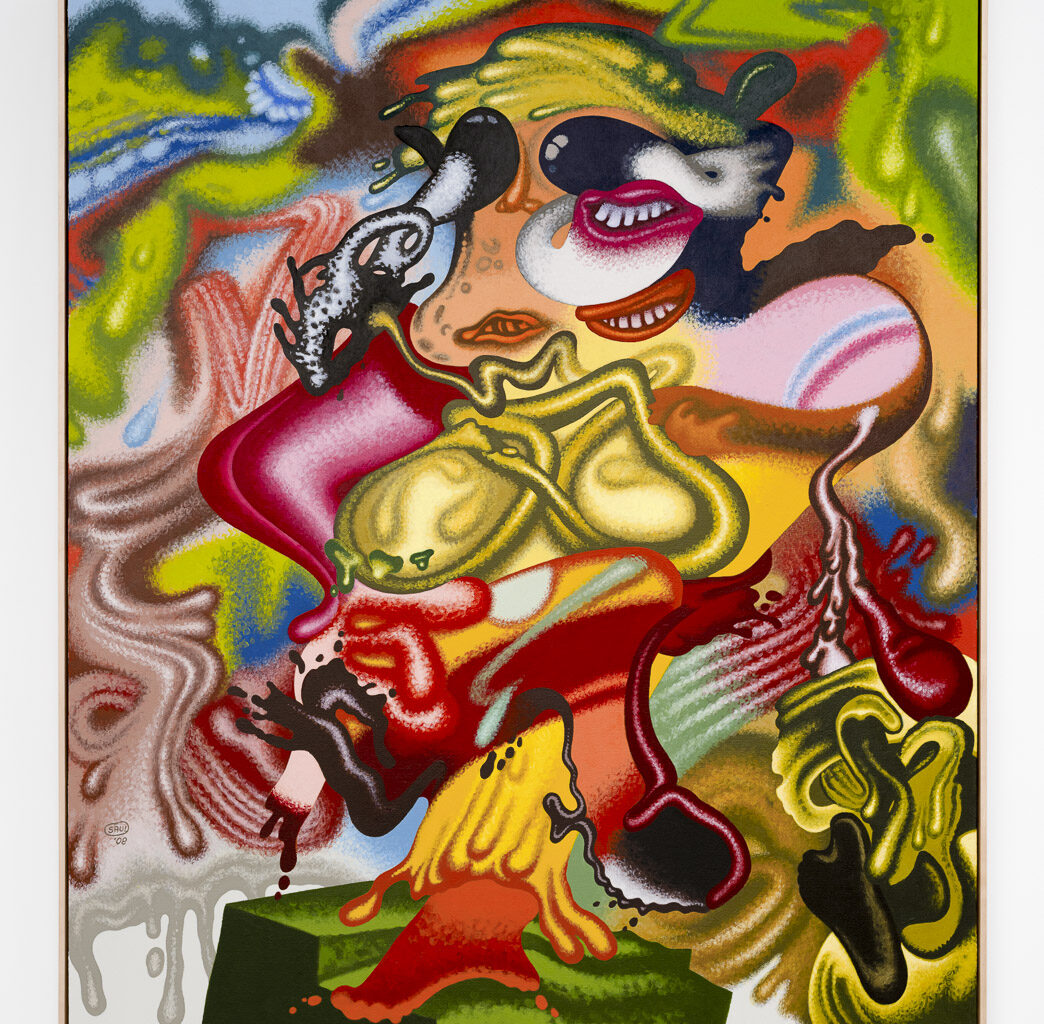
This exhibition at Gladstone Gallery, though titled Peter Saul’s Art History, is less a sweeping survey of Saul’s interpretation of art history than a concentrated, slapstick chapter on Western modernism and perhaps his influences. It is composed of a sampling of works which Saul, over the course of his career, has revisited. To these, he has applied three distinct strategies: amplification, recontextualization, and assimilation. So we have a number of variations on Willem de Kooning’s women and Marcel Duchamp’s Nude Descending a Staircase. Saul’s version of Pablo Picasso’s Guernica is given center stage, not having been exhibited since the 1980s. Meanwhile, paintings based on Salvador Dalí’s watch, Jasper Johns’s maps and Picasso’s women in a mirror appear in walk-on roles.
The de Kooning women, in most of their versions, are rendered as monstrous, bordering on misogynistic, while retaining their status as avatars of painterly aggression. Long read as brutalized erotic objects, de Kooning’s women are pushed further by Saul: their bodies are inflated, their limbs splayed, their faces frozen and fragmented into grotesque grimaces. The painterly torque that once gave these figures a tragic, existential weight is replaced by a kind of graphic polish, as if Saul were turning de Kooning’s abjection into a form of visual inflationism, in which the violence is not denied; it is simply displaced from the field of expression into the realm of stylization, the misogyny no longer masked by abstraction but laid bare.
Meanwhile, Picasso’s Guernica is treated differently. Saul recontextualizes it in a manner reminiscent of one of Ad Reinhardt’s “trees,” cartoon diagrams of art’s genealogy. He turns Guernica into a schematic of its own iconography, retaining Picasso’s primary vectors—falling bodies, upraised arms, ruptured planes—and adding a portrait of Picasso, with each element labeled with a seemingly phonetic spelling of an art movement, while translating its greyness into high-key color. In doing this, Saul shifts Guernica’s primary message about the horrors of war into an image of artistic cultural contention. In a more neutral register are the variations based on Duchamp’s Nude Descending a Staircase, the Johns map, and the Dalí clock; these are rendered with a kind of dead-pan clarity, their significance neutralized, not by mockery but by a measured demonstration of the distance between the canonical and the cartoonish. Together, Duchamp’s Nude, Dalí’s clock, and Johns’s map are merely cartooned up—appropriated and brought into line with Saul’s own graphic style.