
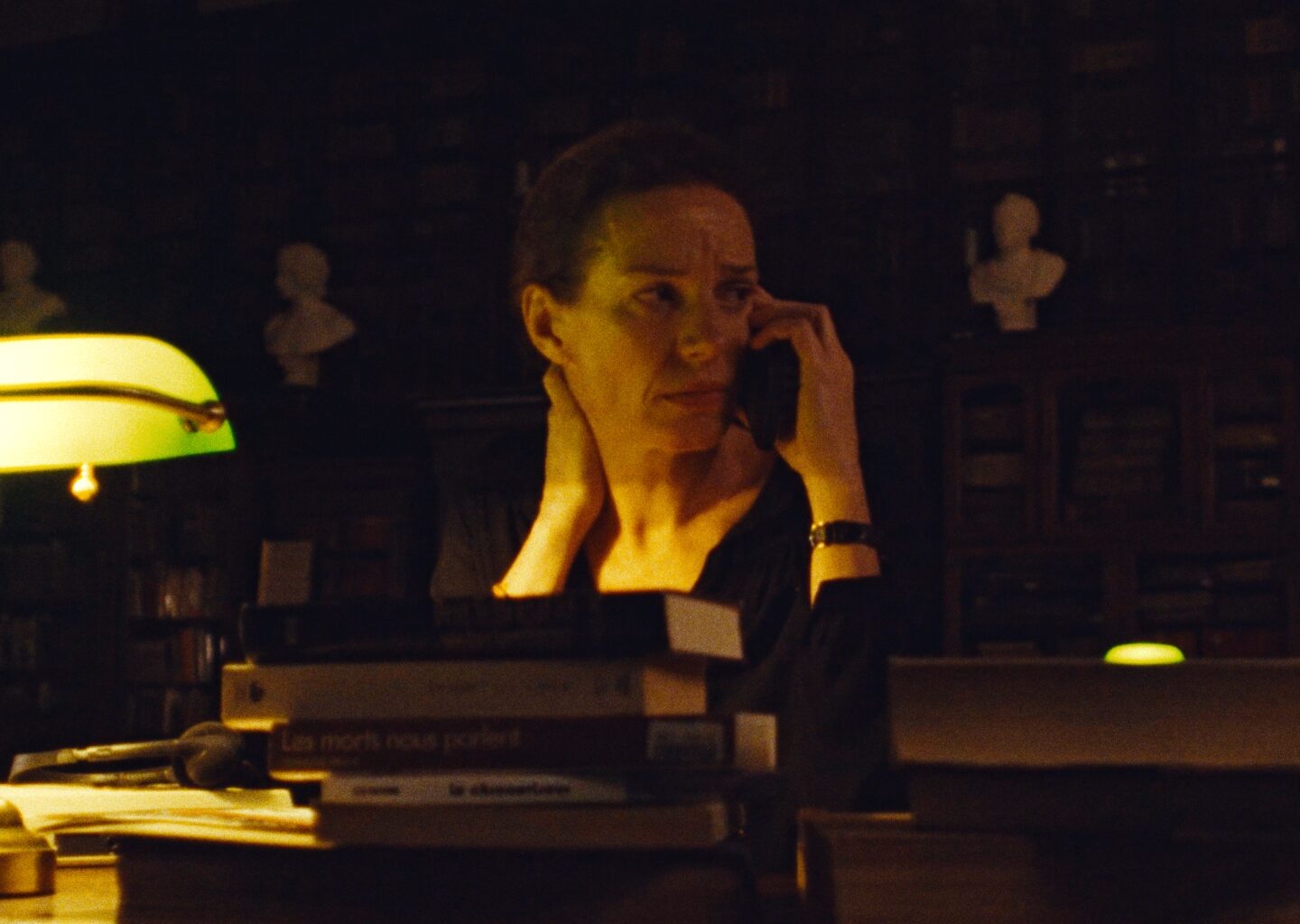
Chronovisor (2026)
Kevin Walker and Jack Auen
Cosmic Salon Films
New Directors/New Films 2025
April 10, 2026, 8:45 p.m.
Q&A with Kevin Walker, Jack Auen
FLC, Walter Reade Theater
New Directors/New Films 2025
April 11, 2026, 5:30 p.m.
Q&A with Kevin Walker, Jack Auen
MoMA, Titus Theater 2
Chronovisor (2026), the latest feature from filmmaking duo Kevin Walker and Jack Auen (Marblehead [2021], Roundabout [2024], Things Hidden Since the Foundation of the World [2025]), begins with a long and static shot looking across a bar table at a middle-aged woman (Anne Laure Sellier), academic in type, surrounded by glasses of wine and, one assumes, her seated drinking companions. She’s discussing the history of neural science as relates to memory, charging through Jacobite and classical theories of the various ventricles’ different functions, to get at what she calls “the inner phenomenological architecture of [the] mind.” She’s shot on 16 mm film, and much of the low-lit bar background is obscured in darkness. Her lecture, which in fact begins while the production logos are still playing, is quite quiet in the sound mix, otherwise filled out with barroom chatter and the clanking of dishware.
The woman is Béatrice Courte, a professor of philosophy at Columbia University. Over the course of the film, her obsession with memory will take her deep down the rabbit hole of the titular “Chronovisor,” a fabled device claimed to be invented by the Benedictine monk and musicologist Pellegrino Ernetti in the 1950s. Allegedly, the machine was capable of receiving and displaying memories from any point in history, before being promptly hushed up by Pope Pius XII. Given that the Chronovisor case has been sealed shut for something like multiple decades before the film begins, much of the drama takes place in the pages of books, if not in the magnetic pulse encoded onto plastic tape.
The opening scene introduces some of the film’s essential tensions: Where do we focus our ears? How can we distinguish signal from noise? How do we begin to form a narrative from the sensory chaos? The question is rather similar to Chronovisor’s fundamental gambit: crafting a sub-two-hour film from thousands of pages of largely text-based research. With the sum total of the world’s memory in play, the role of the intermediators—technological and human—is placed under considerable stress.
“Fascinating,” one of her companions responds, standing, as soon as Béatrice pauses for breath. “But I have to return and grade student papers. I have an 8 a.m. class tomorrow morning.”
While, on the one hand, Chronovisor seems to share some DNA with various Dan Brown adaptations and other Catholic-conspiratorial pulp, Walker and Auen are more interested in the fuzzy boundaries of conspiratorial thinking—its temptations, hazards, and stubborn grains of truth. The amount of prop literature the film summons in evidence of the Chronovisor beggars belief, until one verifies post hoc that all, or nearly all, of this material actually exists. Pellegrino did claim to have invented the Chronovisor with the collaboration of Wernher von Braun and other scientists; he did publish part of the text of the ancient tragedy Thyestes that he claimed to have traveled to 169 BC to watch; a photo of the “true face” of Jesus Christ at Golgotha was published in connection to him. Walker and Auen’s film is too tempted by fantasy to make a documentary of this material, and yet includes too much truth and documentary technique in its mix to exist comfortably in the category of fiction.