
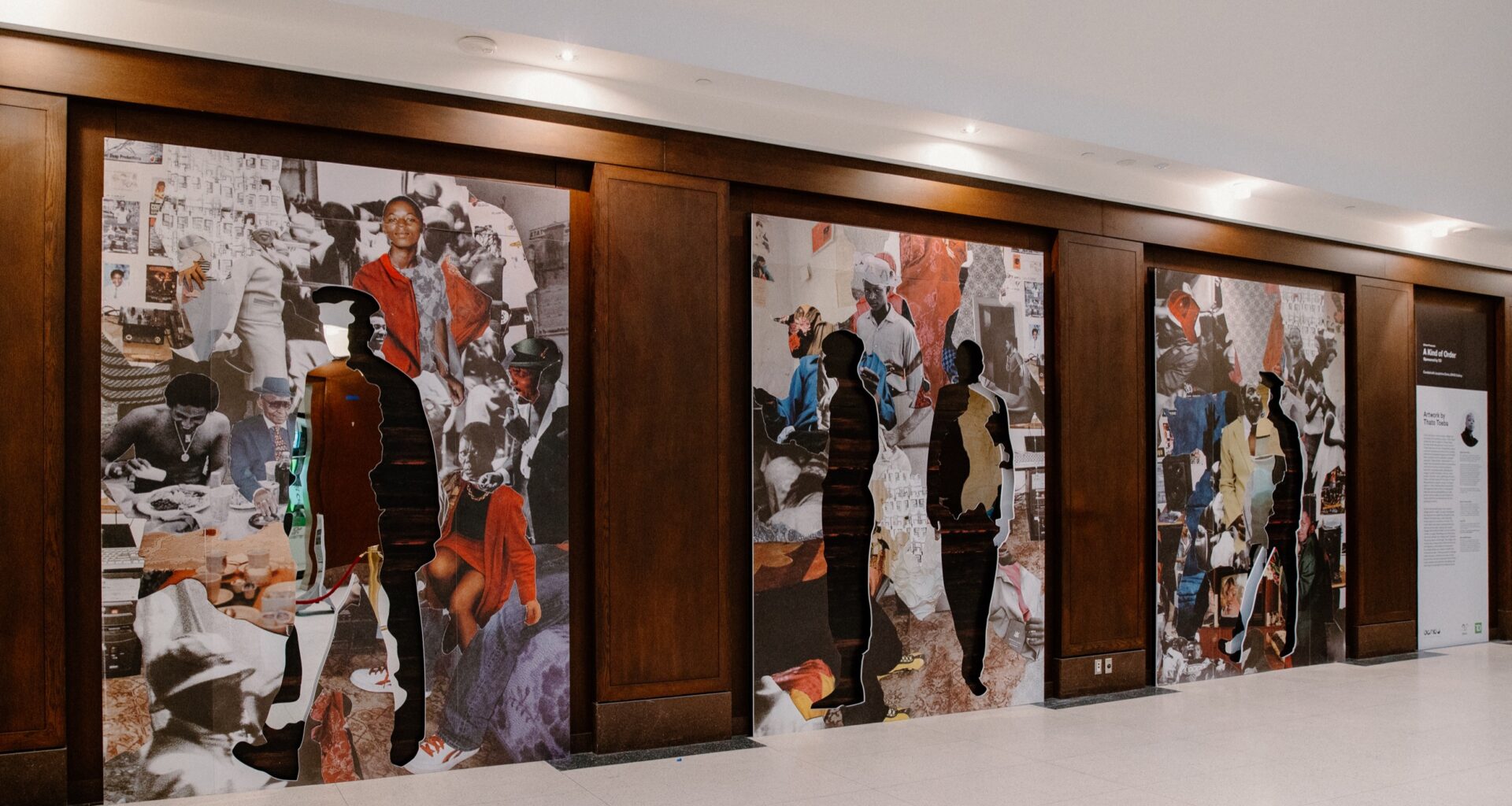
A Kind of Order
Union Station
February 12–August 31, 2026
Toronto
Union Station, a Palladian, tier 1 heritage space that prohibits significant building alteration, is a local, regional, and national transportation hub, home for the unhoused, thirty retailers, and a confluence of 300,000 people a day. I entered the space as a traveler who came specifically to view art via the Union Pearson Express (UP) train. After disembarking, I was ushered into a corridor that opened into the Oak Room. That is where I first saw TD Bank signage and a lounge for cardholders, which then merged into the West Wing. Because of the socioeconomic convergences in the space, there’s a collision of multiple (sometimes competing) interests and an inherent choreography within its walls.
Despite these various factors, Osmington Inc., which runs the art programming at Union Station, champions the station as a cultural destination. To mitigate these factors, they invite premier Toronto-based galleries to curate the space, which, in this case, held up a mirror to the stakeholders involved, the unpredictability that occurs from gathering in a shared space, the station itself, and human behavior. As Canada celebrates Black History Month for the thirtieth year, the Union team used the heritage month’s designated funds to approach Black Artists’ Network in Dialogue (BAND) Gallery to produce an exhibition that celebrates cultural diversity called A Kind of Order.
A Kind of Order, curated by Joséphine Denis, Director of Curatorial Initiatives at BAND Gallery, recontextualizes a phrase used by Toronto’s third Poet Laureate Dionne Brand to explore how collage mimics the movement and advertising language of the station. To explore questions such as, “What does it mean to gather the artists in a space that has multiple functions where art may not be the primary focus?”, Denis creates a mostly non-figurative arrangement of collage which evokes the complex layering and subtractive and additive dimensions of being part of a diaspora, making Toronto Union an ambient force or character within the work. What is unique to Denis’s take is that she scaffolds the viewer’s experience: the surface layer evokes curiosity, the second highlights its aesthetic contributions to the space, and the third focuses on the conceptual with varying layers of access. The show does not flatten its theoretical depth despite being present in a public space. There are moments that feel like inside information—if you know, you know—which feels like what Denis calls a “refusal of total access,” an important notion for Black artists to embrace so that they can create their own enclave while in plain sight. Their intervention maintains radicality for that reason.
The first work viewers encounter is outside, a multi-strip banner in between the columns of the Neoclassical entrance. Camouflaged as promotional signage for the show, an abundant grammar in Union Station, Lazarus Contained (2026) by Aaron Jones shows a microcosm of an individual’s life as told through their possessions, frozen in time. It showcases a tank littered with the artist’s everyday things, such as toys and figurines, resting on a branch over an icy waterfront. The surrealist scene echoes the mythology of returning home or to an environment like Union Station that is perpetually in flux.
In the West Wing, a beige monochromatic atrium repeats the columnar form, is Cross Section (2026) by Timothy Yanick Hunter. Cross Section displays an accumulation of images that he gathered from the Toronto Public Library Digital Archive. His imagery encases the pillars as static portraits and one looping video that mimics the movement of what the images might have been in nature. A few steps away from the columns in the middle of the atrium is a double-sided plinth with a vinyl collage of detailed shots of sand, ants, larvae, particulate matter, and a singular figurative image on the front of the plinth with what looks to be Black women telephone operators coalesce. Yanick Hunter even exposes the white margins and scientific text of the work to reveal the artist’s hand of processing many analog photos and synthesizing them, which he describes as “sampling and splicing.”
There’s even a sense of loss and discovery, according to the curator’s didactics, in how “Pixelation suggests the work is constantly returning its own frequency to the motion it trades. The grain reads like calibration: information coming into focus, stepping out again, being in motion rather than settling into certainty.” He translates analog photos into digital, which makes them lose resolution and adds to their allure and mysticism. But again, his work appeals to folks of all backgrounds with his layering, although he shared an anecdote that a Black woman approached him, expressing pride that he made it to Union Station. She asked if there were ways for her granddaughter to take classes or learn from him. This affirms that, in many ways, the exhibition feels like a community milestone.