
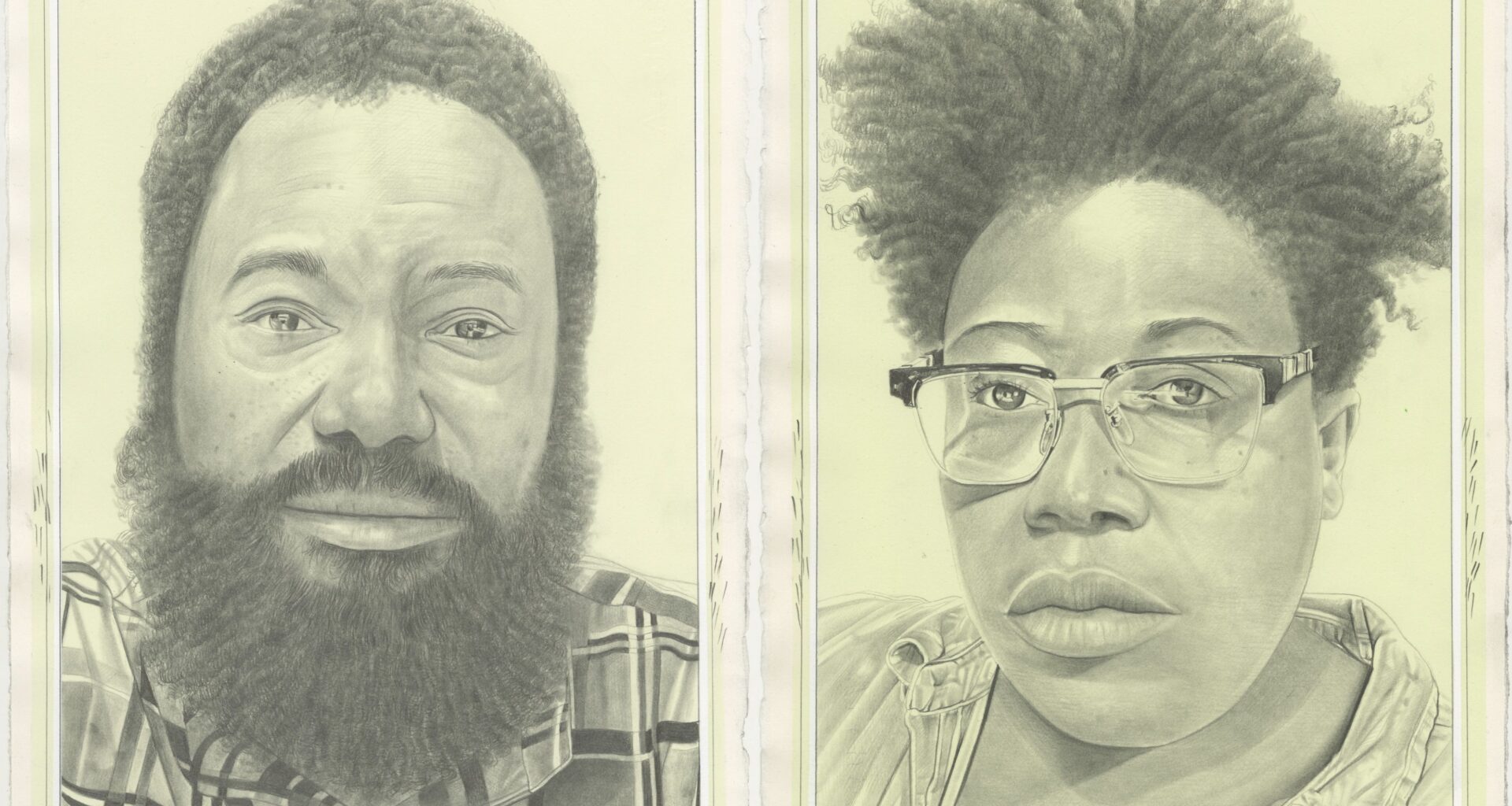
Cloud: Yeah, I think another thing I recently was hearing—specifically talking about Black women—is how on the internet, the Black women are not real. They might be like a Russian or whatever, just using an AI image to say these things. And I was hearing about how in disinformation campaigns, the thing that the person is saying is a real thing somebody believes; the deception is not in the thing they’re saying, but in who is apparently saying it. So I think that art is always kind of ahead of its time. I think that our discussion about stories about Clyfford Still and so forth, that our suspicion of those stories is a kind of suspicion of disinformation—of trying to consider the source. When I would tell my students a story about Pablo Picasso, if the student is suspicious of Picasso, then they will be suspicious of the story. So what I would do is figure out what artists they were not suspicious of. So maybe it’s Kara Walker, and I would just change the person in the story to be Kara Walker, and then they would accept the moral of the story because they were not suspicious of her. But I realized that if there were two students standing there, I couldn’t change it to both things. So that’s why I removed it entirely and just called it “it,” or, “the artist.” These are disinformation techniques, right? To remove the source. And I think having multiple people read the story is another disinformation technique, because if you would be suspicious if I said it, well, what if this person says it? Or this person, or this person? Sooner or later, we will get to somebody you believe.
Morgan: They take authorship of what is being said. They usually start with, “I once knew an artist,” so there’s a familiarity there.
Cloud: And why is disinformation so important in art?
Rail: Well, art is, to a certain degree, disinformation: it’s traditionally, historically, a form of reasserting certain images or timelines. Can it be a source of truth, too? Is the sound component the main aspect in the Neubauer exhibition?
Morgan: No. Michael, your paintings are pretty sizable, like, floor-standing sculpture paintings. And then I’m going to use panels, like fifteen of them; and I’m making a fake, inset panel the same color as the wall; and I’m cutting out a square window, similar to what I’m doing with these Post-it pieces with the mat; so the wall becomes a mat with a cut-out window, and there will be either an image or video behind it, with the letterpress print posted over it. There’ll be different compositions all throughout the space. Then the sound piece that exists throughout the building in the bathroom: it will be activated when someone goes up the stairs, and plays very low. And then also there’s the chimney in the main space: when someone walks in front of it, the sound will start to come out of the chimney. We’ll put a speaker up there.
Rail: Nyeema, you grew up with artist parents. Do you think that the way that your mother approached her career, and the way your father approached his career was because of the sort of gender differential in the art world?
Morgan: Oh, I’m sure. My mom grew up in a conservative, religious household, and she was one of six siblings. She grew up during the civil rights era in Philadelphia, as did my father and my grandmother; she didn’t tolerate any frivolous things. But, you know—I didn’t find out till later—my grandmother had wanted to be an opera singer, so there was a tolerance for the arts. My mother played many instruments: the guitar, piano—all of that stuff. And so I was actually surprised that my grandmother allowed her to go to art school. She went to Moore College of Art. But you know, they had kids in their early twenties: they had my brother at 21, which I couldn’t imagine. And I think my mom put off going to graduate school until we were in pre-K or kindergarten. She did struggle with it. I think she struggled with those gender roles of being a woman artist and being a mother as well. I think there was a lot of compromise. I guess that was expected of her—and I’m not saying that my father pushed that on her. He was really supportive of her, but she was also very shy, so I think at times she just kind of allowed herself to fold in or collapse in on herself, or just say, you know, “Oh yeah, I’ve got my kids. I’m taking care of my kids.” Very classic story of artist moms taking the back seat.
Rail: I’m guessing that, Nyeema, you had the support of your parents when you decided to be an artist? Or maybe it was just seen as inevitable. But, Mike, your parents are not artists; were you supported in your artistic pursuits when you were younger?
Cloud: I think I had more of a kind of benign neglect, so I was allowed to do whatever I pleased, you know, as long as I wasn’t in jail or something. I think that being, say, a graphic designer or something seemed like as reasonable a job to them as anything. And I was clearly talented. I could draw pictures and things like that. It was also a different time than it is now. I think we live in a more precarious economic world today than at that time. So in the nineties or the late eighties, I think being a graphic designer or an art teacher seemed like reasonable things to do, but they didn’t interact. I think my mother only owns like one work of mine, which was a poster that they did for the Lincoln Center for Black History Month one year. So that’s pretty hands-off. And my father had a postcard that I did when I was maybe an undergrad, or a little younger. It was like a Christmas card—a Chicago-themed Christmas card. I forget what company it was for.
Rail: And that was where, on his desk?
Cloud: On his refrigerator.
Rail: So then when you met Nyeema and you found a family where this discourse of art was actually part of family dynamics, did you feel like you’d reached the promised land?
Cloud: Well, yeah, her family was very supportive. I can’t imagine the pressure artists must feel when they have parents who are artists, because I imagine they’re not sure if they would be artists if they were discouraged or something like that. I don’t know what the dynamic is, but from my experience of her family, it was nothing but supportive. And her parents are very sophisticated in their understanding of art. They’re both abstractionists, so it’s not like their understanding of art was limited to greeting cards or posters like my own family.
Rail: We talked about Nyeema’s mother and father. What are your perspectives now as a man and a woman in the art world, married? You know, there are these stereotypes or tropes of husbands and wives in the art world.
Morgan: I mean, I feel like I really lucked out: we’re really both genuinely supportive of each other. I don’t think there’s ever been an ounce of competitiveness in our relationship. I feel very fortunate that we have that kind of encouragement. Because, yeah, the tropes—the antagonism and artist couples that people talk about? Yeah, it exists.
Rail: I should have phrased it slightly better, because I know that you guys are supportive of each other. I know there’s not a kind of Lee Krasner/Jackson Pollock thing going on. I mean, at least if there is, you’re hiding it very well. I’m sort of more interested in how you navigate the exterior world, which, even up until now, does position male and female artists in different ways. Do you feel that certain things have happened for one or the other of you, because the world is the way it is? And how do you then navigate that?
Morgan: I guess the things that have happened and the things that we’re doing, I either attribute to the differences in our work, or just the difference in personality, in terms of the things that either one of us pursues or doesn’t pursue. Michael, what do you think?
Cloud: Well, I always thought that being Black artists—especially in the early 2000s, before the art world was even as enlightened as it is now—we shared a territory. So I didn’t think that there were really differences in that. But when I was first starting out in the early 2000s, you would get a lot of calls during Black History Month: people would be putting on shows that have Black artists and stuff like that. But it always seemed about fifty-fifty to me, as far as male and female artists back then. When identity art was just cementing itself in the late-nineties or early 2000s, it did seem to me that most Black male artists—when I would do college visits and stuff like that—were abstractionists, and the women Black artists were embracing more of the concepts of identity art. But I think that evened out over time; and of course, Nyeema and I are both somewhat conceptualists. So I think we’ve always been in very similar pools of artists, although Nyeema is more conceptual and I’m more painterly. So it’s easier to be a painter than other things. I think that has been a big difference. I make paintings like spiders make cobwebs. I’ll just continuously make them, and they’re easy enough to sell. I’ll continuously make these roughly similar objects—as you see behind me, piling up—and Nyeema is more project-based and less concerned with selling a gaggle of objects, to get them out of the way to make more.
Rail: I see them growing behind you even now, as you’re talking.
Cloud: They’re just happening, crawling around.
Rail: I want to talk a bit about each of your vocabularies, or dictionaries, or encyclopedias of symbolism—starting with the Post-its. Talk to me about the Post-it as a symbol. I know you do a lot with print and with books and with the idea of paper-on-paper. How did the Post-it come about?
Morgan: I think in our everyday lives, we’re enamored with these seemingly benign objects and things that are in the orbit of our lives. Reading, taking notes, putting Post-it notes, or being inundated with a pile of dirty children’s clothes all the time. For me, it was really a questioning of all of this material and how innocuous it is: being suspicious of the materials in our lives, these branded objects like Post-it notes. I think it comes down to a kind of suspicion and an interrogation of our use and obsession with all of this stuff and all of this material. I was always interested in using these cultural things as materials for my works, whether they’re book pages or jokes.
Rail: And so similarly, the joke for you is sort of this Freudian seepage of our deepest fears? What do you see? How do you want to use the joke?
Morgan: I’m interested in that fine line between humor and violence which exists in comedy, in jokes. I remember a story Dave Chapelle told once. He talked about this moment where he was doing his brand of comedy, where he came out as a Black protagonist and then came out dressed up as this racist caricature. Every time the protagonist did something, he would come out and do this dance. He said he noticed some of the white crew members were giving the wrong kind of laughter, and so he had to distance himself and just reassess what was happening and how this work was being interpreted. That was just one moment among many—whether it’s a joke, whether it’s through language, or whether it’s through these kinds of comedic pratfalls. My kids would watch Looney Tunes—this was after my mom died—and they were laughing kind of hysterically while the coyote would get into the Sisyphean cycle of pursuit and death: coming back to life and dying, and then coming back to life and dying again. But questioning that fine line again between the humor and the violence—that kind of got woven into my work, thinking about interpretation and how things are framed and contextualized. There’s a lot of framing that happens in my work, whether it’s the “Soft Power” works and their really ornate frames which are very sculptural, or this newer work, with the more modern and simplified white frame, which proposes to be this neutral, non-thing. But it is this framing device that becomes an important part of the work, as do the margins, which are another frame. In the drawings, I’m doing drawings of the title pages of books, not the covers. And so the title phrase—the title page as para-text—is also another type of frame, as are footnotes and bibliography and stuff like that. They’re framing the body of written work.
Rail: Mike—as a corollary, the stretcher is a symbol for you. What have you decided it means?
Cloud: There may be better symbols to use: sometimes I use brooms. I’m saying that maybe I’m using the wrong symbol by using a stretcher bar. So I use brooms sometimes instead of stretcher bars, and those maybe make sense, because normal people use them. I guess I started using stretcher bars maybe in undergrad, because it seemed to me that artists are like time travelers, because we had art history to travel through. The problem is that time travelers would never run into each other, except at really popular moments, like the John F. Kennedy assassination or something like that. And then I thought to myself, “The only other place time travelers would encounter each other is at the store where you buy batteries for time travel machines.” So the stretcher bars and an emphasis on painting store materials—canvas and things like that—is this reference to the place where paintings start all of our adventures through time and space. I guess in some ways, the community of painters is more interesting to me than any adventures we could have through this kind of fantastical space of art history. Does that make sense?
Rail: You mean the community of artists across time, or the community of living artists right now?
Cloud: Of living ones, of right now. I would say that each one of us living painters is more in communion with the imaginary painters of the past than we are with each other. That was something I felt in school, and that’s kind of what the joke of the stretcher bars originated from.
Rail: But you’re married to a painter. Do you feel more in touch with her as a painter, or with the past of painting?
Cloud: Well, don’t threaten me with a good time. I’m not married to a painter, unfortunately.
Rail: Oh, a Conceptual artist.
Cloud: I don’t even know if she originally knew what stretcher bars were.
Morgan: Come on. Come on. My father is a painter. But I appreciate the little digs over the decades—the painter/sculptor digs, you know. He’s always quoting Barnett Newman every time he knocks over something of mine.
Rail: What about the URLs that you used in the last series of paintings that I saw about a year ago at Corbett vs. Dempsey, Mike? What do they symbolize?
Cloud: I don’t know when I started using them, because I go back and forth with things. I remember using them in a 2019 show called Tears in abstraction, in New York, and they reference tragedies. I guess the URLs are a reference to facts. I didn’t initially think people would actually search them, because I wouldn’t. I suspend my disbelief; like, I believe you if you tell me some event happened. They used to be a reference to facts when the internet was more trustworthy in some way—before algorithms, before disinformation campaigns—and they were a way to nail the paintings down so that they could only be about one thing, and not like “the human condition,” or “man’s inhumanity to man,” or that sort of thing. So they’re also kind of a joke about that; like, Guernica (1937) is not about man’s inhumanity to man. It’s about this event that happened on this day in this place. They’re usually explicitly the URL. And you would think that would be sufficient.
Rail: Yeah. But it’s about trust and about mystery; it’s about verifying your symbolism.
Cloud: Well, good luck.
Morgan: Or maybe mistrust. I think a lot of people are highly suspicious of your work, Michael.
Cloud: There’s an internet meme that is an image from Arrested Development. There’s a paper bag in the refrigerator and it says “DEAD DOVE.” And he opens the bag, and there’s a dead dove. He says, “I don’t know what I expected.”