
Record numbers of New Yorkers called 311 to report heat and hot water outages during this winter’s cold snap. But a quirk of the city housing agency’s response procedure meant that buildings with multiple complaints saw thousands of them closed without direct follow up. The Mamdani administration thinks the system is ripe for reform.
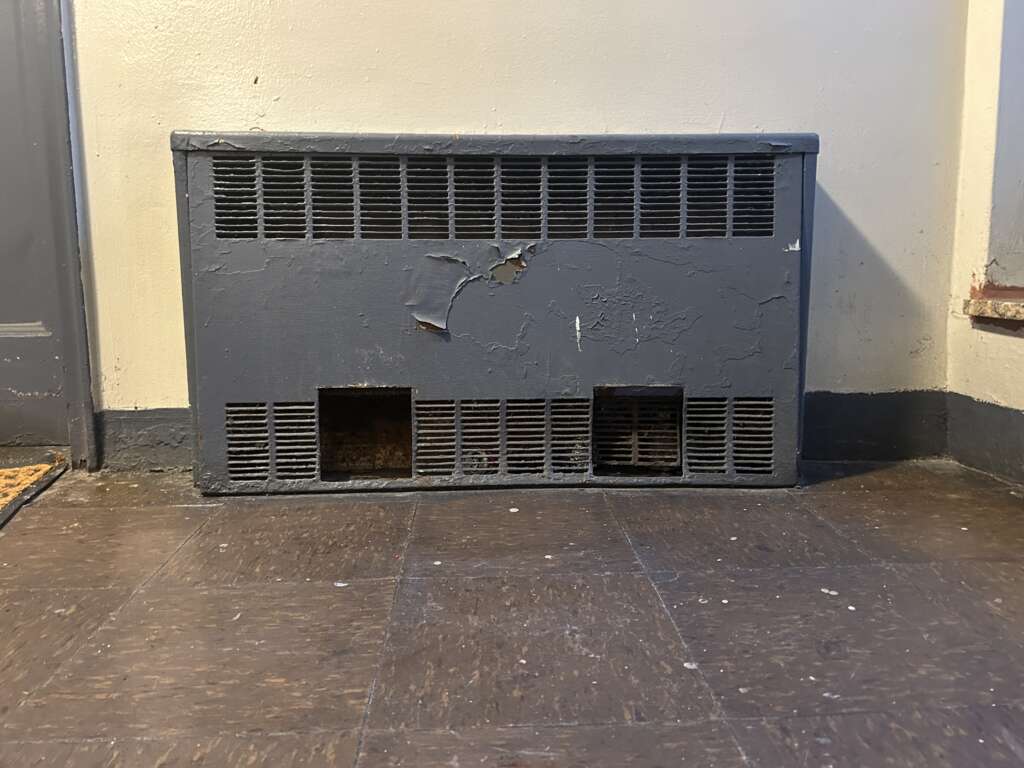
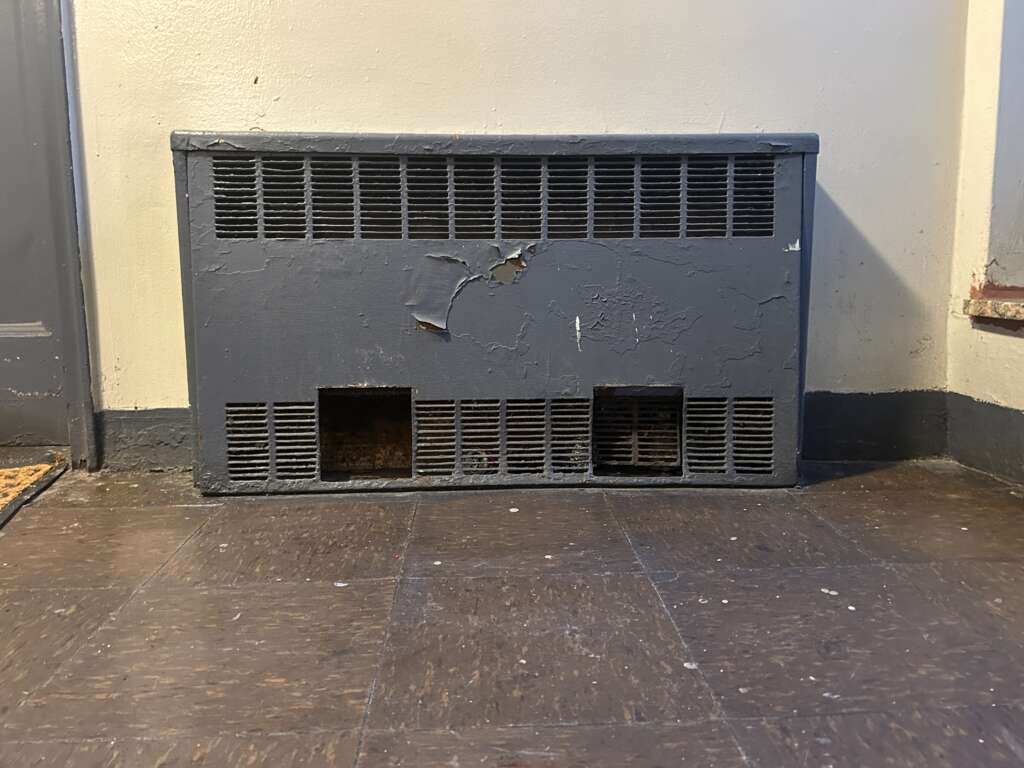 The radiator at a building in Flatbush, Brooklyn, where tenants complained of frequent heat outages during the January 2026 cold spell. (Patrick Spauster/City Limits)
Tenants are tired of hearing “call 311.” The city’s helpline is supposed to be a lifeline for tenants dealing with serious building conditions. But for many renters, it feels futile.
When it comes to lack of heat and hot water, it doesn’t just feel like tenants’ complaints are going unanswered; in some cases, they actually are.
A City Limits analysis of data on 311 calls during the city’s recent cold spell, where temperatures fell below freezing for nine straight days, shows the majority of complaints for no heat and hot water in the system were flagged as “duplicates.”
When the city’s housing agency, the Department of Housing Preservation and Development (HPD), receives multiple heat and hot water complaints at a given property, it flags the first complaint as the primary and groups the rest together. If officials close the first complaint in the set, they close them all.
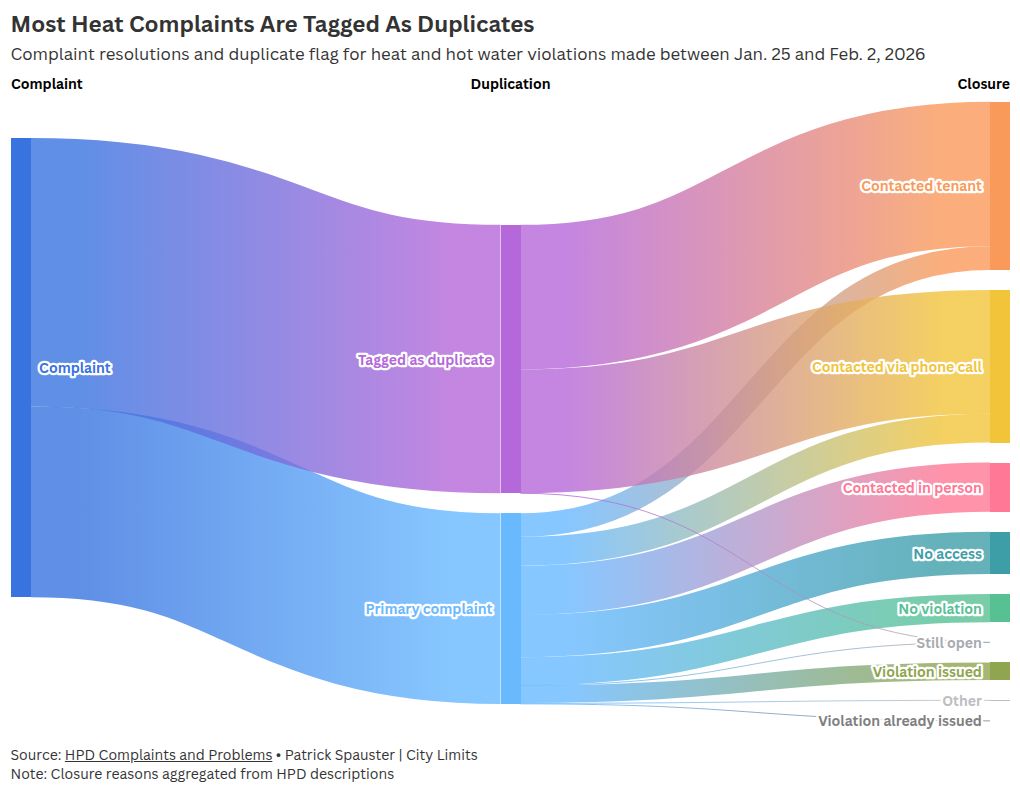
From Jan. 25 to Feb. 2, a nine-day period of below-freezing temperatures where the city received over 30,000 complaints—the most on record—58 percent were flagged as duplicates.
As a result, many of those complaints never resulted in an apartment inspection. HPD inspectors, an agency spokesperson said, always try to call before conducting an in-person inspection. Of those 21,247 complaints flagged as duplicates, nearly 10,000 were closed after HPD called someone in the building before sending a team. But under the duplicate system, reaching one tenant or the landlord often means several other complaints in the building get closed at the same time, without confirmation that the heat is back on in all cases.
“It’s really concerning. And something we hope that will change,” said Andrea Shapiro, director of programs and advocacy at The Metropolitan Council On Housing. Shapiro’s team at the Met Council fields thousands of calls from tenants through their helpline every year.
Another 11,000 complaints were closed by other HPD contact with the building, but it was not clear whether that was by phone or in person; 11 duplicate complaints are still open.
“The city really should be checking in on every single heat complaint. And there’s no excuse for just assuming you’ve been to one apartment in the building, you’ve been to all of them,” said Shapiro.
A spokesperson for HPD said they are always looking at ways to improve their system. But the agency closed over 80,000 heat and hot water problems in 18,000 buildings, issuing 3,100 violations for no heat using their current system in January—which had the most heat and hot water complaints recorded of any month on record.
The city encourages tenants with heat and hot water issues to first try contacting their owner, manager, or super. If the landlord won’t act, they’re told to call 311. When tenants don’t get an inspection but issues persist, there’s only one path forward: call again.
“We end up in this dynamic where it feels like the city is meant to be a backup landlord,” said Cea Weaver, director of the Mayor’s Office to Protect Tenants. “I really want to think about ways that tenants and the city can coordinate better, to put more pressure on the owner to make the repairs.”
During the cold spell, if tenants complained about heat at their building, they usually did so more than once. Half of buildings had more than one call to 311 during the period, with three complaints on average. At 707 East 242 St., tenants called over 150 times in nine days.
“The cold spell really highlighted how bad it’s been for the past few years. But because we’ve had relatively mild winters, landlords have really gotten away with a lot,” said Shapiro.
Responding to tens of thousands of complaints, as HPD does every month, is an enormous undertaking. And inspectors are undisputedly hustling, especially during emergency periods like the cold spell.
HPD only duplicates complaints for heat and hot water issues, which usually make up roughly 40 percent of all 311 calls about housing conditions, but were more than half during the cold spell.
The duplication procedure, HPD says, is designed to help manage the massive volume.
“It is appropriate that if the tenant calls 311 and says, ‘My heat isn’t on,’ the first person that HPD may call is the owner to say, ‘Turn on the heat,’” said Weaver.
When the heat does come on, and HPD clears a complaint by calling the tenant or landlord, “in some ways, that’s because HPD has already immediately taken action, and the data doesn’t always capture that,” Weaver added.
But some tenants and advocates say it only incentivizes more call volume, and can overlook some serious code violations.
For example, when City Limits visited 155 Linden Blvd. in Brooklyn in early February, the heat had been out for several days. But complaints for Nicole Gallan’s apartment were closed out after HPD records indicate they called another tenant in the building who said that the heat had been restored.
 City inspectors issued violations at Gallen’s building Flatbush in February. (Patrick Spauster/City Limits)
After City Limits wrote about Gallan’s apartment, HPD returned and found that even though heat had ticked back on in the building, a broken radiator in her unit meant that her bedroom was below the legal temperature threshold. HPD issued two violations for the apartment.
“The actual answer to the problem is we need better repairs,” said Shapiro. “So that we don’t need to have people just calling 311 all the time and ever escalating those calls.”
A frustrating system
In recent years HPD has decreased its response time modestly, even as heat and hot water complaints have spiked. The median wait until a first inspection for heat and hot water problems was just under two days in the fiscal year ending in June 2025, according to the Mayor’s Management Report.
“HPD is making very good choices about how to do as much as they possibly can with limited resources,” said Weaver, though she acknowledges there’s room for improvement.
Tenants still frequently lament when inspectors come and they aren’t home.
“It can get very frustrating, especially making complaints and then nobody’s showing up and then closing out the complaints,” said Jared Riser, coordinating senior attorney with the New York Legal Assistance Group.
Tori Brown, a Crown Heights tenant who attended one of Mayor Zohran Mamdani’s recent “Rental Ripoff” hearings in Brooklyn, told City Limits they went without hot water for several days in February.
“We’ve had 311 come, but then we get into the issue of like, you show up and we’re not home because we’re at work, and nobody’s actually communicating that. So it kind of just hasn’t really resulted in anything,” said Brown.
HPD said officials are using the Rental Ripoff hearings to hear directly from New Yorkers. Their top priority, a spokesperson said is keeping tenants safe in their homes.
Among all 30,000-plus heat complaints that HPD closed during the cold spell, violations were issued in response to just 1,381, according to data on closure reasons. Inspectors closed another 3,800 in person when tenants said the issue had been resolved, while 2,000 were resolved by an inspection that did not result in a violation (most likely it was not cold enough when inspectors came). Another 3,300 complaints were closed out when an inspector failed to gain access to the building or apartment.
Simple communication fixes could improve the system, Weaver suggested, like letting tenants know why their complaint was closed. “Maybe it does, for efficiency’s sake, make sense to record these things as duplicate complaints,” she said.
“[But] the message that renters are getting is: your complaint was closed. It doesn’t say why,” Weaver added. “I saw a heat complaint get closed four minutes after it was made, because it was a duplicate complaint and I talked to a tenant about it on the phone. It’s very frustrating.”
Shapiro said “persistence” is the key, given how the 311 system works.
“Calling repeatedly gets them the inspector. Or an entire building calling together—so it’s not randomly,” she said.
Even when tenants do get an inspector out, it doesn’t always resolve the issue. With heat, it’s extra tricky. Sometimes landlords leave the heat on during the day, and it will be warm enough when inspectors come by. But then the heat will go off again at night.
Shapiro said that she encourages tenants to keep a log of the temperature: “Because landlords have to be notified when an inspector is coming, they turn on the heat for that,” she said.
Weaver pointed to an existing code enforcement program where HPD puts heat sensors in tenant’s apartments. “I’d like to try to figure out a way to get a sort of closer look at the heat violation recording process in a way that we can prevent this practice of landlords turning the heat on, turning the heat off, turning the heat on, turn the heat off,” said Weaver.
Persistence also proves instrumental in holding landlords accountable.
Though it can be tricky to get that first violation, a spokesperson for HPD said that’s all they need to use their emergency repair program—where the city fixes an issue and bills the landlord—or pursue civil penalties. Riser helps tenants sue their landlords for outstanding repairs and says that closed complaints are dead ends, but getting a violation issued is a foothold.
“Once we have that violation, it’s ‘You’ve got to fix this,’” said Riser. “There’s so many more things that I can do as an attorney with this violation.”
For the best chance of getting an inspector to come into your home and issue a violation, experts and HPD officials suggest submitting a complaint for an individual apartment, rather than a building as a whole.
Experts say regularly recording temperatures can help tenants show proof of insufficient heat. (Adi Talwar/City Limits)
Building-wide complaints, which are often anonymous, get lumped together. But by providing an apartment number, tenants can increase their chances that an inspector will come and measure the temperature in their apartment and issue a violation, experts say.
But the duplication system also confounds some tenants who have modern heating systems. In older buildings with a central oil or gas powered boiler, an outage often means everyone in the building has no heat or hot water. But many modern heating systems aren’t so centralized, and have individual heating electric units in each apartment.
And these more energy-efficient systems are only getting more popular as building owners prepare to comply with new pollution requirements from Local Law 97, which introduces fines for buildings with emissions beyond a certain threshold.
“It seems like the city is just paying attention to boilers, which are important. But individual apartments have their own problems, often with radiators not working,” added Shapiro.
The modern heating systems also sometimes surprise tenants with new out-of-pocket costs. In New York City leases, heat and hot water bills are often included in the rent, and electricity is paid separately by tenants. With electric heat, winter electric bills can push some tenants’ utility costs through the roof.
“How can we tackle our affordability problem without sacrificing the climate transitions that the city needs?” asked Weaver.
When heat and hot water complaints are grouped, inspectors will check the apartment of the primary complaint first. If they are unable to access the apartment, they will go down the list of complaints in that group, measure the temperature of building common spaces or try to reach other tenants who supplied their apartment number, if available.
Many tenants submit complaints anonymously because they’re scared of retaliation from their landlord. Who complains, when, and what about is public information. Landlords also receive an automated call asking them to fix an issue whenever a tenant in their building files a complaint.
“The only way to do it is to let them know. A landlord can’t fix something they don’t know about,” said Shapiro, who added there are strong laws in place to protect tenants from retaliation.
Solutions
The Mamdani administration has floated ideas to improve what Weaver described as an “inherently reactive system,” for tenant complaints.
“The mayor’s focus on making government work better for New Yorkers—a lot of that has to be sort of improving people’s experiences when they try to get a complaint at their building resolved,” she said.
While running for office, the mayor’s campaign platform called for a system where New Yorkers could schedule inspections with HPD to ensure they would be home.
Mamdani spent a morning answering 311 calls from New Yorkers earlier this month and at a “Rental Ripoff” hearing in the Bronx, said his housing plan will tackle “how to build a more effective 311 response.”
But a solution is not so straightforward.
HPD’s system is at once modern and outdated. Inspectors in the field use an app that gives them real-time data on where complaints are outstanding, and an algorithm tells them where to head next after they complete an inspection—decisions based on the urgency of complaints and their current location.
Moving to a schedule-based inspection system at scale would throw a massive wrench into the agency’s carefully-crafted response system. Instead of efficiently routing inspectors from one building inspection to another in real time, triangulating inspections with tenant schedules may actually increase response times in some cases.
“We can’t schedule every single inspection in the city—maybe one day,” said Weaver.
In the meantime, she says, the administration is looking closely at other solutions to make inspections more predictable. That could be piloting a scheduling system, working with tenant associations to coordinate “roof to cellar” inspections where HPD spends a day looking at everything in the building, or having a certain number of complaints trigger a scheduled inspection.
“I think there is a happy medium of both tenants being able to schedule and geographic efficiency,” said Shapiro. “Saying we can’t do it because we just want to go to the closest building first seems like an excuse to me.”
HPD said that after an attempt to inspect a non-duplicate problem, tenants currently do have the ability to ask for a scheduled inspection. They said they were working closely with City Hall about improvements to the system, including scheduling.
More inspectors to deal with the rising volume could also help, as would a sense of urgency about reform, advocates say.
“If inspections are being done, people are getting heat and we won’t have to have an escalating number of calls on 311,” said Shapiro.
To reach the reporter behind this story, contact [email protected]. To reach the editor, contact [email protected]
Want to republish this story? Find City Limits’ reprint policy here.