
As electricity demand rises for the first time in decades and affordability concerns mount, new polling highlights strong bipartisan support for natural gas among New York voters. Voters know what experts have been saying for years: natural gas remains one of the most reliable and affordable ways to generate electricity.
A recent survey of 801 New York voters found broad support for natural gas, particularly when respondents consider its role in keeping electricity costs affordable. The poll was conducted February 23–26 among voters who do not work for electric utilities, independent power producers, the New York Public Service Commission, or the New York State Energy Research and Development Authority (NYSERDA).
As policymakers debate the future of New York’s energy system – and grapple with their anti-natural gas history – the results point to a clear takeaway. Voters want reliable and affordable energy, and natural gas remains a key part of the mix.
Broad Support Across the Political Spectrum
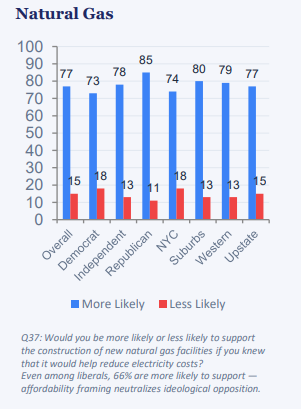
The survey results show that natural gas enjoys strong favorability among voters across the political spectrum. In fact, 77 percent of respondents said they would be more likely to support the construction of new natural gas facilities if they knew it would help reduce electricity costs.
Source: Independent Power Producers of NY
Even among voters who traditionally lean more skeptical of fossil fuels, affordability changes the equation. Sixty-six percent of liberal-leaning respondents said they would be more likely to support new natural gas development if it helped lower electricity prices.
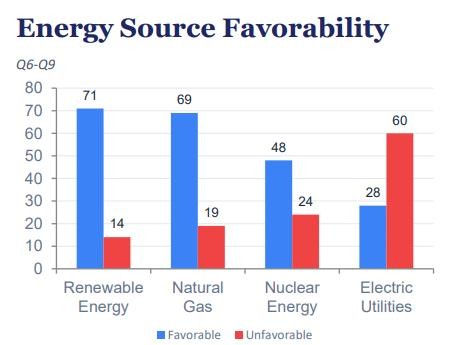
According to the survey, both renewable energy and natural gas receive strong majority favorability from New York voters, suggesting that many residents view the state’s energy future as one that includes a balanced mix of energy rather than relying on a single fuel source.
Source: Independent Power Producers of NY
Reliability Matters When Demand Surges
Support for natural gas also reflects the role it plays in maintaining reliability when extreme weather and rising demand place stress on the power grid.
During Winter Storm Fern and the coldest January since 1988, natural gas played a critical role in powering homes and keeping Americans warm. Natural gas generation in the lower 48 states increased 14 percent from the previous week during the storm, stepping in as other sources struggled to meet demand.
Natural gas was consistently one of the most-used fuels for electricity generation before, during, and after the storm, helping stabilize the grid as temperatures plunged. In PJM — the nation’s largest grid operator serving more than 67 million Americans — natural gas provided roughly 40 percent of electricity during the height of the storm.
Dispatchable generation remains essential for grid reliability. Natural gas continues to provide that reliability, ensuring homes, businesses, and power plants have the energy they need when demand surges.
The Affordability Advantage
Cost is another major inflection shaping public support for natural gas.
Electricity prices are influenced by many factors, but roughly 45 percent of the average electric bill comes from the cost of generating electricity. Understanding how those costs are calculated is critical when comparing different energy sources.
Comparing the costs of a solar panel and a natural gas-fired power plant is difficult because you have to look at the cost to generate electricity over the resource’s lifetime but there are other considerations that add to the cost because not all energy resources operate the same way. Wind and solar generation depend on weather conditions, meaning they cannot always produce electricity when demand is highest. Ensuring reliable power from intermittent resources requires additional infrastructure such as backup generation, expanded transmission lines, storage systems, and reserve capacity.
When those broader system needs are included, the cost picture changes significantly.
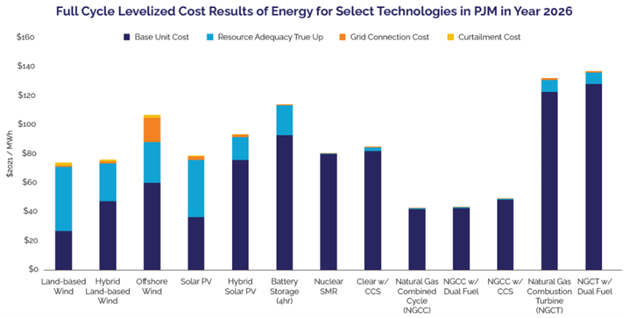
For example, analysis using the Levelized Full System Costs of Electricity (LFSCOE) metric found natural gas combined cycle generation costs roughly $35–$40 per megawatt hour, significantly lower than wind and solar once the costs of storage and system reliability are included.
The analysis found that solar generation costs ranged from $413 to $1,380 per megawatt hour and wind from $291 to $483 per megawatt hour under full-system cost modeling, highlighting the additional infrastructure and storage required to maintain reliability when intermittent resources are the primary energy source.
Even under scenarios where storage costs fall dramatically, the analysis found that natural gas generation remains more cost-competitive than wind or solar on a full-system basis.
Other research examining electricity markets reaches similar conclusions. When the full cost of connecting resources to the grid and maintaining resource adequacy is included, natural gas generation consistently outperforms many other technologies on cost.
Source: Electric Power Supply Association
Electricity systems require more than just generating power, they must ensure energy is available whenever consumers need it. Because natural gas plants can produce electricity on demand, they provide that reliability without requiring the same level of additional infrastructure and backup capacity.
Voters Want Natural Gas – New York Policymakers Should Listen
These sentiments are particularly notable for a state that has repeatedly restricted natural gas access. For years, New York policymakers have pursued some of the nation’s most aggressive climate targets, including sweeping emissions-reduction goals, mandates to rapidly electrify buildings and transportation – even as they are now walking these targets back – as well as targeting fossil fuel producers in baseless climate litigation. At the same time, the state has repeatedly moved to block or constrain new natural gas pipeline and energy infrastructure, limiting the very supply needed to keep electricity affordable and reliable. That combination of ambitious mandates and restricted fuel access has tightened the state’s energy system, putting upward pressure on costs and raising growing concerns about grid reliability. Against that backdrop, it is no surprise that New York voters increasingly support natural gas as a practical, dependable, and cost-effective part of the state’s energy future, and is yet another cue to policymakers to change course.
Bottom Line: The poll reinforces a clear trend in today’s energy debate: voters prioritize reliability and affordability over ideology. Natural gas continues to deliver both — powering homes during extreme weather, supporting grid reliability, and helping keep electricity costs in check. Rather than taking steps to block natural gas pipelines that could help lower electricity costs, New York’s lawmakers should listen to the voters and support reliable, affordable natural gas.