
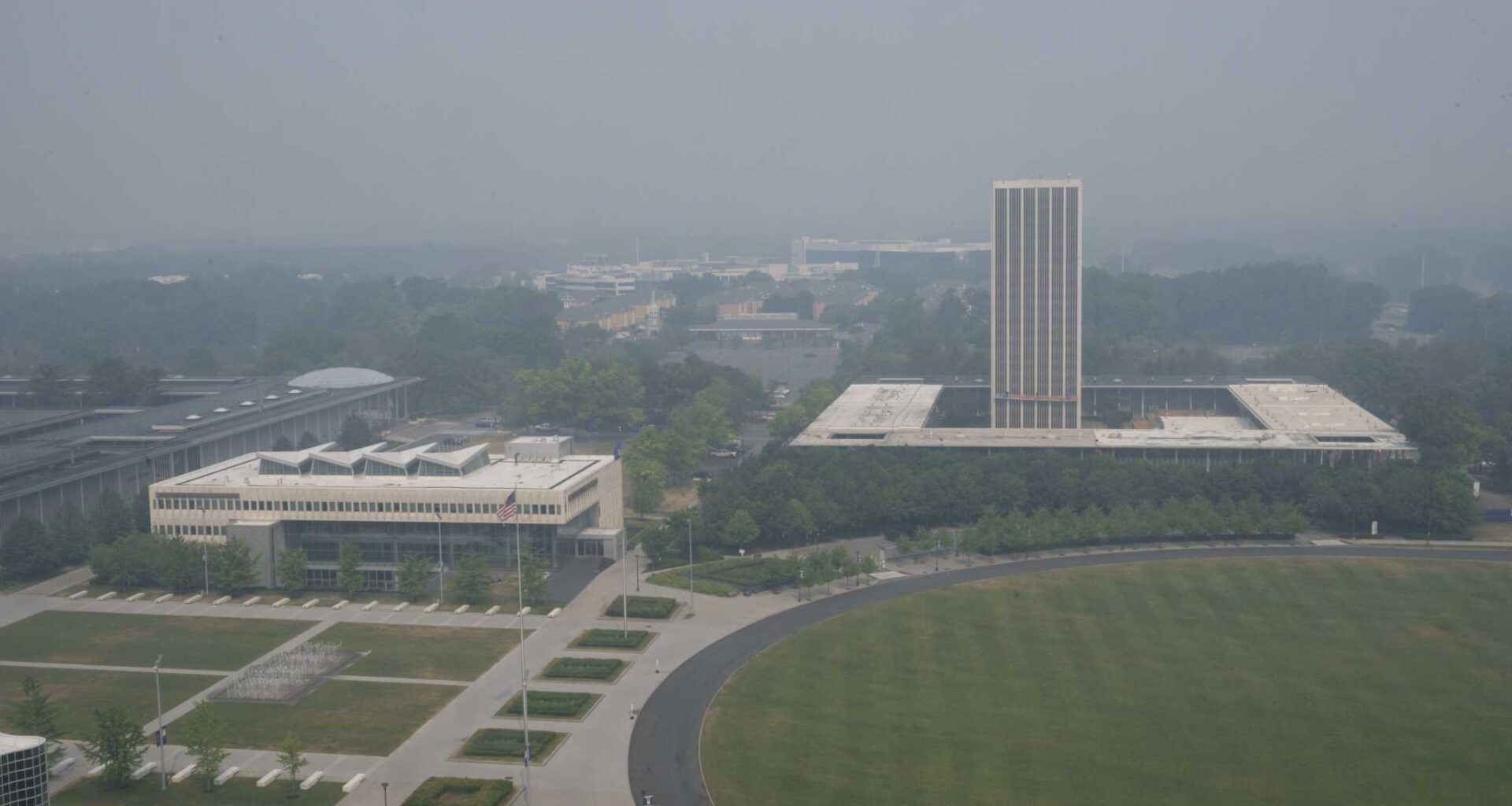
The Helderberg Mountains would usually be visible in this view from a University at Albany dorm tower on June 7, 2023, in Albany. Smoke from wildfires in Canada caused poor air quality and visibility in the Northeast.
Lori Van Buren/Times Union
ALBANY — Are the Capital Region and Hudson Valley in for another smoke-filled summer thanks to wildfires? Drought conditions in regions north and west of upstate New York indicate it’s a possibility.

“Certainly, the ingredients are there for a good wildfire season,” said Ryan Torn, a professor at the University at Albany’s Department of Atmospheric and Environmental Sciences. “If that’s the case, we’re likely to see some sort of impact for that.”
Article continues below this ad
There are many factors that lead to wildfires, but one of the main ones is drought, Torn explained. Particular areas of concern are the western United States and Canadian forests. “Unfortunately,” he said, both areas are “under decent drought conditions right now.”
Study: Canadian wildfire smoke changed the songs of New York birds
Weather: Warming planet felt locally with record-breaking tornado, wildfire seasons
Make the Times Union a Preferred Source on Google to see more of our journalism when you search.
Add Preferred Source
The West, in particular, is gearing up for a bad wildfire season. The Rocky Mountains had one of the lowest snowpacks in recorded history this season, and what fell is melting quickly, Torn said. But the Canadian province of Quebec — where wildfires sent a thick haze of smoke to upstate New York in 2023, causing the worst air quality since 2002 — is also currently under a moderate drought. And while smoke is more likely to move east into the Capital Region from western wildfires, smoke blowing south from Quebec can’t be ruled out — and it would be much more severe.
Article continues below this ad
“The farther away the fire is, the less the impact is going to be,” Torn said. “Think of putting a dye in a small container of water.”
If fire breaks out in more remote parts of Quebec’s forests, where crews can’t as easily get to them, and north-south winds blow this summer, there could be a repeat of 2023.
In 2025, the U.S. saw 77,850 reported wildfires that burned over 5 million acres, according to the National Interagency Coordination Center Wildland Fire Summary and Statistics Annual Report. While less land was burned overall, more wildfires were reported — perhaps the most notable being the wildfires that swept across Los Angeles County in California. But significant fires also emerged in the South and states like New Jersey and Alaska.
Clockwise from top left: Smoke from Canadian wildfires produced hazy views throughout the Capital Region, including in Albany and John Boyd Thacher State Park in New Scotland. The Jennings Creek Wildfire in 2024 burned thousands of acres in southern Orange County.
Photos by Will Waldron/Times Union and the New Jersey Forest Fire Service
Smoke from Canadian wildfires produced hazy views throughout the Capital Region, including in Albany and John Boyd Thacher State Park in New Scotland. The Jennings Creek Wildfire in 2024 burned thousands of acres in southern Orange County.
Photos by Will Waldron/Times Union and the New Jersey Forest Fire Service
What about wildfires in upstate New York?
The Hudson Valley and further upstate have also seen their share of brush fires. In fall 2024, the Jennings Creek wildfire burned thousands of acres in southern Orange County and northern New Jersey. Already this year, state forest rangers helped extinguish at least eight fires that burned a total of 22.8 acres of land, according to the state Department of Environmental Conservation. The largest was in the Steuben County town of Bath, where nearly 11 acres burned. Half the fires were caused by debris burning, according to DEC, which noted the statewide ban on residential brush burning is in effect until May 14.
Article continues below this ad
The Capital Region and Hudson Valley are currently considered to be under “low” fire risk, according to data from the New York State Mesonet at the University at Albany, but abnormally dry conditions are currently reported in parts of the Adirondacks and Hudson Valley.
Rising temperatures paired with gusty winds in the spring can lead to that seasonal fire risk, noted Abbey Gant, meteorologist with the National Weather Service in Albany. Increased precipitation would decrease that risk; it’s harder to start a wildfire if its fuel is wet. The current outlook from the national Climate Prediction Center shows equal chances for at, above or near normal precipitation and temperatures this spring.
“It’s difficult to say whether it’s going to be more active or less active than last year’s was,” Gant said.
Article continues below this ad