
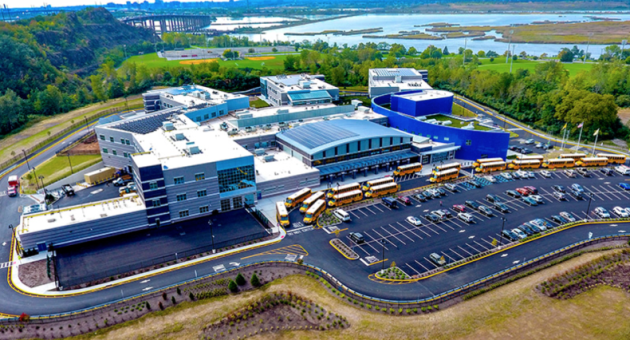
Hudson County Schools of Technology (HCST) officials budgeted incorrectly for years due to “systemic failure of the accounting and finance department’” resulting in a multi-million dollar deficit, according to a recently completed forensic audit.
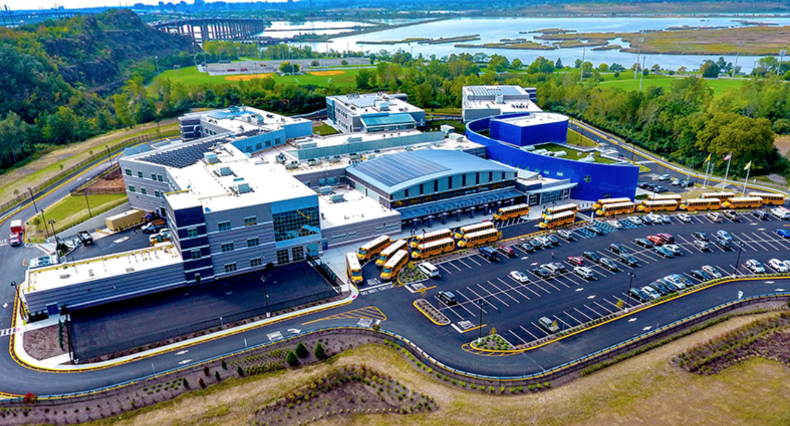 Photo via mastconstruction.com.
By Dan Israel/Hudson County View
“As of the date of this Report the State of New Jersey has provided funding in excess of $10 million for the current fiscal year and the request to Hudson County is still pending approval,” Richard Corcoran, of PKF O’ Davies Advisory, wrote in the 12-page audit report.
” … This deficit is the direct result of the systemic failure of the accounting and finance department to budget appropriately for the District’s operating expenses from 2022 to 2025.”
While HCST was looking to impose municipal tuition fees to the tune of about $6,000 dollars per student to each local school district yearly, county officials fought the proposal until the county schools agreed to find another solution, as HCV first reported.
The Hudson County Board of Commissioners recently received the preliminary findings of the forensic audit on March 26th ahead of the district’s upcoming rescheduled budget hearing and HCV obtained a copy.
“This deficit is the direct result of the systemic failure of the accounting and finance department to budget appropriately for the District’s operating expenses from 2022 to 2025,” Corcoran also wrote.
From 2019 to 2022, the district spent less than it raised, with revenue exceeding expenditures by $1,987,983 in 2022. This changed in 2023, with operations losing money annually until expenses exceeded revenue by $5,786,995 in 2025, the report says.
The deficit is anticipated to increase by $1,718,692 in June when the 2026 fiscal year begins.
Board secretary reports in March, April, and May of 2025 “potentially misled the board” and did not accurately reflect outstanding accounts payable obligations from 2022 to 2025, which is also highlighted in the 2025 Auditor’s Management Report and the Annual Comprehensive Financial Report.
According to the audit, over 23 employees of the school district and current auditors were interviewed and cooperated completely including Superintendent of Schools Tom Macagnano, Acting Business Administrator Dominick Pandolfo, and Assistant School Business Administrator Kerri Sullivan, among others.
While investigators sought to speak with former Superintendent Amy Lin-Rodriguez, the report states her legal counsel advised her to only respond in writing due to conflicts of interest, which they rejected as “neither efficient nor effective.”
Also not included in the audit was testimony from former Business Administrator Nicholas Fargo and former Board Secretary Joseph Muniz.
While a judged dismissed Muniz’s retaliation case against the district in February, it was reinstated last week, as HCV first reported. The lawsuit alleges his suspension was retaliation after he ended an 18-year affair with then-Superintendent Amy Lin-Rodriguez.
“Unfortunately, I was never contacted nor interviewed for the forensic audit report,” Muniz said today.
The report denotes it is “highly unusual” to see the roles of business administrator and board secretary separated, with Essex and Hudson counties being the only two of 21 county vocational schools in New Jersey to split the “overlapping” roles.
At HCST, separating the roles did not increase financial transparency, save money, increase board awareness of financial distress, nor provide accurate budgets, and “failed the public,” Corcoran wrote.
A financial audit issued January 14 by Donohue, Gironda, Doria & Tomkins, LLC established a budgetary deficit of $3,642,070 as of the start of the 2025 fiscal year.
Further, the report says the 2026 budget was not prepared adequately, failing to capture operational needs, resulting in a request for $12 million in aid from the state and county.
The state has committed to providing over $10 million thus far, but the county request is pending.
“Management’s failures” resulted in approximately $4,247,051 in unpaid State of New Jersey Health Benefit Plan invoices – now totaling over $11 million including interest – contributing to the deficit.
Two months of utilities bills went unpaid in 2025, totaling $392,576.
Additionally, the report claims that internal controls were circumvented at Fargo’s request, as invoices were not entered into the accounting system.
Staff repeatedly told auditors they were told not to enter utilities and health insurance invoices “because there was not enough cash to pay the bills.”
HCST continued this practice into August 2026 before Fargo went on sabbatical, “impairing the ability of the board to make sound financial decisions.”
The report states the prior administration “either did not understand accounting and financing for government agencies or willfully ignored the correct procedures.”
Corcoran further stated, via the audit, that the practice of “ordering and then finding the money” was so common that almost every employee interviewed was aware of it, with auditors noting “too many examples to include a complete list.”
However, the administration and department heads are now complying with correct practice, the report states, as auditors witnessed invoices being denied and department heads told to return goods.
From 2019 to 2025, salaries were underbudgeted every year except 2021, by an overall 5.46% or approximately $14.6 million.
The report states that budgets also failed to account for recurring deficits in food service and the transportation consortium, draining the surplus, also noted that the 2024 and 2025 budgets were clearly negatively impacted without the benefit of COVID-19 funds.
Additionally, during interviews, auditors constantly heard that “transportation makes money,” but the report states there was no indication in any financial statements that transportation was breaking even.
The transportation operating deficit totaling $991,340 in 2025 was not budgeted for and had to be covered by the surplus.
Using actual costs, transportation is expected to generate an operating deficit of over $4.7 million that needs to be budgeted, the report states, with interviewed employees appeared to be in disbelief over the shortfall.
The report calls for an investigation to see if services are accurately being charged to outside entities, also highlighting “significant internal control deficiencies.”
HCST labor was not charged to outside entities whose vehicles were serviced, yet HCST paid overtime for those repairs, the report found.
The report states health insurance premiums were historically over-budgeted, but double-digit increases caused problems compounded by employee contributions being frozen at 2019 levels.
As wages increased, the increased premiums fell onto the district, decreasing the budget “cushion” to cover shortfalls in salary expenses.
Four collective bargaining agreements provide additional benefits including longevity pay, payment of unused sick and vacation days, and other items that are “at best …improperly budgeted … potentially violating State of New Jersey statute, [and] … incredibly generous.”
HCST management also negotiated agreements for unions where relatives were active members without recusing themselves.
The 2024 budget was underbudgeted for these contractual benefits by 4.66%, the 2025 budget by 4.39%, and the projected 2026 budget by approximately 10.2%.
Employees were “cashing” in unused sick and vacation days annually, potentially violating state statute, further contributing to fiscal issues, the report states.
One employee, who was not named, requested over $23,000 for unused sick days and $23,000 for vacation days in 2024. Meanwhile, certain employees receive 25 to 30 sick days versus the typical 12 to 15, with vacation days exceeding 20.
Other “incredibly generous” benefits included employee sauna use, reduced cafeteria prices, and health care contributions frozen at 2019 levels.
Auditors found little communication between administration and the board during the last round of negotiations, specifically work papers indicating a cost-out was completed.
Additionally, a number of vendors were flagged in the report for appearing to circumvent public contract laws, a concern raised in previous audits.
Department heads repeatedly told auditors “that is the way we always did it” or “spread the contract around.”
In the report, transportation and buildings and maintenance employees explained partial purchase orders of $6,000 saw final payments surpassing the state bid threshold, with one instance of over $66,000 paid to a vendor for cafeteria bagels.
While the financial impact of this was not assessed, the report states the district is in the process of strengthening those guidelines.
HCST offers community programs that have become “impossible” to fund without county support, the report states, recommending a comprehensive review of non-primary programs and considers moving them to a “more appropriate organization” reporting directly to the Hudson County commissioners and County Executive Craig Guy.
Several auditor recommendations have already been implemented during the audit or are in the process of being implemented, the report concluded.
According to Board of Commissioners Chair Anthony Romano (D-5), the HCST budget was not yet approved due to a computer glitch at the state level, and the new budget hearing date is set for April 1st at 4 p.m.
“The forensic audit speaks for itself—the current administration is taking corrective action to fix inefficiencies and strengthen operations,” Macagnano said in an email.