
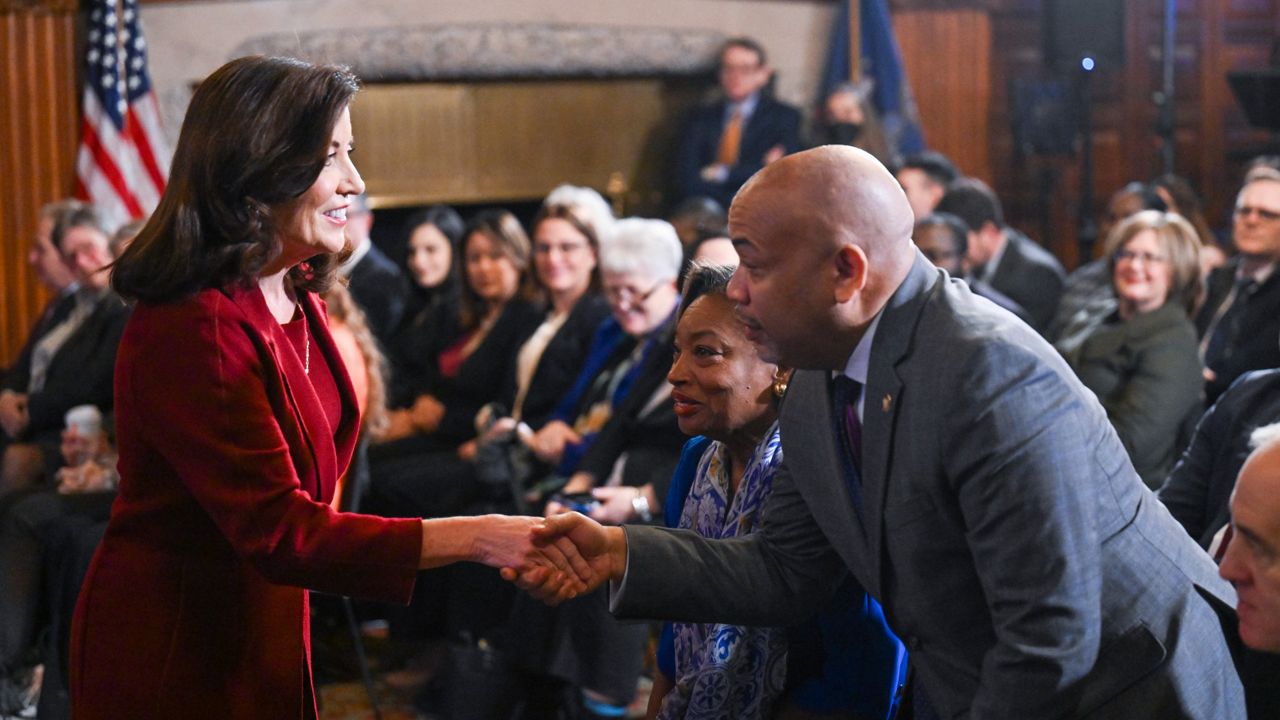
Gov. Kathy Hochul’s Budget Director Blake Washington offered some relatively good news to budget watchers in Albany Wednesday as the state spending plan slipped past the April 1 deadline, marking five late budgets in five years under Hochul: It might not be as late as last year, when Hochul signed the spending plan on May 9 — the latest in 15 years.
That comes as conversations continue at a glacial pace around Hochul’s pitch to transform car insurance policy to lower rates and dial back the state’s 2019 climate law amid affordability concerns. Leaders bought themselves a week through a budget extender passed Tuesday, representing a sizable chunk of the prescheduled break for Easter and Passover.
“Once everybody returns from the holiday season, we hit the ground running, and I don’t think it should be very long after that,” Washington said. “I don’t see any reason it should drag into a repeat of last year. That being said, the governor has been very, very clear on what her needs are out of this process.”
Of course, Washington is Hochul’s budget director — a partner in crafting the very proposals causing the logjam. It’s resistance from — and the give-and-take with — state legislative leaders that drives the delay. Washington acknowledged as much.
“Of course, the speaker and leader have things they want to achieve as well,” he said.
Both Assembly Speaker Carl Heastie and Senate Majority Leader Andrea Stewart-Cousins addressed reporters this week and painted a picture of a budget process that is predictably stagnant — and predictably late. In fact, on the date the fiscal plan was due, the conversation had not even reached the point of discussing numbers, only policy.
“I’ve been here 26 years, nothing fazes me in this place,” Heastie said. “This is the pattern. We get it done. Hopefully we will get it done sooner rather than later,” Stewart-Cousins added.
There wasn’t much shock and awe in the halls of the state Capitol on April 1 this year, just a resigned frustration with a process driven by the governor. But if legislative leaders hold out long enough, they can secure some of their priorities and perhaps stave off some of their members’ biggest concerns about Hochul’s proposals.
Heastie said much of the energy is being spent on issues where there is broad agreement but still significant differences. “Once you start diving into the details, you say, ‘Is this something we could really be OK with doing?’ ” he said.
Though the budget process is notoriously unpredictable — and new items can be introduced at any moment — Heastie seemed to agree with Washington that this doesn’t compare to last year’s weekslong row over changes to the state’s discovery laws.
“The subjects are not as difficult as discovery,” he said, rating this year’s issues at a “six or seven” in difficulty.
Heastie said the importance of language and details is on full display as the parties dig into Hochul’s car insurance reforms. The governor is pushing a platform that seeks to lower rates by weeding out fraud and abuse, cracking down on staged accidents and limiting claims for individuals found to be at fault. But Heastie has concerns about what that would mean.
“The fact that if, god forbid, you are the primary reason there is an accident, you will no longer be entitled to pain and suffering. That is a pretty serious thing for people to accept,” he said.
Stewart-Cousins said Tuesday that her concerns center largely on verifying the data presented by the executive chamber and ensuring insurance companies aren’t left off the hook.
“We want to make sure if there are things the insurance companies can do to lower prices, that they are doing that as well,” she said, as the governor continues to point to data she argues shows fraud and litigation are the appropriate targets.
When it comes to Heastie’s concerns over the at-fault issue, Washington stressed that the governor’s proposals are intended to bring rate relief through broad strokes, as opposed to getting bogged down in finer what-ifs. Addressing responsibility, he said, is one area where “New Yorkers receive the greatest benefit on their auto insurance bill.”
“The governor’s take is making rational proposals — revisions that are common in many peer states — to reduce auto insurance bills,” Washington said. “The stuff around the edges is always challenging in any body of law — there are always exceptions and asterisks — but we have to gravitate toward the many in these cases.”
On the governor’s proposal to reform the state’s landmark 2019 climate law, the fact that conversations are moving, and that legislative leaders have indicated compromise is possible, is noteworthy in itself, given the resistance from rank-and-file members of the Democratic majorities and initially from leadership.
“It’s getting to a place where they feel comfortable, too. What is the workable solution here?” Washington said.
Heastie didn’t necessarily signal comfort but acknowledged that changes are likely coming.
“I think members — we’re totally committed to the planet. We want to see the elements of the CLCPA materialize,” Heastie said. “We also know that we have a federal administration that has pretty much put a halt to anything that isn’t fossil fuels. So I think there is an acknowledgment that we don’t have a partner or a friend in Washington. The goals are a little bit more difficult to achieve.”
While acknowledging that global instability around the Iran war has raised questions about continued reliance on fossil fuels, the pathway to transition has been squeezed by the Trump administration.
“What we thought it would take to achieve the goals has been compromised by the aggressiveness of this current administration in trying to move people away from renewable energy,” he said.
While Heastie placed blame on the Trump administration, Hochul has pointed to a pending lawsuit, the impacts of the COVID-19 pandemic and federal policy shifts as reasons for seeking to delay regulations that would help fund the transition, and to change how the state tallies emissions.
It has come amid much pushback from environmental advocates who have dismissed her reasoning and insist fossil fuels reliance is behind sky high rates.
Key Democrats in the Legislature have said they are more concerned about the methodology change than the delayed regulations. When asked whether Hochul would be willing to drop that piece, Washington didn’t rule it out.
“Everybody in this discussion is going to have to give a little. The governor has set a framework of goals that she believes are very important to protect New Yorkers,” he said. “We’re going to have a dialogue, and when we’re all collaborating to get to a result, it will be one we can all embrace — and one that protects ratepayers.”
Speaking of ratepayers, Washington also didn’t rule out utility rebate checks proposed by the Assembly in its one-house budget. Checks of $500 would go to residential ratepayers with incomes below $150,000, while those earning between $150,000 and $300,000 would receive $300.
“Are we able to land a $2.6 billion rebate among all the other things out there? It’s a challenge,” he said. “It’s still very much alive.”
The fact that it’s in play at all is the latest sign that the trade-off for the Senate and Assembly budging on the climate law could be inclusion of their environmental priorities.
Stewart-Cousins indicated Tuesday that she would not be open to a climate deal that didn’t incorporate some combination of proposals from the Senate and Assembly one-house budgets aimed at addressing utility rates.
“Any conversation has to include things that are really going to help people, I think the Assembly put something in its one-house that would offer rebates or whatever, which we are open to,” she said.
Heastie said discussions around Hochul’s proposal to reform New York’s environmental quality review process remain difficult, ranking alongside car insurance and the climate law.
On a potential immigrant protection package, Heastie said it remains unclear whether it will be included in the budget or passed separately, but the sticking point remains how to address local government cooperation with Immigration and Customs Enforcement.