
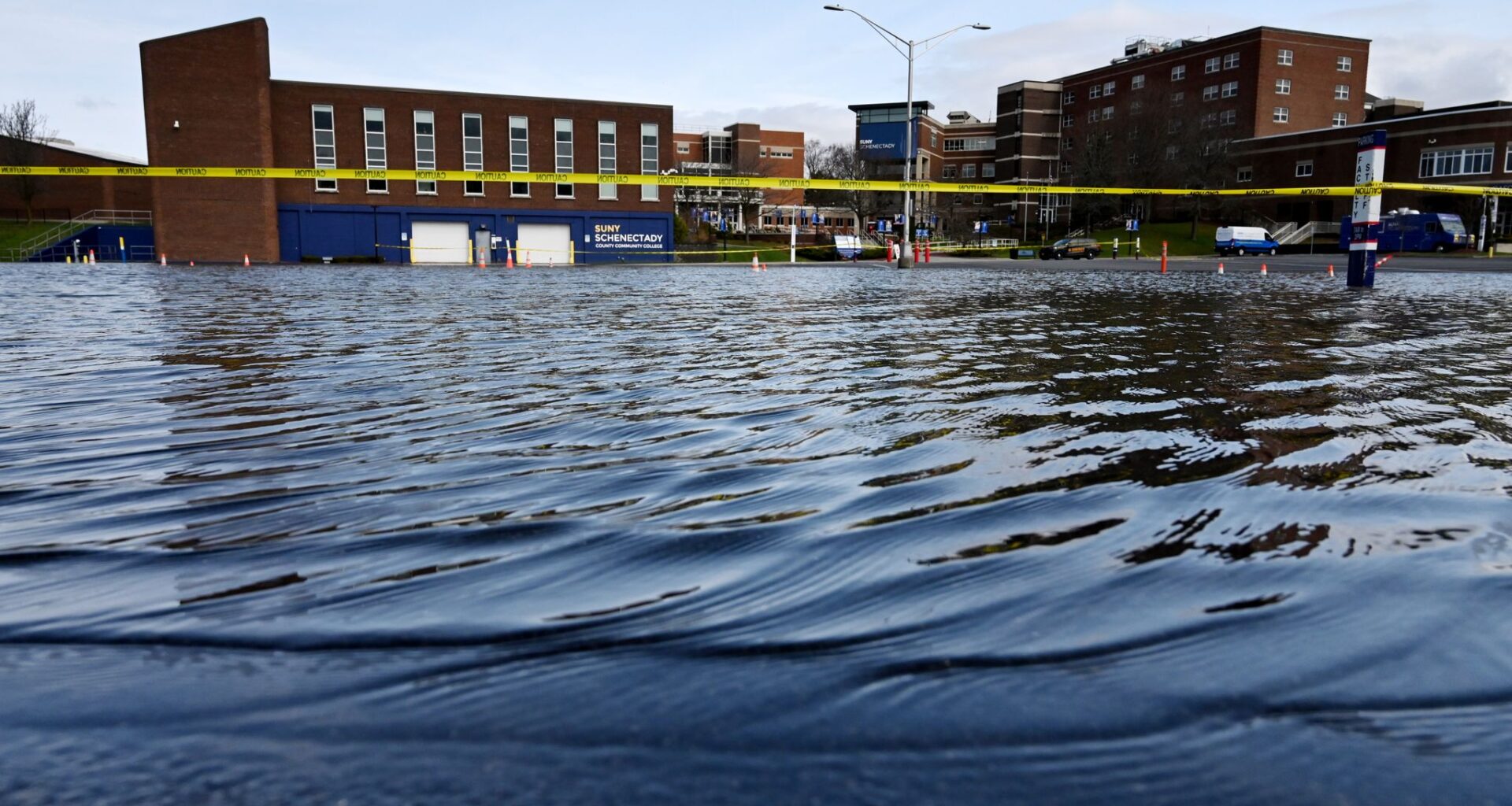
Part of the rear parking lot at SUNY Schenectady is flooded on Wednesday in Schenectady. Storm sewers on campus were overwhelmed. (Will Waldron/Times Union)
Will Waldron/Times Union
SUNY Schenectady canceled classes on Wednesday after part of the campus parking lot was flooded. It was the third time in less than a month that flooding prompted school officials to cancel classes. This photograph was taken at 9 a.m., roughly two hours after students were alerted classes were canceled due to flooding.
Jesse Taylor / Times Union
Part of the rear parking lot at SUNY Schenectady is flooded on Wednesday in Schenectady. Storm sewers on campus were overwhelmed. (Will Waldron/Times Union)
Will Waldron/Times Union
Part of the rear parking lot at SUNY Schenectady is flooded on Wednesday in Schenectady. Storm sewers on campus were overwhelmed.
Part of the rear parking lot at SUNY Schenectady is flooded on Wednesday in Schenectady. Storm sewers on campus were overwhelmed. (Will Waldron/Times Union)
Will Waldron/Times Union
Part of the rear parking lot at SUNY Schenectady is flooded on Wednesday in Schenectady. Storm sewers on campus were overwhelmed. (Will Waldron/Times Union)
Will Waldron/Times Union
The floodwater pump house on Washington Avenue on Wednesday, April 1, 2026, in Schenectady. The city-owned pump station used to clear storm sewers is currently inoperable. (Will Waldron/Times Union)
Will Waldron/Times Union
The floodwater pump house on Washington Avenue on Wednesday, April 1, 2026, in Schenectady. The city-owned pump station used to clear storm sewers is currently inoperable. (Will Waldron/Times Union)
Will Waldron/Times Union
Plaque for the floodwater pump house on Washington Avenue on Wednesday in Schenectady. The city-owned pump station used to clear storm sewers is currently inoperable.(Will Waldron/Times Union)
Will Waldron/Times Union
Water levels on the Mohawk River are elevated at Schenectady’s Stockade after periods of heavy rain and snowmelt to the west on Wednesday in Schenectady. (Will Waldron/Times Union)
Will Waldron/Times Union
SUNY Schenectady canceled classes on Wednesday after part of the campus parking lot was flooded. It was the third time in less than a month that flooding prompted school officials to cancel classes. This photograph was taken at 9 a.m., roughly two hours after students were alerted classes were canceled due to flooding.
Jesse Taylor / Times Union
SUNY Schenectady canceled classes on Wednesday after part of the campus parking lot was flooded. It was the third time in less than a month that flooding prompted school officials to cancel classes. This photograph was taken at 9 a.m., roughly two hours after students were alerted classes were canceled due to flooding.
Jesse Taylor / Times Union
Schenectady Mayor Gary McCarthy says the city has received a grant to repair this pump station next to the SUNY Schenectady, but no bids have been solicited.
Jesse Taylor / Times Union
The flooding at SUNY Schenectady expanded as time wore on Wednesday morning.
Jesse Taylor / Times Union
SCHENECTADY — For the third time in less than a month, the partial flooding of SUNY Schenectady’s parking lot prompted the cancellation of all classes.

The storm sewers on campus were overwhelmed Wednesday. At times, heavy rain fell on Tuesday and Wednesday, but the college blamed the flooding on a rising Mohawk River. The National Weather Service in Albany says the 1.05 inches of rain that fell in the area were not significant enough to cause flooding.
Article continues below this ad
Schenectady Mayor Gary McCarthy initially said flooding of the campus parking lot was caused by failures in a nearby city-owned pump station on Washington Avenue that is used to clear storm sewers. But he later said the issue was far more complex. He said construction on the campus and other factors could contribute to the backup of water. He noted the college has its own pump stations.
“I answer all the questions. I shoot from the hip,” he said when asked about his initial remarks. He said the amount of recent rainfall and the level of the Mohawk River, which is rising from rain and snowmelt to the west, were not high enough to trigger use of the pump station. “We’re not at a point where we would have turned the pump station on,” he said.
SUNY Schenectady President Steady Moono sent a withering letter to McCarthy after Wednesday’s flooding, placing the blame on the city.
Make the Times Union a Preferred Source on Google to see more of our journalism when you search.
Add Preferred Source
“It is the predictable result of a longstanding infrastructure failure that has gone unaddressed for over a decade,” Moono wrote. “During my tenure. I have repeatedly raised concerns regarding the condition and functionality of the Washington Avenue pump station. I have consistently emphasized that addressing this issue would significantly mitigate, if not eliminate, the chronic flooding that disrupts our campus operations.”
Article continues below this ad
Saying the college and city had “reached an inflection point,” Moono continued, “The frequency and severity of these closures are unacceptable and the impact on our students, faculty and staff is profound.”
McCarthy, a onetime student, questioned the decision to close the campus. “When I went there, we’d still have class if there was a little bit of water in the parking lot,” McCarthy said.
A spokesperson for SUNY Schenectady said the college has two “small pumps, just to handle downpours,” not an inundation of water from a rising Mohawk River, which borders the campus.
“Campus has been shut down for the safety of students, facility, and staff. The pipes have backflow protectors, but with high river levels flowing in from the west, the rising water pressure can still force backflow into the parking lot,” Saba Mann said.
Article continues below this ad
The situation raised questions about the college’s decision to install chargers for electric vehicles in the portion of the parking lot that floods. Mann said the devices were turned off, but did not answer a question about whether plans were afoot to move them to high ground.
Sign up for the Schenectady Now newsletter
Keep up with the latest happening in Schenectady, Niskayuna, Glenville, Duanesburg and other communities in Schenectady County.
A solution to the flooding, if there is one, is a long way off. McCarthy says the city has a $26 million grant in place to repair the city’s facility, but no bids have been solicited, and there is no estimate for when the work could begin. Until bids are received, McCarthy said it is unclear if the grant will cover the entire cost or just a portion of the work.
SUNY Schenectady said options to alleviate flooding have been discussed on campus, including a plan to improve flood control as part of a long-gestating plan to move an Interstate 890 off-ramp to the western edge of the campus.
Article continues below this ad
The campus alerted students about the closure at 7:06 a.m., but some missed the alerts and made the unnecessary trip to the campus.
The water only flooded a portion of the campus parking lot.
College officials canceled in-person and remote classes on Wednesday. All other campus activities were called off and offices were closed, too.
Classes were canceled at the college on March 9 and 12. At the time, unseasonably warm temperatures caused the snowpack to melt and caused the Mohawk River to rise, but officials later said that was not a factor in the campus flooding.
Article continues below this ad
Rain and the continued melting of snow in the western edge of the Adirondack Mountains were sending water into the Mohawk River, according to the weather service. The West Canada Creek north of Herkimer was flooding and the Mohawk was near flood stage in Little Falls. The Mohawk was not expected to flood in the Schenectady area.
Sophia Mead, a hospitality and tourism major, drove from Clifton Park to Schenectady County Community College, not realizing the school had closed for the day.
The 19-year-old was planning to take a test and was supposed to meet with her adviser to schedule her classes for next semester.
Mead said the college typically lets students know about flood closures well ahead of time and that it was her fault for needlessly making the trip without checking her email first.
Article continues below this ad
“I feel like emailing at 7 is OK, but for anyone that might live farther from campus than I do, it might be a little bit difficult,” Mead said.
She said it isn’t the first time flooding has caused the school to close, noting she was “kind of bummed” but not too upset.
“When we get rain, it pretty much is flooded,” Mead said.
Article continues below this ad
Mann said the campus sent a variety of messages via social media posts, email, robocalls, text messages and other means of communication.