

Illustration: Brando Celi
On February 24, as snow blanketed city sidewalks for the second day in a row, mayor Zohran Mamdani’s seemingly unflappable charm offensive met its first formidable foe: the public-school calendar. It was clear to many in the outer boroughs, where snowplowing had lagged, that thousands of students and teachers would struggle with their commutes if the buildings reopened that day. But Mamdani also knew that a snow day would cause the city to fall short of the 180 days of instruction that are required for the school system to receive the maximum state funding. The calendar was limping to viability by allowing one snow day (on February 23, granted through a waiver from the state commissioner of education) and counting four professional-development days (when students are off from school but faculty come into the building) toward its tally. Schools had also shuttered for a remote-learning day during an earlier snowstorm.
Although he could have requested a second waiver from the state, Mamdani may have sensed that another day off from school would push working parents to the brink. This school year, K–8 students are scheduled for complete five-day school weeks just over half of all weeks; for high-school students, 22 of 44 school weeks will be incomplete. The snow has played a part, but the bigger culprits are religious and cultural holidays, as well as staff-development days. There are 16 total, plus winter recess (eight weekdays including Christmas), midwinter recess (five weekdays) and spring break (seven weekdays, including Good Friday and part of Passover). Five of the holidays have been added to the calendar in just the last decade, leading New York’s public-school students to miss school for more holidays than their peers in Los Angeles, Chicago, Seattle, San Francisco, Boston, and Washington, D.C. There are also two half-days for parent-teacher conferences.
Each closure poses a logistical and financial challenge for parents as they scramble to find babysitters, tap their paid time off, ask their bosses for leniency, or enroll their kids in day camps. At Hex&Co., a board-game café in Morningside Heights, a full day of holiday camp costs $170. At Private Picassos, an art studio in Clinton Hill, it’s $175. A day of camp at the Queens zoo is $150. “You think that you’re past the days of really expensive day care, but it adds up,” said one mom who spends more than $4,100 a year on holiday camps for her two children, who attend public school and universal pre-K on the Upper West Side. As a city-government employee, she has 15 days of paid time off each year, and her office is closed for a fraction of the religious holidays given to her kids. “Like a lot of parents, I feel really conflicted,” she said. “I think it’s really good that we’re being inclusive, but when people’s jobs don’t keep up with it, it’s really challenging.” For the city’s large swath of self-employed parents, the holidays can also lead to lost income. “Unfortunately, what I have to do most of the time is just not work, which means I make less money that month,” said public-school parent Laura Schmitt Hall, who owns her own residential architecture and design company. “This definitely has made a dent in my career.”
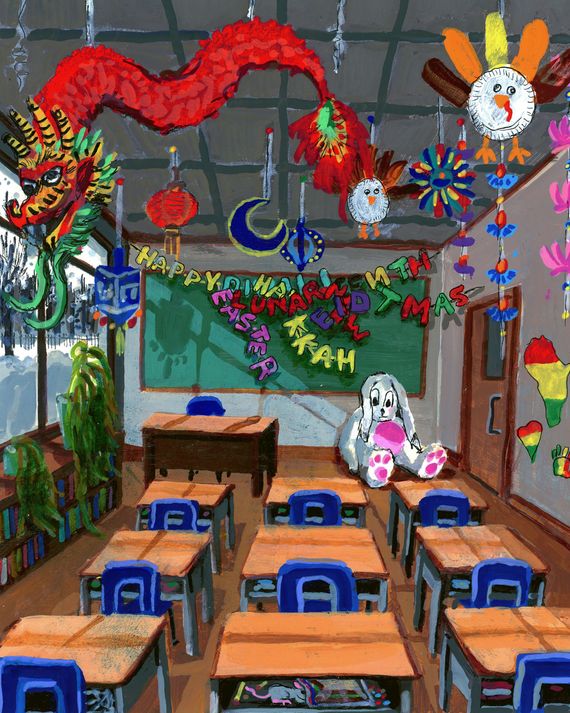
The seeds for today’s holiday-heavy school calendar were sown by the city’s fast-growing Muslim and AAPI communities, which argued that a Judeo-Christian calendar isn’t reflective of a place where nearly one in five students identify as Asian American and an estimated 1 million New Yorkers practice Islam. Community groups and religious leaders rallied to add the days to the calendar so that children who observe Eid, Diwali, and Lunar New Year could do so without missing important assignments — the same privilege afforded to their Jewish and Christian classmates on long-established DOE holidays like Yom Kippur and Christmas. Mayoral candidates took up the cause. Back in the 2011–12 school year, students stayed home for ten holidays (not counting winter and spring breaks). Then-Mayor Michael Bloomberg had staunchly refused to add new holidays to the school calendar despite pressure from the City Council. But by 2015, Mayor Bill de Blasio announced that New York would become the nation’s “first major metropolis” to close its public schools on Eid al-Fitr and Eid al-Adha. Lunar New Year advocates pushed him to keep his campaign promise of adding their holiday too. But by then, the calendar was becoming a concern: Wiley Norvell, de Blasio’s deputy press secretary, said: “Whenever we add a holiday to the calendar, it takes months of analysis of not just what that day means, but how that day plays off all the other holidays” and “meeting the mandate is often a challenge.” More than 40 elected officials, advocacy groups, and community leaders responded with an open letter to de Blasio, and he promptly capitulated, adding Lunar New Year to the 2015–16 calendar despite his doubts. Then, in response to a sweeping national movement against racial injustice, in June 2020, de Blasio also announced that New York would recognize Juneteenth as an official city and school holiday. He warned that he would not consider any more days off, again pointing to an increasingly overloaded school calendar.
But the day after Eric Adams was elected in 2021, he tweeted out a fresh holiday promise: Diwali, the Hindu festival of lights, would soon be a day off from school. When his administration struggled to add it while meeting the instruction mandate, state lawmakers took up the charge at the behest of the South Asian and Indo-Caribbean community, and in 2024, Diwali was on the list of holidays for public-school students. “For too long, too many children across New York City have celebrated Diwali while being forced to choose between their faith and their future,” said then–assembly member Mamdani in 2023, when he helped push for the holiday as a co-chair of the Asian Pacific American Task Force.
Now, as mayor, Mamdani faces the same tricky task as his predecessors: trying to squeeze enough instruction into a holiday-filled timeframe that is also constrained by a collective-bargaining agreement with the United Federation of Teachers, the largest teachers union in the five boroughs. The current contract, which runs through 2027, specifies the calendar’s start date (the Tuesday after Labor Day, when teachers report for two professional-development days), end date (June 26, 27, or 28), and midwinter recess. The UFT also has input into spring-break dates and the calendar’s professional-development days, which are negotiated before the calendar is released. Mike Sill, the UFT Secretary, said the organization has conducted an analysis through 2035, and “the calendar can include 180 days of instruction without sacrificing anything that has traditionally been in the calendar or the holidays that are more newly recognized.” Still, it’s clearly a formula that leaves little room for the possibility of inclement weather. On the snowy in-person-learning day of February 24, the school attendance rate citywide was only 63 percent. The DOE sees remote learning as the solution to this conundrum, but as a parent tasked with continually redirecting a 5-year-old during chaotic Zoom school sessions in the pandemic, I can assure you the term is mostly an oxymoron.
Teachers often remind parents that “school is not day care” when they complain about a calendar full of breaks in a country where the majority of private-industry workers receive less than two weeks of paid vacation after one year on the job. “Our country is clearly not set up to support working families, but the issue is not with the DOE calendar; it’s with our inability to take off work when needed to support and spend time with our families,” Rachel Kessous, a public-high-school teacher in Brooklyn, told me. While her words may be true, employers seem unwilling to extend grace to working parents, whom they have increasingly ordered back to the office in recent years, eliminating a perk that made pandemic-era school closures somewhat more manageable. Forty-one percent of private U.S. companies with 500 or more employees have declared Juneteenth a paid holiday, but far fewer observe Lunar New Year, Diwali, or the Eid holidays — and that’s unlikely to change as corporate America rapidly retreats from DEI initiatives.
Aside from the astronomical cost of camp and stress of missing work, several parents told me they were worried about their children missing out on the primary point of school: learning. “Decreasing instructional time, as has happened in many districts that have switched to a four-day school week, lowers student achievement,” said Brown University professor Dr. Matthew Kraft, who researches K–12 education policy. According to a 2024 study in the American Education Research Journal that Kraft co-authored, the average American student goes to school for 6.9 hours a day for 178.6 days, totaling 1,231 hours annually. If you take into account the city’s shorter-than-average school day of 6.3 hours and higher-than-average holiday count, New York City students will spend roughly 130 fewer hours in the classroom this year, on average, than their peers nationwide.
Parents of high-schoolers told me they worry this puts their children at a disadvantage for Advanced Placement exams since they’ve received less instruction than students in other states by test time in May. Parents of children with learning differences or social struggles vented that the inconsistent schedule can be especially tough. Jean, a public-school parent in Queens, said that lack of routine is a significant challenge for her ninth-grader, who has ADHD and dyslexia and tends to lose focus and fall behind during shorter weeks. “It’s a start, stop, start, stop that’s a real pain in the butt,” she said. As a Korean American who celebrates Lunar New Year, she appreciates the recognition but is firm in her stance. “I would rather my child be at school,” she said.
The DOE declined my request for an interview, but Isla Gething, associate press secretary, sent a statement: “We know how vital consistent instructional time is for student success and for families who rely on a dependable school schedule. That’s why we plan the school calendar thoughtfully and provide advance notice to the maximum extent possible.” As of late March, the DOE had not yet released the 2026–27 calendar.
In recent weeks, other progressive cities and towns have tried to tweak their calendars. A week before children in Montclair, New Jersey, were slated for a day at home for Lunar New Year, the Board of Education voted to convert it back to a regular school day and warned that Eid al-Fitr would also be nixed if the school system needed to close for weather again. “This was not an easy decision,” wrote superintendent of schools Ruth B. Turner in an email to parents. “It reflects the real constraints we are navigating around required instructional days, as well as the need to manage our operations responsibly in a time of serious budget pressures.” In Montgomery County, Maryland, school leaders attempted a similar change but reversed their decision after facing significant backlash.
Solutions are scarce in New York, where most of the holidays are written into law or based on longstanding contracts or practices. Even the upcoming Anniversary Day/Chancellor’s Conference Day on June 4 keeps popping back onto the calendar despite efforts to scrap it dating back to the early 1900s. When State Assemblywoman Jenifer Rajkumar introduced legislation to recognize Diwali, she proposed eliminating the holiday, calling it “an obscure and antiquated day.” Yet it remains.
“If the public schools truly are about serving the public like they claim, schools should be offering something on these holidays for parents who don’t have any child care and can’t leave their job,” said Alina Adams, an admissions consultant for both public and private K–12 schools in New York City. Her suggestion: The DOE should provide in-school programs similar to Summer Rising, the free full-day summer program that serves roughly 110,000 students in grades K–8 (and waitlists thousands more). Several parents I interviewed said that the solution, in their minds, is starting the school year in August, a practice adopted by many of the city’s charter schools (and most school districts in the United States). When asked, the DOE would neither confirm nor deny whether it was considering any of these solutions to its calendar challenges.
But Labor Day falls unusually late this year, on September 7, meaning kids won’t return to the classroom until September 10 if the DOE adheres to its current contract with the UFT. Working parents will have to pay for an additional week of summer camp — that is, if they can even find one open in September.
Related