

New York City is losing jobs, making life more difficult for Mayor Zohran Mamdani as he seeks to close a big budget deficit while emphasizing economic justice rather than growth.
The city lost 20,000 jobs in 2025 to end the year with employment of 4.823 million, according to revised job numbers released Thursday by the state labor agency. Economists for the city, as well as the state and city comptrollers, had expected an increase of about 40,000.
The biggest change came in health care jobs, which had been the one area of expansion, with the number of home health care workers revised down by 46,000.
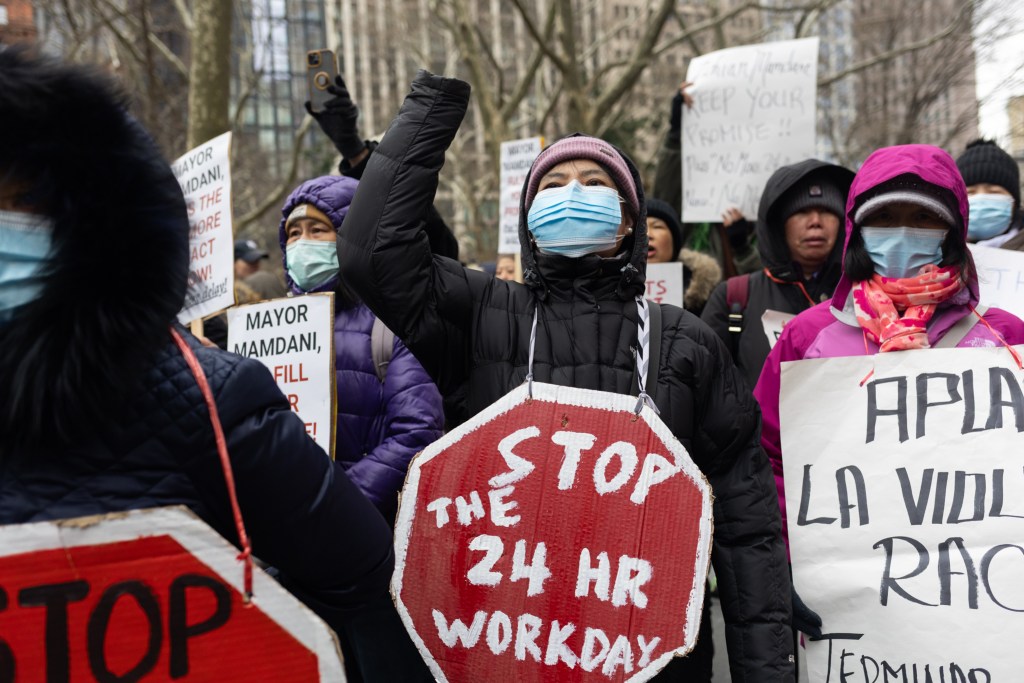 Home health aides rally before starting a sit-in outside City Hall to demand the passage of a bill ending 24-hour shifts, March 18, 2026. Credit: Ben Fractenberg/THE CITY
The bad news comes as the city grapples with a series of new economic problems:
Unemployment among college graduates in their 20s has been rising sharply in the last year.
The once thriving film and tv production industry is in a major contraction.
And Wall Street, whose soaring profits and bonuses have boosted tax collections, is being whipsawed by the war in Iran.
Some economists lay the blame on President Donald Trump.
“It is no surprise to see that Trump policy has been taking a toll on the economy, including in New York City. Tariffs, policy volatility and uncertainty, the dismembering of the social safety net, and the expansion of multiple deadly wars around the world are not good policy anywhere, including here,” said Emily Eisner, an economist and acting director of the Fiscal Policy Institute.
Monthly data on jobs comes from a survey of employers by the federal Bureau of Labor Statistics. Each year the state department of labor updates the numbers by using data on unemployment insurance taxes paid by employers, which is more accurate but not as timely. This year’s revision was delayed several weeks by the federal government shutdown. (The numbers in this story are based on a comparison of December 2025 to December 2024).
 The New York Stock Exchange, Sept. 21, 2020. Credit: Ben Fractenberg/THE CITY
The new numbers on home health care employment, almost entirely paid for by the state Medicaid program, may be the most significant development, as it accounted for as much as two-thirds of all new jobs in the last two years. The Hochul administration’s efforts to curtail its soaring cost appear to be working, which is good for the state budget — but bad for the city’s economy.
For the first time, the jobless rate among young college graduates between the ages of 22 and 27, which has risen to 6.5%, is almost the same as for young New Yorkers between 22 and 27 without a degree, according to a report issued last month by the city comptroller.
The reversal is dramatic. In late 2020, amid the pandemic, just over 25% of young New Yorkers without a degree were jobless, while only 10% of those with a bachelor’s or advanced degree were looking for work.
Ads for entry level jobs have fallen by a third since 2019, according to a recent report from the Center for an Urban Future. Even internships are harder to come by, plunging 37%, it found.
In a so-called low-hire, low-fire economy, there are simply fewer opportunities for new entrants in the workforce, notes Janelle Jones, a senior economist at the progressive Groundwork Collaborative.
Whether companies are not hiring because they expect artificial intelligence to replace workers is harder to figure out, she adds, a view echoed by the comptroller’s report.
“New York City’s youth unemployment rate, especially for college graduates, is an alarming trend,” said City Comptroller Mark Levine. “Whether it is the high cost of living or the impact of AI, everyone in government should be focused on how we help young people entering the workforce.”
Film and TV productions struggle
 Steiner Studios has a sprawling lot at the Brooklyn Navy Yard, May 24, 2024. Credit: Alex Krales/THE CITY
At the same time, the city’s once thriving film and TV production business has contracted by about 20% dramatically despite an annual $800 million in state tax credits, amid consolidation and a sharp reduction in the number of shows and films being produced.
New York isn’t alone in suffering. The job decline in Los Angeles is 30% as the number of live scripted films and tv shows with budgets exceeding $40 million produced in the United States has declined from 251 in 2021 to 159 last year.
More bad news appears on the horizon for New York. It was reported last week that Deutsche Bank filed a foreclosure lawsuit against the Hackman Capital, owner of the iconic Kaufman Astoria Studios, for failure to pay back a loan in a clear sign of financial distress. Hackman also owns Silvercup Studios, another crucial soundstage in Long Island City.
Despite the restructuring of the industry, the Adams administration’s Economic Development Corp. continued to support the expansion of studio space, with another stage on Pier 94 opening in January.
Wall Street slumps
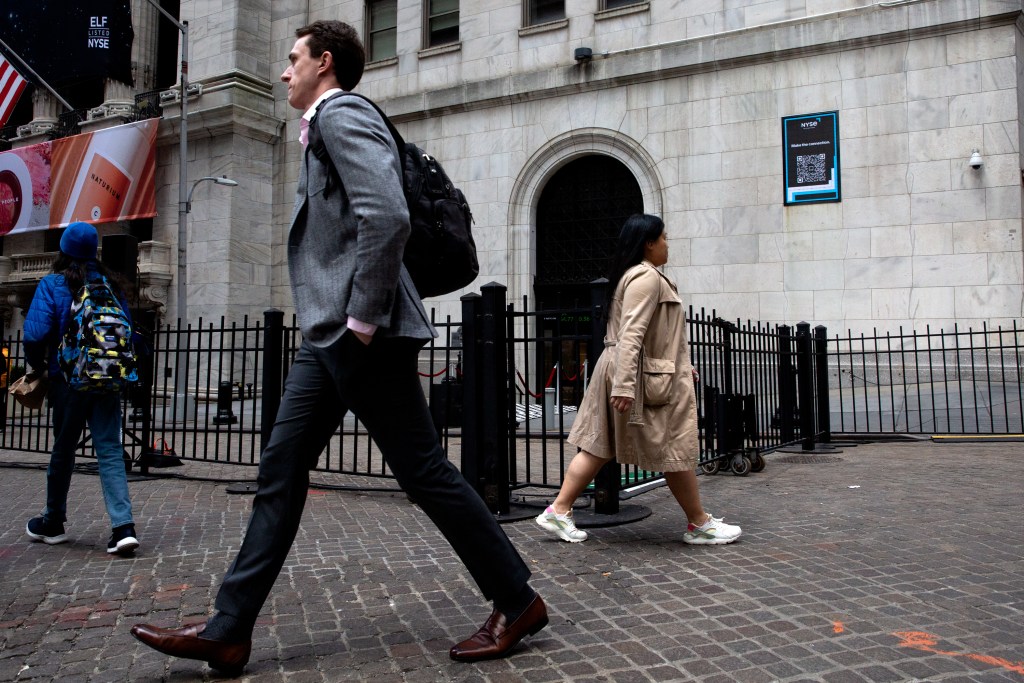 Workers and tourists walk past the New York Stock Exchange on Wall Street, March 18, 2024. Credit: Ben Fractenberg/THE CITY
What happens on Wall Street will be crucial for the city’s economy, and especially the budgets being adopted by the state and city this spring.
Record profits and bonuses last year bolstered income tax collections for both the state and city and the jobs revisions boosted employment to a record level. Both the governor and mayor are taking advantage of this by increasing their revenue expectations for the next budgets.
But the stock market is down 6% for the year, and if the war with Iran continues, it could endanger plans for the biggest initial public stock offerings in history this year from AI companies and SpaceX. IPOs generate huge profits for Wall Street firms.
Mamdani’s focus: Economic justice
Meanwhile, the Mamdani administration has yet to outline a plan for the economy. For the first time in anyone’s memory, the city does not have a deputy mayor for economic development. Instead, Julie Su is the deputy mayor for economic justice. It has yet to name a new head of the Economic Development Corp., historically the agency most responsible for finding ways to grow the economy.
The Mamdani administration did not reply to a request for comment.
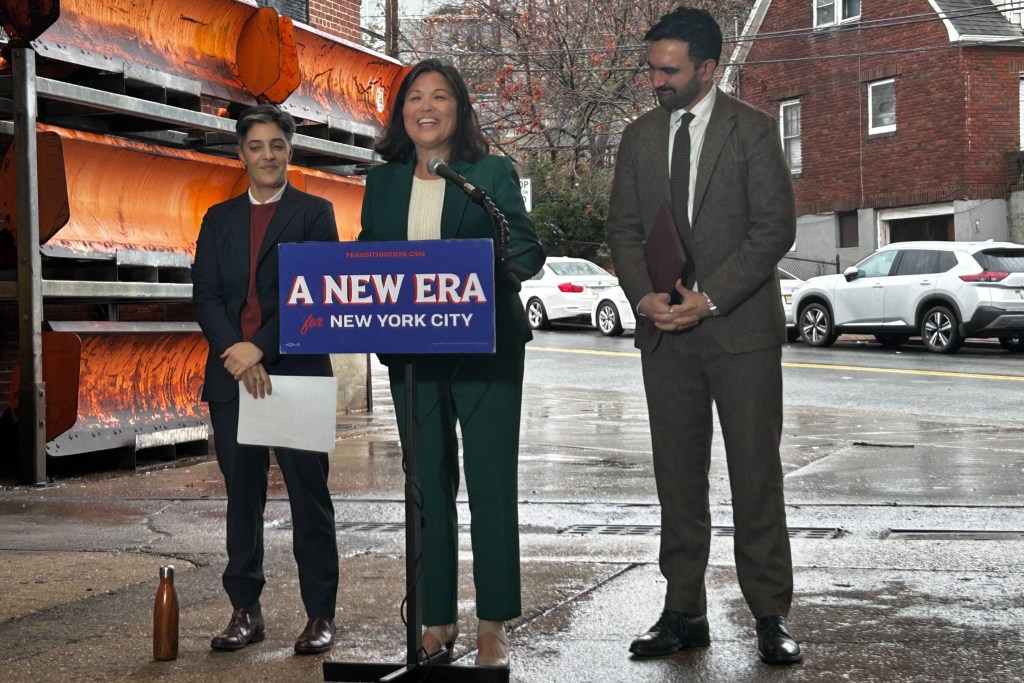 Julie Su speaks on Staten Island next to Mayor-elect Zohran Mamdani after her appointment as Deputy Mayor for Economic Justice, Dec. 19, 2025. Deputy Mayor for Housing and Planning Leila Bozorg is to her left. Credit: Katie Honan/THE CITY
The new jobs data will be front and center as Albany and City Hall adopt their next budgets and decide between offsetting federal aid cuts and increasing taxes, with the governor opposed to tax increases and the mayor pushing an increase on the wealthy and large corporations.
Progressives say it is imperative to find ways to offset the impact of federal aid cuts. This week, 450,000 New Yorkers were notified they would lose their health coverage in July because of changes to one of the state’s most important health care options.
“Now we have clearer evidence that the Trump administration’s actions have had a destructive and negative impact on people’s ability to find work and earn a living to support their families in the U.S. and New York City is not immune from this,” said Lauren Melodia, who tracks the city’s economy at the New School’s Center for New York City Affairs.
“This is primarily a problem that requires federal action, and New York policymakers, firms and workers are in a particular bind as the decline in jobs in the city leads to greater poverty and need for a social safety net that the federal government is also actually shredding.”
But those opposed to tax increases say the new data is not a reason not to change course.
“The loss of jobs reinforces what we’ve been saying: that the economy is fragile and the risks are mounting in a serious way, from AI disruption to tariffs and now growing tax uncertainty out of City Hall and Albany,” said Steven Fulop, CEO of the big business group, the Partnership for New York City.
“The city and state can’t control AI or tariffs, but they can control taxes and raising any taxes now would likely cost more jobs and only deepen the affordability crisis,” he said.
Related