
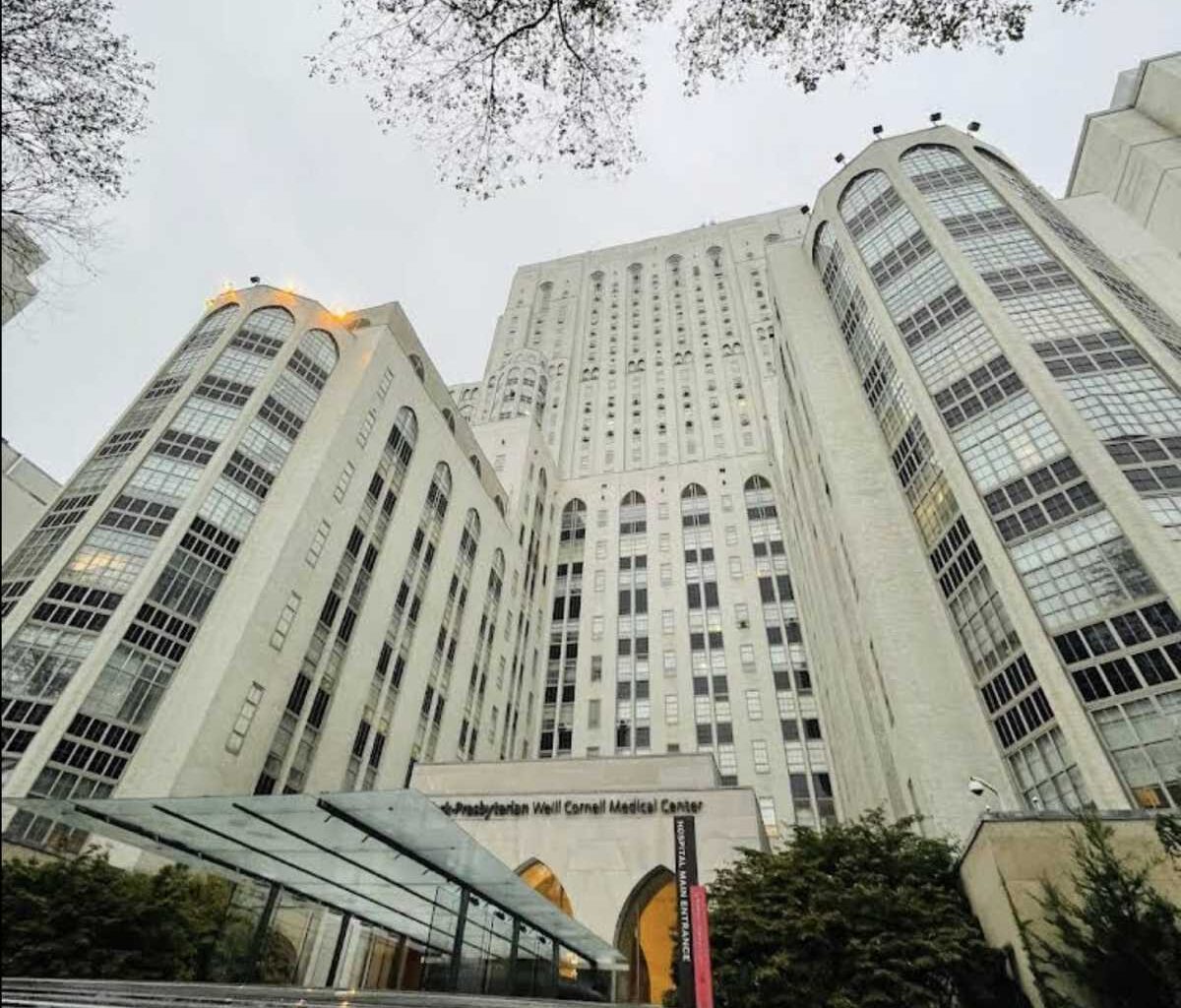
NewYork-Presbyterian Hospital’s Weill Cornell Medical Center on the Upper East Side in Manhattan.
Photo via Google Maps
The city is feuding with the NewYork-Presbyterian Hospital system over a health care contract that labor unions estimate could affect about 40,000 city workers, retirees and their families.
If the two sides do not reach an agreement by April 10, those patients could lose in-network access to the hospital system, which has hundreds of locations throughout New York City and the surrounding area. Should an agreement not be reached, thousands of city employees may have to pay more for care or switch doctors and hospitals.
United Federation of Teachers (UFT) President Michael Mulgrew said in a statement Thursday that the hospital was negotiating in bad faith and putting profits before people.
“NewYork-Presbyterian is trying to boost profits with no regard for how its price gouging hurts working families,” said Mulgrew, who leads the union representing the city’s public school teachers. “Our standard has always been high-quality, premium-free health care for city employees and retirees. Other hospitals have worked with New York City to safeguard this benefit. NewYork-Presbyterian needs to do the same.”
Contract negotiations between the hospital system and EmblemHealth, which provides insurance to a large number of city workers, have dragged on, spurring the two sides to agree to an extension of their current contract’s expiration date from April 7 to April 10.
NewYork-Presbyterian spokesperson Angela Karafalzi told amNewYork in a statement that the hospital system will continue to provide care to the city’s workers and that it is working with providers to hammer out a new contract.
“NewYork-Presbyterian is currently in-network with EmblemHealth and in negotiations to reach an agreement,” Karafalzi said. “We believe that New York City employees covered by EmblemHealth deserve access to the hospitals of their choice.”
The union leaders’ claims of the hospital’s power plays, however, are bolstered by a Department of Justice lawsuit against NYP filed last week, which accused the system of anticompetitive practices that unlawfully limit care and force providers to pay more.
The lawsuit claims the hospital system used its size and influence to limit competition with some contracts imposing restrictions on offering more budget-friendly plans that could mean more patients choose competing hospitals and other providers instead of NYP.
This practice, according to the DOJ’s complaint, resulted in NYP maintaining an unfair monopoly and charging more for standard services than its competitors.
“NYP effectively forces payors to include NYP in almost all networks for commercial insurance products and requires that NYP be featured at the most favored level of benefits in each plan, regardless of how NYP’s prices compare to its competitors,” the DOJ said in its complaint against the hospital system.
In some plans that were threatened by the dispute, New York City’s price transparency tools showed that common procedures such as colonoscopies at NYP locations could cost around three times as much as at other hospitals. The tool estimated that the procedure could cost in-network plans over $12,000 at Weill Cornell Medical Center, while showing that nearby Lenox Hill Hospital charged about $4,500 for the same service.
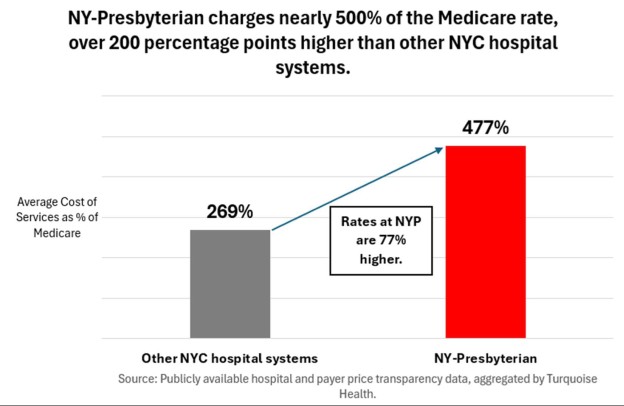 UFT complained that New York-Presbyterian charged sky-high prices compared to other NYC hospitals for the same services, citing data from Turquoise Heath, a third-party healthcare price transparency company.
The UFT is not the first labor organization to speak out against the hospital system. In 2024, 32BJ SEIU, the major NYC union that represents property service workers like doormen, window cleaners, and building maintenance workers, launched a campaign against NYP, complaining about sky-high prices.
The union slammed the hospital system for taking millions in tax breaks, charging exorbitant rates and “falling short of its commitments to our communities,” according to the campaign.
With the deadline approaching, the outcome of the negotiations will determine healthcare options for thousands of city employees. But it’s unclear how the DOJ lawsuit’s outcome may impacts NYP contracts and pricing going forward.