
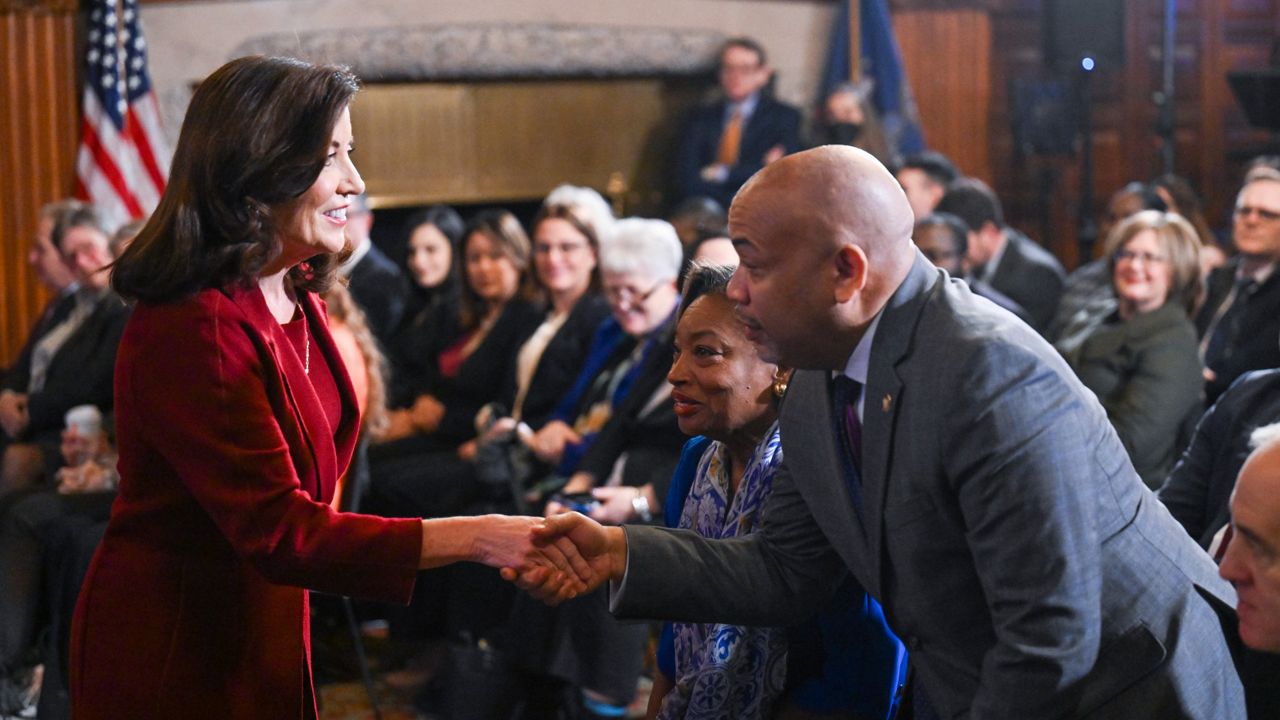
New York’s state budget is late. It’s the fifth year in a row, and Gov. Kathy Hochul and state legislative leaders in the Democrat-led Senate and Assembly are confident it will be wrapped up relatively soon.
It’s a pattern that one good-government watchdog group doesn’t want you to get too comfortable with, even if most people aren’t intimately familiar with the process or its implications.
State Senate Majority Leader Andrea Stewart-Cousins has a system for updating the press and others who are tuned into Planet Albany on where the sometimes agonizingly slow process of negotiating New York’s massive and chronically late budget with Hochul and Assembly Speaker Carl Heastie stands.
“As you probably have imagined, we’re still at ‘the beginning of the middle,’ as it turns out,” she said Tuesday before pausing as reporters murmured.
“Was there a…?” she said with a laugh, correctly guessing that casual bets had been taken over how close the process was to the “end of the end,” prior to her arrival. “Who won?” she asked, before someone answered, “I don’t think anybody won,” in a moment of levity amid an otherwise in-the-weeds run-through of where various policy discussions stand.
In describing negotiations, Heastie sometimes takes reporters on a journey from outer space when deadlocked, to eventually “the same street” when a sticky budget issue is nearly settled.
“I think we might be in the same galaxy, but I don’t know if we’re on the same planet yet,” he said of conversations around Hochul’s car insurance proposal Wednesday.
The governor’s system is to simply imply that reporters should not even bother asking for closed-door specifics. As budget negotiations get underway, most questions on where things stand receive the same answer: “I don’t negotiate in public.”
“Nice try,” she will sometimes add with a smile if someone makes a particularly valiant attempt to circumvent the typical response.
After five straight late budgets under Hochul, it can at times seem normal and routine, but some good-government watchdogs are sounding the alarm that it shouldn’t.
“Really bad things happen in Albany, often when we don’t know about them,” said John Kaehny, executive director of Reinvent Albany.
He stressed that as more of New York’s legislative session gets eaten up by policy-driven budget debates, it’s the public that ultimately suffers when state law is crafted or changed in a closed-door budget detour, rather than through the usual progression of passing both houses and ultimately being sent to the governor’s desk for her signature or veto.
The state budget also must be approved by the Legislature and signed by the governor — but the process meanders in a different way after Hochul makes her executive budget proposal in January, with new items sometimes becoming public either at the end of the process or through the press.
“We don’t have information about what’s going on because the budget process is more secretive and less leaky,” he said, adding that when individual bills are negotiated after passage, there are more open conversations between the bill’s sponsors, leadership and the governor’s office following the bill’s initial passage through both houses. “There are no sponsors with axes to grind or points to make, so that means that journalists and the public don’t know what’s going on as much during the budget process, and that’s not good for democracy.”
New York’s complicated budget process has grown unwieldy and increasingly skewed toward the governor, even if the state Constitution prescribes a co-equal legislative branch and executive.
“It’s on the governor’s home field, and she has a huge advantage,” he said.
Heastie said the finer points of a governor’s proposal can leave legislative leaders with few choices other than to dig in if members have significant concerns, as was the case with Hochul’s push to change discovery laws last year, and to a lesser extent, her push around car insurance this year.
“The hell is in the details,” he said. “Once you start diving into the details, you say, ‘Is this something we could really be OK with doing?’ ”
While late is not ideal, Kaehny encouraged the Legislature to stand up if they don’t feel one of Hochul’s proposals should move forward.
“It’s really up to the Legislature to say no,” he said. “You can’t abuse the budget process and make it what is essentially the big game versus the regular legislative session.
After sky-high tensions between Hochul and the Legislature when last year’s budget ran into overtime, both Assembly Speaker Carl Heastie and Senate Majority Leader Andrea Stewart-Cousins were asked this week if they saw a problem with yet another late budget, especially given high hopes for an on-time spending plan in an election year with what appeared to be relatively few significant sticking points.
“I’ve been here 26 years, nothing fazes me in this place,” Heastie said. The speaker had initially predicted an on-time budget but explained that digging into the weeds of Hochul’s plans revealed more differences than expected.
“This is how she negotiates budgets, and I’m going to be right there negotiating on behalf of New Yorkers,” Stewart-Cousins said when asked if there would reach a point where legislative leaders lost their patience with that strategy.
Hochul was asked how she felt about concerns from good-government groups like Kaehny’s that so much policy discussion — which clearly involves enough back-and-forth to push the budget past the deadline five years in a row — is being left to the proverbial three people in a room.
“My proposals have been out there in public since January, plenty of time for public discussion. They can have hearings, they can have any conversations about it. I believe in transparency, I prefer on-time budgets,” she said. “I need a Legislature that also wants to meet those deadlines. We’re not there this year, but I hope to wrap it up before too long.”
Hochul has spent the past week holding campaign-style events centered around the budget, imploring New Yorkers to get in touch with their legislators to telegraph that her proposals are best avenue to address the issue of affordability in the budget.
Thursday in Broome County, she told an audience of how her plan to change the state’s environmental quality review would open up opportunities to build more housing and make it easier for young people to buy their first home.
“Developers are saying, ‘It’s just not worth it to build in New York. I’ll go over to Pennsylvania and do it.’ And that’s why we’re suffering today,” she said. “And you have leaders — you’ve heard from our mayors and our county executive, they’re with me on this, but they can’t do anything until we change this law in Albany.”
“Are you with me to change that law?” she asked to cheers. “Let’s get that done.”
But it isn’t necessarily Hochul’s initial slate of plans laid out in her executive budget proposal that is the problem, Kaehny points out. It’s the weeks of backdoor discussion chipping away at the differences between Hochul’s plan and what legislative leaders want.
“Information is the coin of the realm in Albany, so when you’re in the information loop you’re in power, and when you’re not, you’re out of power,” he said.
Another exception to Hochul’s rule is the debate over the state’s climate law, where Hochul’s intentions were only made public skeletally in the form of an op-ed last month.
Blair Horner, senior policy adviser for good-government group NYPIRG, pointed out on social media that the op-ed came after the 30-day amendments, which, like the initial executive budget, come with concrete language that can be accessed by the relatively few who care to do so.
“Still not publicly available, issue not in executive budget, issue not in budget amendments, issue not raised after public hearings, terrible process,” he wrote.