
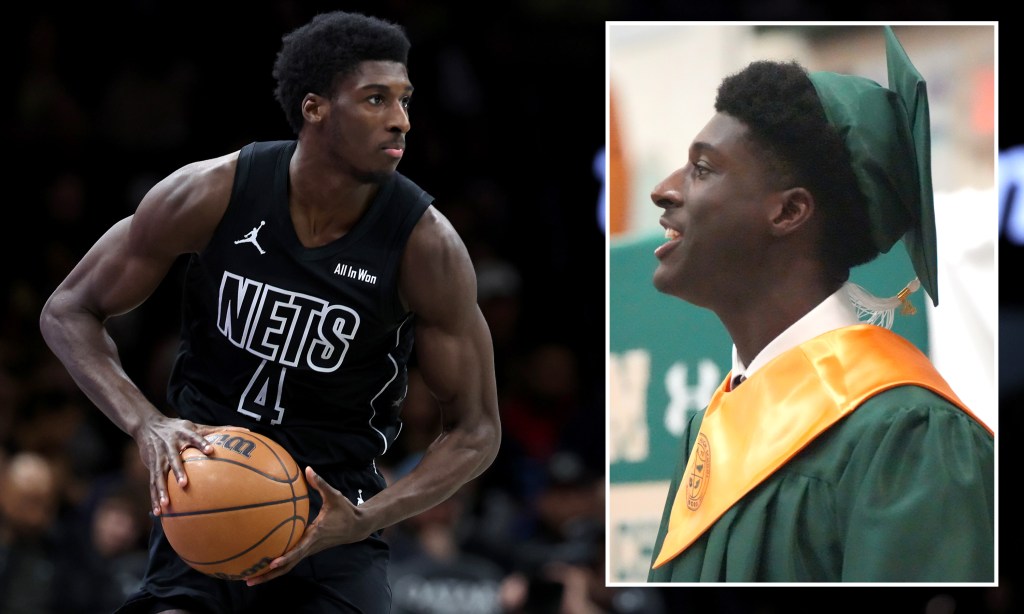
It was after a home playoff game at Northwood in 2023, one of those Friday nights inside Lewis Norwood Gym when the building felt smaller than it actually was.
All 1,700 seats were packed. Forest green and Vegas gold lined the walls. The Nut House had done what the best student sections do, turning the place into a homecourt advantage long before tipoff. By the time the final horn sounded, the crowd spilled out into Pittsboro, N.C., toward spots like the Soda Shop and Mi Cancun, and the gym looked like a gym always does after a big win. Wrappers. Cups. Footprints through spilled drinks. The leftovers of a full house and a conference championship.
Most kids would’ve been thinking about the stat line. Or the highlights. Or the next thing.
Drake Powell was thinking about the trash.
Saturday morning, after the Chargers beat Person High to advance to the state playoffs, Northwood coach Matt Brown unlocked the doors for an early practice. Powell was already there, getting shots up. Then he rolled over a trash can and started picking up the remnants left behind from the night before.
Not in a performative way. Not in a “look at me” way. The five-star junior just didn’t think it was fair to leave the mess for someone else. No one asked him to. No one told him to. And it wasn’t a one-time thing. Brown said Powell did it multiple times during his high school career, like it was just another rep.
“That’s just how I was raised,” Powell said. “I feel like Northwood, the basketball gym felt like my home since I’m there so much, before, during and after school… I just wanted to help out. That was really it.”
For the people who know Powell best, the story says almost everything. Not just about the kind of kid he was at Northwood, but about the habits that followed him to North Carolina and now to Brooklyn, where the Nets are betting on a young wing whose value has never started with volume or flash.
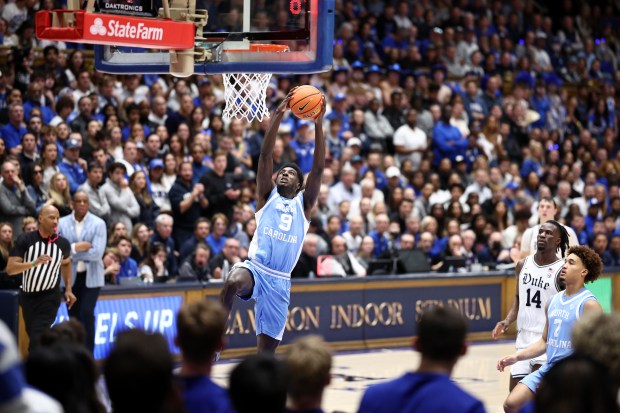
Jared C. Tilton/Getty Images
Drake Powell of the North Carolina Tar Heels prepares to dunk against Duke on February 1, 2025 in Durham, North Carolina. (Photo by Jared C. Tilton/Getty Images)
The Nets selected Powell, now 20, with the No. 22 pick in the 2025 NBA Draft after a one-year run at UNC in which he averaged 7.4 points, 3.4 rebounds and 1.1 assists across 37 games, including 24 starts, and earned the Tar Heels’ Defensive Player of the Year award. His appeal has long started with choices, discipline and the kind of ownership that tends to show up long before the box score catches up.
His mother, Cherice Powell, put it this way.
“He thrives off other people’s success. If other people succeed, then he feels successful.”
For Powell, the work has always lived in the details, the extra routine after practice, the habit nobody sees, the instinct to do something because it needs doing, not because it will be noticed.
That mindset followed him to North Carolina, where changing roles tested his patience without changing his approach. Now it’s followed him into Brooklyn, where the Nets see a player who can guard, run, compete and grow into more.
“When you join a new team, things might not always go your way,” Powell said. “But you still have to find ways to impact winning. Believe in yourself and work on your game.”
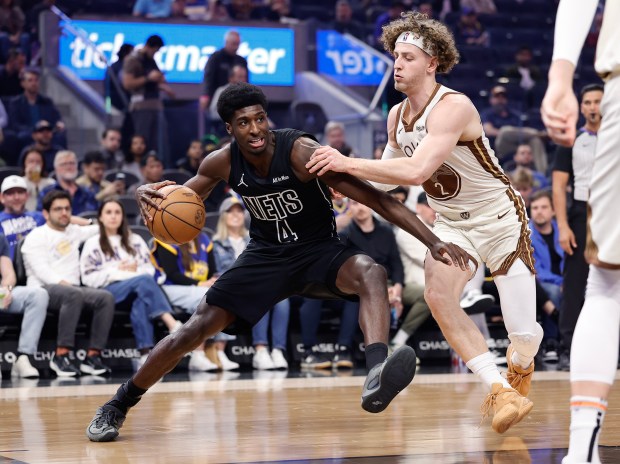
Kelley L Cox/Getty Images
Drake Powell of the Nets on March 25. (Photo by Kelley L Cox/Getty Images)
The Nets didn’t draft Powell for defense alone. They drafted him because players wired this way fit what rebuilding teams need. Coachable. Detail-oriented. Comfortable doing work that doesn’t always show up in the glamorous parts of the game.
Powell knows that’s the path in front of him now.
“They told me the way I can get minutes is through my defense,” he said. “But they see me as a two-way player.”
It’s easy to turn Powell into a type. Defensive stopper. Quiet kid. High-character prospect. All of that is true, but it can also undersell the competitiveness that people around him swear is in there.
Will Price, one of Powell’s AAU coaches, remembers a tournament in Memphis over Memorial Day weekend. Beale Street was right there, bright and loud and built to pull teenagers off course.
A lot of kids were out. Powell wasn’t.
“Drake’s locked in his room, focused on the next day,” Price said. “We didn’t have a good game before that.”
It sounds like a small thing until you’ve been around enough young players to know it isn’t. Price said it showed up over and over. Different cities, different tournaments, same choice. Powell didn’t need the noise. He didn’t need the validation. He kept choosing the next step.
And he kept choosing the hard assignment too.
“I remember AJ Dybantsa told me at Peach Jam, I’ve even got a picture of them two together, he said Drake Powell’s the only one who held him under 15 points,” Price said. “Obviously you know how good AJ is, so that’s a compliment to Drake. That’s what he brings to the table, what he’s all about.”
People around him describe an edge that has always been there, even if it doesn’t advertise itself.
“People really don’t even know he has a ferocious side,” Price said. “One of the biggest dogs.”
Brown saw that side early.
Powell was still a freshman, long and skinny, still growing into his body, when an opposing student section tried to turn him into a joke during a playoff game.
“String bean,” they yelled.
Brown remembers what happened next because it told him something.
“He turned around, gave them a little sign, and he went off for 10 straight points and helped us get to the Final Four that year,” Brown said. “And when he took over and when he quieted the crowd, everyone else followed and we came up with a big victory.”
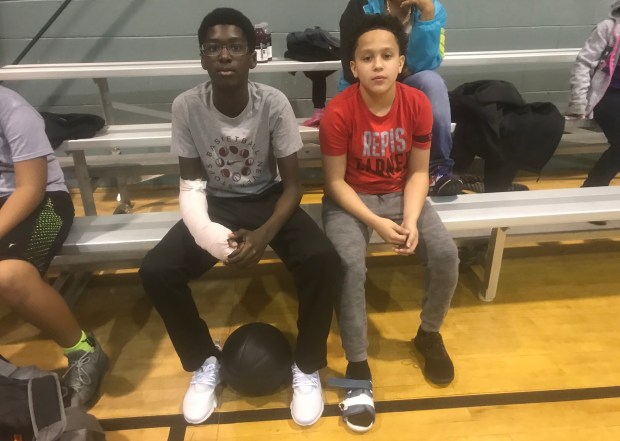
Courtesy of Hanif Omar
Drake Powell in 2018 with Chance Mallory, future Virginia Cavaliers point guard. (Courtesy of Hanif Omar)
He isn’t loud for the sake of being loud or performative for the sake of being seen. But when the moment calls for force, he has another gear.
Hanif Omar, another AAU coach, saw the same makeup in a different setting. Powell once showed up to practice with his right arm in a cast and a sling. That alone told Omar something.
Most kids would’ve disappeared for a while. Powell didn’t.
“He still showed up to practice every day with a cast and a sling on his right side,” Omar said. “So, at that point I was like, Drake is tough. He’s focused. He’s serious.”
Then came the part Omar still remembers most.
“Whatever skill work we did, Drake did it left-handed,” Omar said.
The deeper you go, the clearer the pattern gets. Powell isn’t wired for shortcuts. He’s wired to keep a day from being wasted.
Brown saw it in the smallest routines at Northwood.
“He had a ball handling routine he would do before practice, and he would start on one end of the sideline,” Brown said. “He would do it and if he had messed up or if it wasn’t perfect, he would go back to the very start and redo it rather than a lot of kids would just go through the motions. He would pick up the ball, he would redo it, redo the whole sequence over and over and over again until it was perfect.”
The mistake wasn’t the point. The restart was.
Brown said Powell studied the game the same way. Once Northwood got Synergy (a data scouting service) during his senior year, Powell was constantly on it, studying Jrue Holiday clips, studying Anthony Edwards clips, looking for anything he could pull into his own game.
“He was constantly doing those things,” Brown said.
Brown said Powell could be nitpicky. Not moody. Not impossible. Just exacting. He could play well and still be bothered by the part that wasn’t clean. That’s not always fun in the moment, but it’s a trait that tends to travel well if you’re trying to survive at the highest level in a role built on trust.
The same standards showed up away from the court.
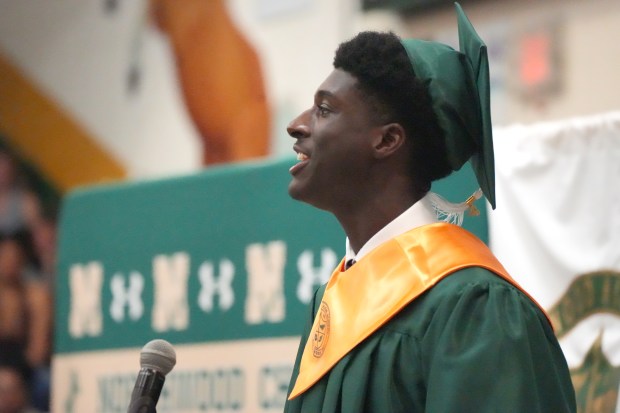
Powell was valedictorian at Northwood. His mom said he practiced his graduation speech for months because he wanted the delivery right, not just the words.
“He practiced it over and over again because he wanted to give the speech without looking at his notes,” she said. “He wanted to memorize it, have the right tone, the right inflection, and he practiced it over and over.”
It was the same instinct in a different setting, the same standards, the same refusal to coast. The family stories round him out even more.
Gene Galin
Drake Powell delivers his valedictorian speech at Northwood High School in Pittsboro, North Carolina in 2024. (Gene Galin)
Brown said teammates used to joke that Jersey Mike’s should’ve been one of Powell’s sponsors because there was one right across the street from school and “no matter what, it was always Jersey” before games. Brown also remembered Powell going to the Raleigh Art Museum before games, a detail that cuts against the typical image of a teenage basketball star.
Powell’s mom calls him quirky, and she means it lovingly.
“He’s really into the arts now,” she said. “He’s not like an artist or anything, but he enjoys going to museums and looking at art. He enjoys going to plays. Don’t get me wrong, he likes sporting events too, but he’s well-rounded in that he appreciates artsy stuff.”
His sister, Cera, sees the same thing in his routines.
“He likes things a certain way,” she said. “He follows literally a pattern to a T and you’re like, ‘Drake, you don’t have to go to Jersey every day before your game, you’re still going to play well.’ He’s like, ‘oh, I got to go.’”
All of it fills in the picture. The work ethic is there, but so are the routines, the quirks, the quietness, the edge. He doesn’t read like a type nearly as much once those pieces are in the room together.
Michael Reaves/Getty Images
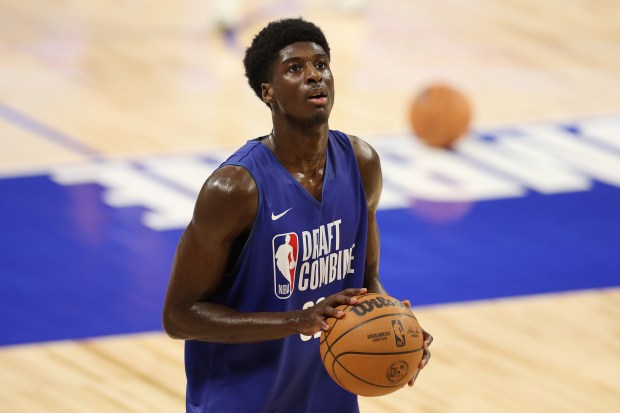
Drake Powell takes part in a shooting drill during the 2025 NBA Draft Combine at Wintrust Arena in Chicago on May 13, 2025. (Photo by Michael Reaves/Getty Images)
If Powell’s story has lacked some grand formative struggle, the NBA may be supplying one now. His rookie season has been full of the kind of basketball adversity that doesn’t flatter anyone — losses, uneven production, shifting roles, trips to the G League and the pressure of trying to grow on a team still figuring out what it is. For a player whose story has mostly been told through discipline and steadiness, this may be the first time those qualities have been tested this publicly and this often.
Powell believes he’s met that challenge the right way.
“I think I’ve handled it well,” Powell said. “Just constant talks with my circle, my coaches and then my vets in the locker room. They’ve been great… feel like I’ve handled it alright.”
And that may be the clearest sign yet of what Brooklyn believed it was drafting. The Nets had to know a season like this could turn harsh. They still chose a player whose value wasn’t just in his tools, but in the steadiness underneath them. A rookie equipped, in makeup and mentality, to keep developing even when the environment around him offered little comfort.
Which is why the trash story keeps coming back.
Brown almost kept it to himself. Powell never treated it like some defining act. To him it was simple. The gym felt like home. Someone had to do it. So he did.
That simplicity carries farther than the act itself.
Even now, with Brooklyn across his chest and the NBA asking much bigger questions of him, Powell is still answering with the same habits. Do the work. Take the hard assignment. Stay ready. Keep improving. Don’t waste the day. Don’t leave the mess for somebody else.
That was true when he was a five-star junior cleaning up Northwood’s bleachers after a playoff win. It was true when he showed up hurt and kept working left-handed. It was true when he studied film, restarted drills, practiced speeches and took the matchup nobody else wanted.
And the people who’ve been around him the longest still don’t sound like they’re guessing about what comes next.
“They’re going to feel him soon,” Price said. “They’re going to feel him. He’s coming.”