
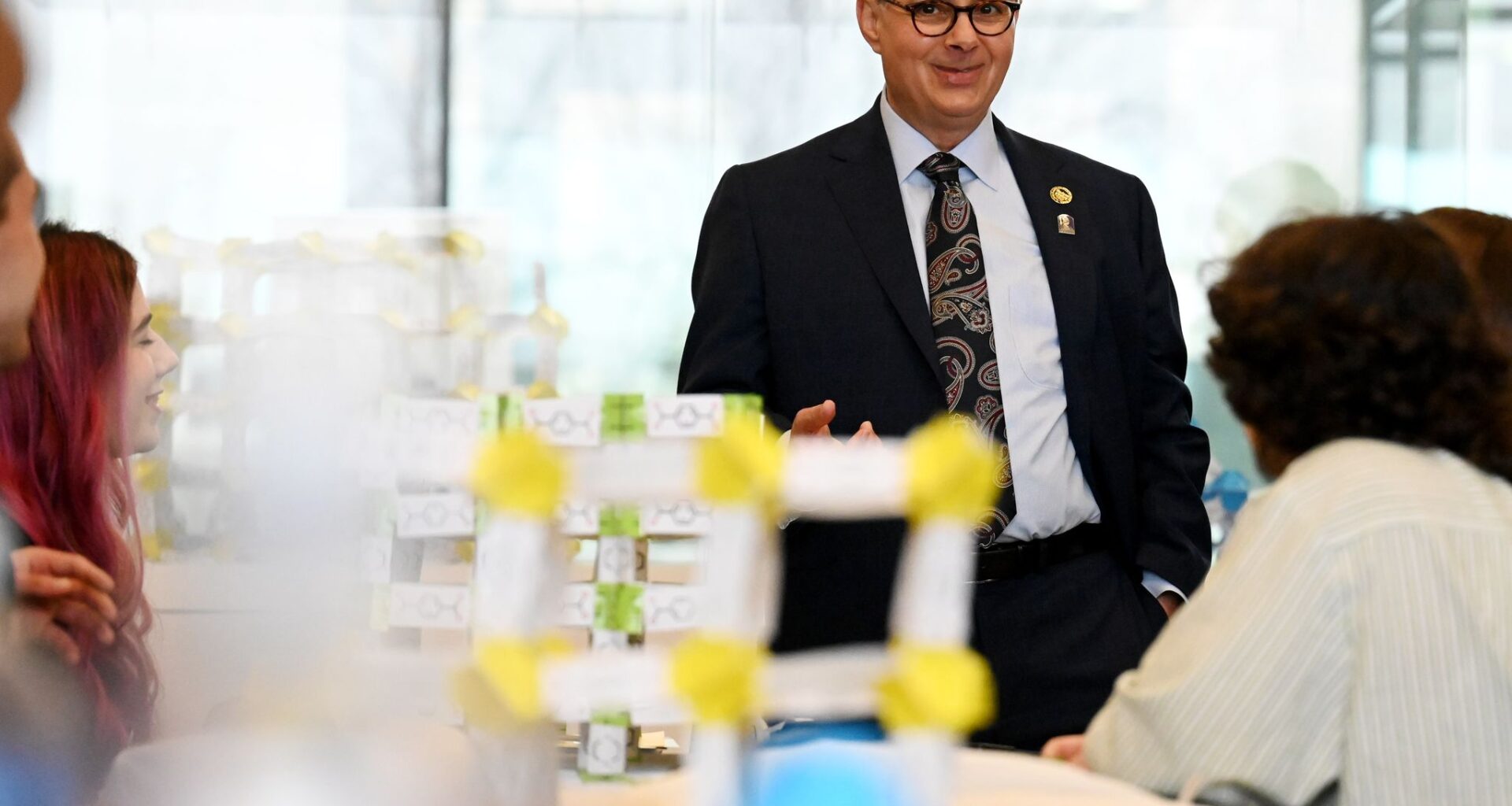
Nobel Prize in chemistry winner Omar Yaghi speaks to students at Hudson Valley Community College, where he once studied, on Thursday at HVCC Science Center in Troy. Yaghi said public education is one of the great things about the United States. “Hudson Valley didn’t care where I came from,” he said.
Will Waldron/Times Union
A poster of Nobel Prize in chemistry winner Omar Yaghi is displayed in the Science Center at Hudson Valley Community College, where he once studied, on Thursday in Troy. The esteemed prize winner also graduated from the University at Albany.
Will Waldron/Times Union
Nobel Prize in chemistry winner Omar Yaghi takes a photo of a 3D model of one of his metal organic frameworks, which was crafted by students at Hudson Valley Community College, where he once studied, on Thursday at the HVCC Science Center in Troy.
Will Waldron/Times Union
Nobel Prize in chemistry winner Omar Yaghi, left, helps lift a 3D model of one of his metal organic frameworks, which was crafted by students at Hudson Valley Community College, where he once studied, on Thursday at the HVCC Science Center in Troy.
Will Waldron/Times Union
A 3D model crafted by students at Hudson Valley Community College of one of the Nobel Prize in chemistry winners and HVCC graduate Omar Yaghi’s metal organic frameworks is displayed during a tour by the prize winner on Thursday at HVCC Science Center in Troy.
Will Waldron/Times Union
Nobel Prize for Chemistry 2025 winner Omar Yaghi is given a tour of the Science Center at Hudson Valley Community College, where he once studied, on Thursday at HVCC Science Center in Troy.
Will Waldron/Times Union
Nobel Prize for Chemistry 2025 winner Omar Yaghi speaks to students at Hudson Valley Community College, where he once studied, on Thursday at HVCC Science Center in Troy.
Will Waldron/Times Union
Nobel Prize for Chemistry 2025 winner Omar Yaghi is given a tour of the Science Center at Hudson Valley Community College, where he once studied, on Thursday at HVCC Science Center in Troy.
Will Waldron/Times Union
TROY — Hudson Valley Community College students welcomed home their new hero Thursday — a student who was just like them, who also just happened to win the Nobel Prize in chemistry.

Almost 200 students packed a theater to hear Omar Yaghi speak.
Article continues below this ad
Yaghi, 61, graduated from HVCC in 1983. He transferred to the University at Albany for his bachelor’s degree, then went on to other institutions to earn his master’s, doctorate, and now the Nobel Prize for his work to develop a way to stitch together molecules into a form large enough for molecular gas to move through it.
But for HVCC students, it was the beginning of that story that was the most astounding.
More: HVCC and UAlbany grad Omar Yaghi wins Nobel Prize in chemistry.
Make the Times Union a Preferred Source on Google to see more of our journalism when you search.
Add Preferred Source
Yaghi’s family members were refugees, living in a one-room house while tending to their cows in Jordan. But Yaghi’s father, seeing that his son was brilliant, insisted that the young man leave the country for college.
Article continues below this ad
Yaghi described to the fascinated students how he traveled to an American consulate office to apply for a visa. The officer was inclined to grant it, but was concerned about how Yaghi would afford life during college. So he asked Yaghi how much money the family had in savings.
Yaghi, who tracked that for the family, knew the exact number: $9,000.
The consulate officer told him that if he came back with a check, made out to Yaghi, for $9,000, he would give him the visa.
Yaghi told the students that if only he’d told the officer a smaller amount of money, he would not have cost his family their entire savings.
Article continues below this ad
Students nodded in understanding.
He described struggling in class, not understanding English well enough to follow the lectures, and being unable to complete a key chemistry experiment.
He said he wondered if he was smart enough for college. HVCC students groaned in empathy.
“You go through this feeling, ‘Maybe I am not good enough,’” he said. “Although I was passionate and in love with chemistry, I wondered whether I had the skill and intellect.”
Article continues below this ad
Asked what helped him keep going, he said, “If I failed, I would have to be shipped back to Jordan in disgrace.”
His audience hung on every word, some whispering to each other about how they, too, would face disgrace at home if they flunked out.
For an entire year in graduate school, Yaghi said, he tried to accomplish one simple task. He failed again and again. At one point, a student who had already earned his doctorate told Yaghi to throw out his experiment.
The next day, the experiment worked.
Article continues below this ad
“So these failures are increments of success,” he said. “So I would say, your passion is important to overcome these difficulties.”
Student Mya Audette, a biological sciences major at HVCC, said Yaghi’s story is not just inspiring.
“It’s proof” that her HVCC education is worth it, she said. “Seeing someone like Dr. Yaghi, who started just like us, reach such incredible heights, shows me that anything is possible.”
Yaghi told the students that his love for chemistry began when, at age 10, he essentially broke into his school library. It was supposed to be closed for school break, but he tried the door and it opened. Inside, he read a book that included drawings of molecules.
Article continues below this ad
“It’s almost like meeting the love of your life,” he said.
When he got a visa at age 15 and came to Troy, HVCC agreed to enroll him without a high school diploma. He took classes and passed them, so he was admitted.
But the truth of the matter was that he did not learn anything in those classes, he told the students.
“My English was so bad and Americans speak so fast,” he said. “Thank God for the textbooks.”
Article continues below this ad
To learn English, he watched soap operas — they speak slowly on those — and read the newspaper, looking up unfamiliar words, he said.
“I was not a spectacular student,” he said. “I was just OK.”
That’s the beauty of a public school, he said: they admitted him anyway.
“Hudson Valley didn’t care where I came from,” he said.
Article continues below this ad
Later, in an interview, he said public education is one of the great things about the United States. Every school he has attended or worked at as a researcher has been a public school. He’s now at the University of California, Berkeley.
“Public schools allow you to come across and interact with people from all walks of life, from the most diverse backgrounds: economic background, ethnic, cultural, geographic, all these things are part of your education,” he said.
Students shouldn’t worry that they need to go to a high-ranking private school, he added.
Article continues below this ad
“What is indispensable and what helps most is your work, the quality of your work, what you’ve done,” he said. “Public schools sort of take everybody in. And then the beautiful thing about the American system is … depending on their initiative and hard work, they can excel.”