
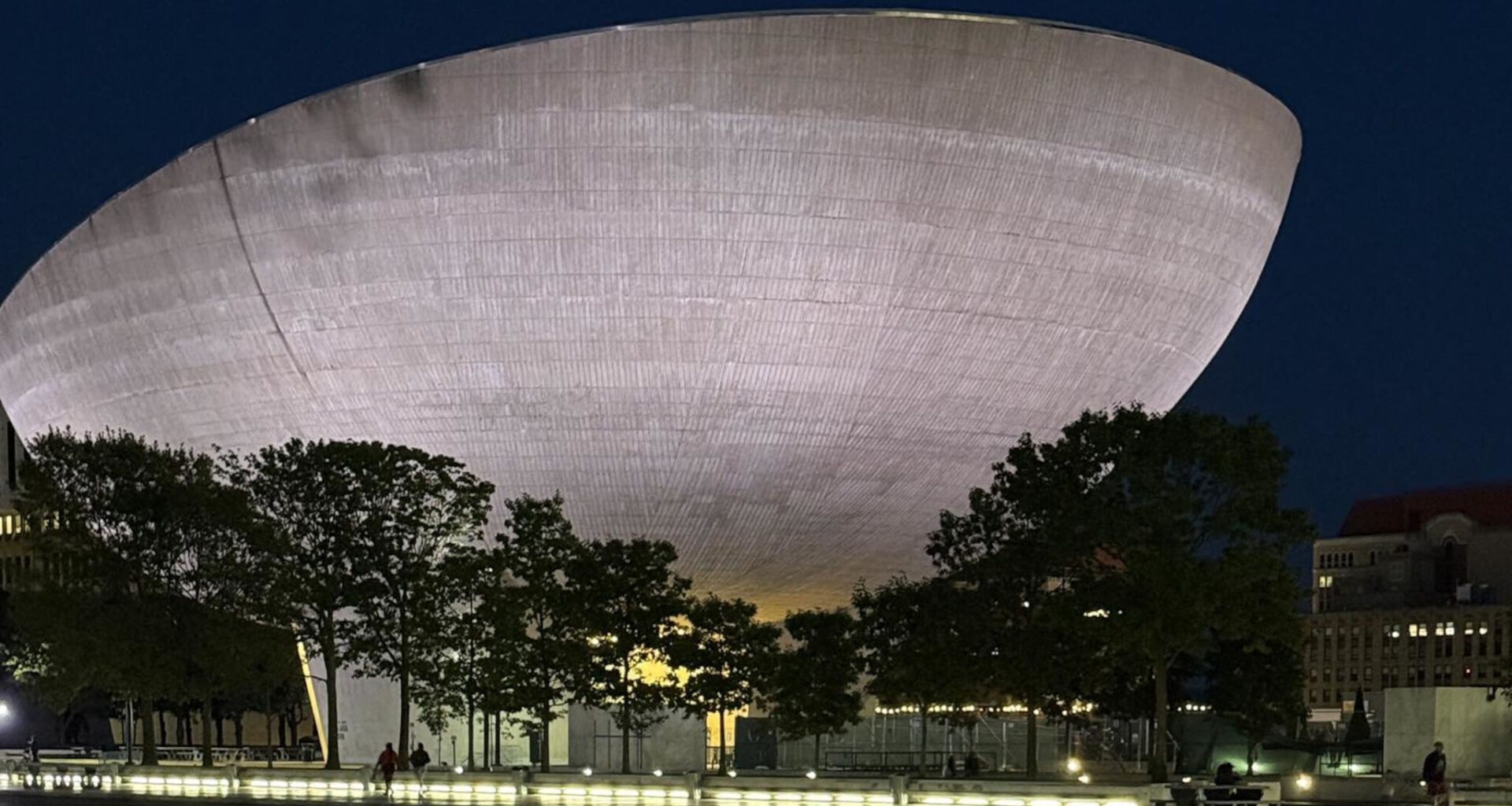
The Egg on the Empire State Plaza in Albany was extensively renovated last year. Arts organizations don’t yet know how much will be available for their capital projects from the New York State Council on the Arts under the new state budget, which has yet to be finalized.
Steve Barnes/Times Union
A graph from the “Capital Region’s Creative Spark” report shows job growth in the arts and culture sector grew at a rate almost 14 times higher than overall regional employment from 2014 to 2024.
Provided by Center for an Urban Future
Elizabeth Reiss, president and CEO of The Arts Center of the Capital Region in Troy, says the amount of funding her organization will have available to regrant to artists and entities will be less than a quarter of what it was two years ago because of budget cuts at the New York State Council on the Arts.
Lori Van Buren/Times Union
For Assemblyman John McDonald of Cohoes, historic venues like the Cohoes Music Hall bring economic value and improved quality of life to the cities they call home.
Tyler A. McNeil/Times Union
A graph from the “Capital Region’s Creative Spark” report shows that National Endowment for the Arts grants to the Capital Region fell from 20 to 3 in only two years. In contrast, the New York State Council on the Arts says that during 2025 and so far this year, it has given $16.8 million to artists and arts organizations of all sizes.
Provided by Center for an Urban Future
ALBANY — A new report that outlines strong growth in the local arts economy but recommends more reliable government funding has been released as state budget negotiations continue between the governor and a Legislature seeking about 50% more than the governor’s proposal for the state arts council.

Gov. Kathy Hochul’s executive budget calls for a total of $111 million for the New York State Council on the Arts. The budget attributes the sharp drop from the $172 million in the enacted budget last year “primarily … to the discontinuation of one-time investments.” (Hochul originally proposed about $111 million for NYSCA last year as well.) Of the governor’s total, $62.7 million is earmarked for grants as aid to localities, $40 million to support capital projects and $8 million for agency operations. Due last week, the state budget is the subject of ongoing negotiations that are expected to continue when the Legislature returns Tuesday.
Article continues below this ad
The one-house budget from the state Senate proposes $103 million in NYSCA aid to localities and about the same amounts as the governor for capital grants and administrative expenses, totaling approximately $150 million; from the Assembly’s $185 million total, the figures are nearly $87 million for localities, $90 million for capital projects and $8 million for operations. The two houses’ bills average 50% more arts council funding than Hochul’s.
“Recurring revenue that you can rely on is so important,” said Elizabeth Reiss, president and CEO of the Arts Center of the Capital Region in Troy, which regrants money from NYSCA. As a result of declining NYSCA funding levels, the Arts Center’s latest grants will be less than a quarter of what they were just two years ago, Reiss said, falling from $484,000 in 2024 to $245,000 last year and an expected $112,000 this year. As a result, some past recipients will receive less money or none, and the programs the regrants help make possible will likely be downsized or canceled, she said. Further, Albany and Schenectady counties have their own arts and cultural grants that can partially offset losses from the state, with Albany County disbursing $1.2 million in two years and Schenectady County $120,000 last year, but Rensselaer County has no comparable program, Reiss said.
“For years and years there’s been talk of regionalism in the arts, about how the arts can really and truly prosper if regionalism was embraced, but here are the real-world disparities that we face,” Reiss said.
Make the Times Union a Preferred Source on Google to see more of our journalism when you search.
Add Preferred Source
Consistent funding for the arts that is adjusted for inflation and partially paid for by recurring revenue streams that could include billboard taxes and surcharges on overnight stays is among seven recommendations in “Capital Region’s Creative Spark,” published at the end of March by the Center for an Urban Future, a nonpartisan New York City think tank. It is among 10 reports put out by the organization, one for each of the state-designated economic development regions, that are follow-ups to a 2023 report arguing that the arts are an underappreciated driver of upstate New York’s economy.
Article continues below this ad
The new report says that between 2014 and 2024, the Capital Region’s population of resident artists increased by 43% while the general population rose by less than 3%. (“Artist” is broadly defined, encompassing visual and performing artists, craftspeople and window trimmers.) During the same period, the arts and cultural sector added approximately 1,000 jobs, or a 50% boost, but overall employment grew by 3.7% locally. Center for an Urban Future based its figures on analysis of data from Lightcast, a leading provider of information about the labor market. Included counties are Albany, Columbia, Greene, Rensselaer, Saratoga, Schenectady, Warren and Washington, with a combined population of 1.1 million.
However, the report goes on, people in the arts and cultural sector earn about half the income of those working in the private sector. Citing interviews by Creatives Rebuild New York, “Capital Region’s Creative Spark” says that 77% of Capital Region artists reported incomes of less than $35,000 annually, 70% said they could not cover a $400 cash emergency, and most have other jobs to supplement their arts income.
The report says, “Throughout the Capital Region, in cities and rural towns, artists have become a powerful catalyst for community building and economic growth, even while largely facing financial instability themselves.”
Among other recommendations are integrating the arts across the state’s economic development and policy agenda; launching a portable benefits system that allows arts workers to accrue and retain benefits as they move between gigs, employers and sectors; expanding a pilot program of artists-in-residence in state government to county and local levels; and requiring a percentage of the budget for all major state-funded economic development and infrastructure projects be allocated for public art.
Article continues below this ad
“If policymakers want vibrant downtowns and a strong local economy, investing in the arts is one of the smartest bets they can make,” said Eli Dvorkin, the editorial and policy director for the Center for an Urban Future and supervisor of the “Creative Spark” reports. In contrast to economic development that is often driven by incentives for specific companies to create some jobs, Dvorkin said, spending on the arts and artists at a local level unlocks economic vitality.
“It’s a bottom-up approach that invests in placemaking and strong local downtowns and ultimately gives residents powerful reasons to not only come out into their communities and spend money locally, but to stay in those communities,” he said.
Assemblyman John McDonald of Cohoes, whose district includes the historic Cohoes Music Hall, opened in 1874, and Troy Savings Bank Music Hall, built eight years later, said, “We understand not only the importance of the arts in general, but where they’re located — in a lot of our legacy communities. We understand how much of an economic driver they are.”
He said his elected colleagues’ belief in the value of the arts, for economic reasons and for the quality of life they help provide, is demonstrated by the Legislature’s significant increase in proposed arts funding compared to Hochul’s budget. However, he cautioned, with New York facing a multibillion-dollar reduction in federal funds this year, “Whether it all makes it through the budget process or not remains to be seen. … Eventually you need to start making some decisions between education, health care, the arts, etcetera.”
Article continues below this ad
Elizabeth Sobol, who will celebrate her 10th anniversary as CEO of the Saratoga Performing Arts Center in Saratoga Springs this fall, just after its 61st summer has ended, said she appreciates the way the Center for an Urban Future’s report provides hard numbers that are useful when making fundraising pitches to potential governmental and institutional donors. In general, arts nonprofits earn only about half of their budgets from ticket sales, programming and other income streams; the rest must be raised. In SPAC’s case, $7 million of its $14 million annual budget comes from charitable giving, she said. SPAC also is raising money to cover about half of the $12 million renovation of the Spa Little Theatre, adjacent to the SPAC grounds in the Saratoga Spa State Park. The remainder was provided by two state agencies: the Office of Parks, Recreation and Historic Preservation, which has a regional office in the same building as the Spa Little Theater, and Empire State Development.
Referring to the latest “Creative Spark” report, Sobol said, “The study shows why it is so important to keep talking about these things. … There is nothing like a thriving arts community in a city to make it a place where people who already live here want to stay and to make it a magnet for relocation, whether you’re talking about individuals or companies.”