
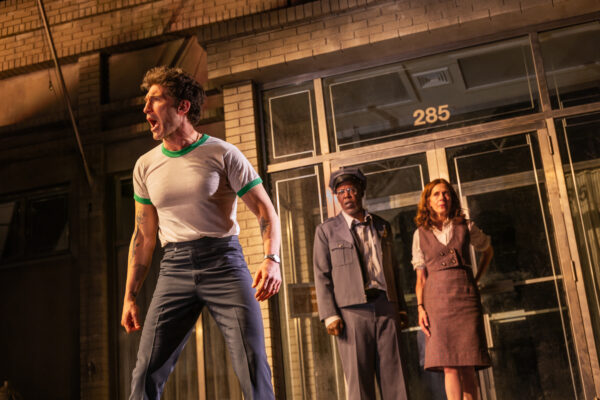
Dog Day Afternoon (Photo: Matthew Murphy and Evan Zimmerman)
Viral fame, fuck-the-police rhetoric, and a likable antihero should make Dog Day Afternoon a property with legs in 2026. But these elements don’t set this new play with fuzzy politics ablaze.
Stephen Adly Guirgis adapted this play from the Sidney Lumet film, Dog Day Afternoon, and the underlying Life Magazine article the film was based on, “The Boys in the Bank” by P.F. Kluge and Thomas Moore (which was about the real-life bank robbery around which this is based).
Guigis’ script largely tracks the original movie plot with an additional effort to make the piece more of an ensemble work. However, his dialogue has a contemporary gloss over-sprinkled with 1970s references.
At the same time, director Rupert Goold forces the material into broad comedy for a good portion of the show. The play offers some occasionally strong performances and an opportunity to consider this moment in history. But ultimately it cannot hold a candle to the power of the original film.
Set in 1972, Sonny (Jon Bernthal) and his trigger-happy pal Sal (Ebon Moss-Bachrach) plan to rob a bank in Gravesend, Brooklyn in 7 minutes. After 9 minutes of arguing with the staff and dealing with a collapsed guard, the robbery part has not begun.
Over the course of the ordeal, we learn the head of the tellers, Colleen (Jessica Hecht) turns down customers who try to ask her out and has spent her life taking care of her relatives. One bank teller, Roxxanna, (Elizabeth Canavan) had a fling with the bank manager, Mr. Butterman (Michael Kostroff). Another, Alison (Andrea Syglowski) is having an affair with her college teacher, and the other, Lorna (Wilemina Olivia-Garcia) likes to steal lollipops from the bank branch. The last one, Guadalupe (Paola Lazaro), is in the toilet smoking pot.
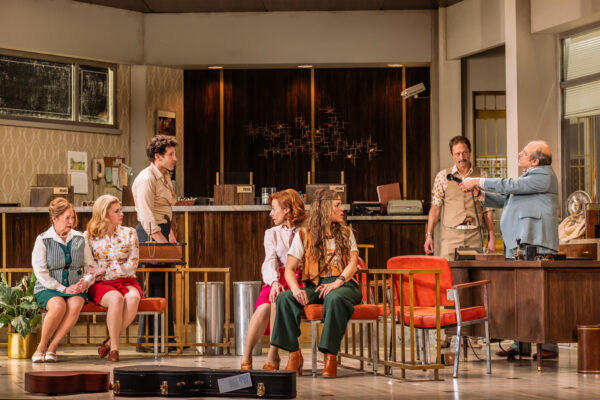
Dog Day Afternoon (Photo: Matthew Murphy and Evan Zimmerman)
Like the robbers, the characters in this bank are people with lives outside their workplace and Guirgis decides to give more space and time to the women on stage.
This is a massive shift from the original film and it makes this less of an all-male revue. It also breaks up the interludes where Sonny and the police Detective Fucco (John Ortiz) try to negotiate their way through what becomes a hostage situation.
Though I’d probably rather just see a whole other play about the women in a Brooklyn bank in 1972 where not all their stories are about men. The tidbits we gleaned did not add up to fully-fleshed out characters.
It’s hard not to compare what they are calling a ” new play” to the original film which feels like an indelible record of 1970s New York. Every frame is filled New York characters, like a late-night ride on the subway.
What’s missing from the overly bright stage version is the dark comedy cynicism of the film. Sure the situation is funny, between the ineptitude of the robbers, the no-nonsense attitude of the head bank teller, the sudden TV attention given to the robbery, and a gay twist no one sees coming. But the laughs are meant to come from the pit of your stomach in a queasy, gallows humor (we’re all gonna die) kind of way. But here, Goold is playing it with bright lights on, in a TV sitcom style. The stakes never feel real.
The pressure-cooker of this sweaty anguished night that is dragging on and on just does not come alive on stage (the second act really loses steam). To be fair, we lose a lot without close ups but the dialogue doesn’t make up for it.
At times, the obvious 70s references feel expository, like everyone is really trying to justify their New York credentials, but these are not the natural expressions of these characters.
And one familiar element of 70s cinema is of how awfully racist, sexist, and direct people could be (The Taking of the Pelham 1-2-3 I am looking at you). Everyone on stage seems generously and warmly accepting of gay folk heroes in a way that has to be anachronistic.
Overall, Ortiz is most at ease in Guirgis’s vernacular as are some of the others who have starred in Guirgis plays before. But the weakest link is Bernthal.
His Sonny isn’t unstable enough. He’s too together, bright, and shiny. Has this guy ever been down on his luck or lost? He shouts and he complains but there’s not a lot in-between. In theory, there should be tremendous ambiguity in Sonny as he flits through his disaster of a robbery, his unexpected hostage crisis, his new found TV fame, and his complex relationship with his wife Angie and his other wife Leon (Esteban Andrea Cruz). Bernthal just doesn’t deliver the shading for any of this nuance.
While Berthal and Moss-Bachrach are friends in real life, the reframing of the play around the larger ensembles leaves them with less time to establish the bond between Sonny and Sal on stage. Yet, even in those brief moments we hardly saw much at all.
Moss-Bachrach plays a very still but tightly-wound Sal. When he says he does not want to go back to prison, we know there is a story there. But his quiet performance of fear, sadness, and confusion gets lost in all the other stage business. I wish he could have had more moments center stage.
Cruz as Leon manages to bring together a sense of panic, mental instability, tension with authority, and genuine affection all in a few scenes. Sonny should be an equal counterpart to this Leon with his own contradictions, confusion, love and fears, but I could not tell you who that Sonny on stage really was. This Leon, for sure, was not loved by whoever we saw.
The production also turns to the audience to be the stand-in for a loud Brooklyn street full of lookie-loos. When Sonny first learns that TV cameras and the neighborhood have come out to watch and are shouting for him, he gets revved up and turns to us for the call and response as he starts to see his power at work.
Being that it is Broadway, it’s not the most natural of moments. The audience had to be overly encouraged into a reaction. I mean I am happy to cheer for “Fuck the NYPD,” but not sure anyone around me was joining in that particular whoop-whoop.
Sometimes I wonder if this is a perennial Broadway problem. No matter the material when it is shifting into the political, the space and dynamic of where we are sitting and who we are sitting with can undermine that radicalization in a Broadway theater house. Maybe the black box downtown version of a scrappy Dog Day Afternoon could have nailed the sentiment. But this production did not really lead us to this moment either.
It’s not like the rest of the show felt radical, so that this fourth wall-breaking moment would have been more authentic.
Without ever giving us a sense of who this Sonny is, I am asking myself why am I supposed to be cheering for this overly confident mook with a perfectly coiffed head of hair, a tight-ass t-shirt (showing off a Hollywood bod) strutting across the stage throwing money at us?
Plus there was no clarity on the politics of the play. In the middle of the scene where Sonny is shouting for the audience to join him, it is Colleen, the bank teller, who encourages Sonny to shout “Attica,” a reference to the Attica prison riot which took place in 1971.
The prison riot was about the human rights violations and egregious treatment of prisoners in the New York prisons and the excessive response by the state of New York in the effort to “re-take” the prison, which led to many people being killed by law enforcement officers (and some prisoners being summarily executed by law enforcement).
Frankly, handing over this line and idea to Colleen was one of the weirdest choices of the whole show. The production frames Sonny as a gay liberation activist. So wouldn’t it make more sense for the leftist political perspective to come from Sonny rather than Colleen who is so straight and narrow that she won’t accept a gift from a customer at the bank.
Also, Sonny had been ranting about Governor Rockefeller earlier in the play and it was Rockefeller who was blamed for the situation at Attica. All in all, it was a confusing shift in power and voice to Colleen. Who again…maybe deserves her own separate play. We can never have too much Jessica Hecht on stage.
For me, I wanted to see how this story might feel in today’s moment. But rather than revealing or meeting our times, it was an ambiguous shrug in 70s polyester. Not breathable.