
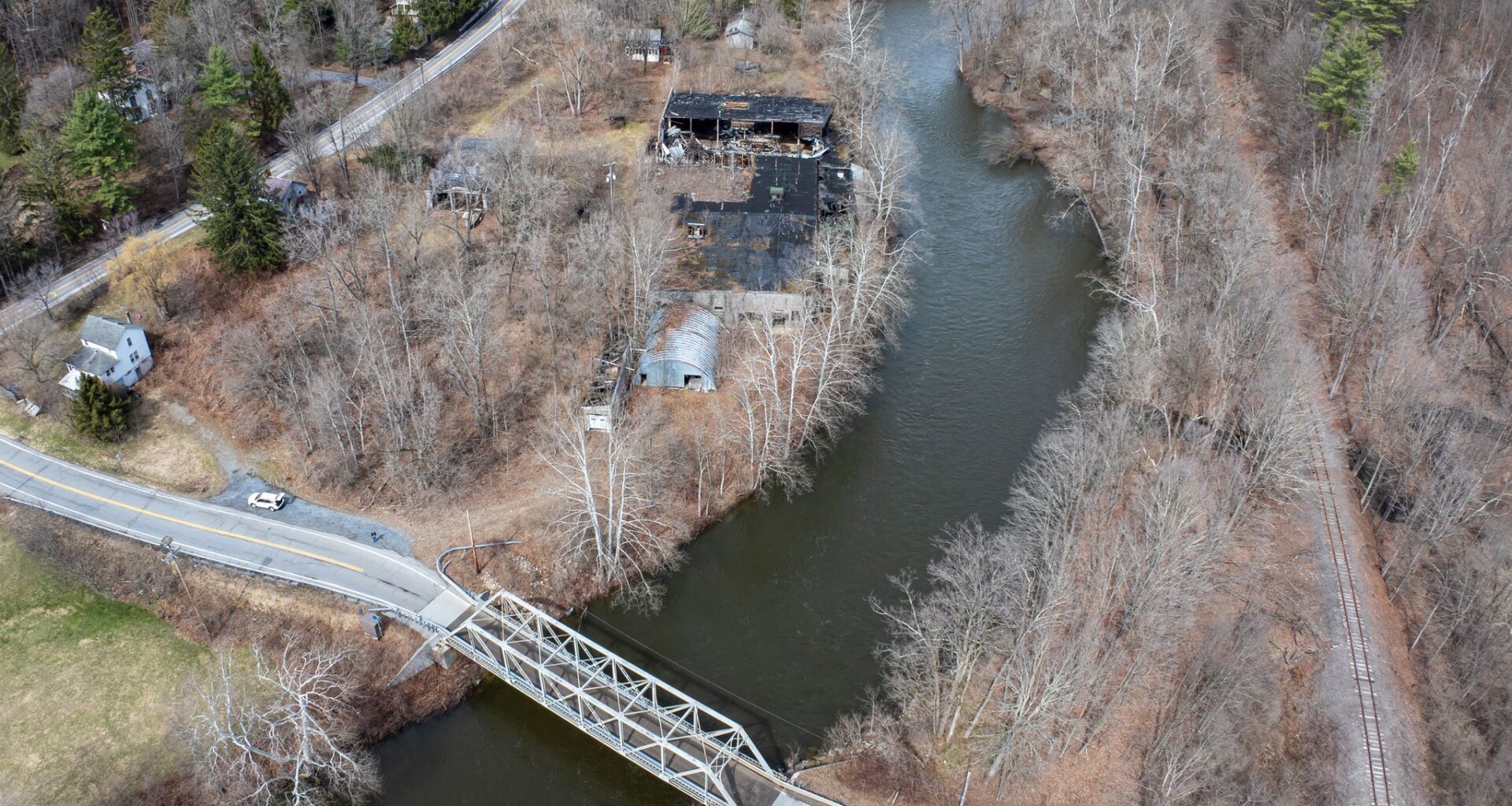
An aerial view shows an abandoned property on Friday near the intersection of Routes 61 and 29 in Greenwich. The brownfield is one that might be redeveloped under a new Washington County land bank program.
Jim Franco/Times Union
Under Washington County’s new land bank program — the 32nd program of its kind in New York — this abandoned property near the intersection of Routes 61 and 29 in Greenwich may be redeveloped. A goal of the program is to ease the rural housing crisis and bolster economic development. The revitalizations will also return property to the tax rolls.
Jim Franco/Times Union
An abandoned, overgrown property is seen Friday through the trees near the intersection of Routes 61 and 29 in Greenwich. The brownfield is one that might be redeveloped under a new Washington County land bank program.
Jim Franco/Times Union
An abandoned property on Friday near the intersection of Routes 61 and 29 in Greenwich. The brownfield is one that might be redeveloped under a new Washington County land bank program.
Jim Franco/Times Union
An abandoned property on Friday, near the intersection of Routes 61 and 29 in Greenwich. The brownfield is one that might be redeveloped under a new Washington County land bank program.
Jim Franco/Times Union
Property near 61 Vail St. on Friday in Salem. The brownfield is one that might be redeveloped under a new Washington County land bank program.
Jim Franco/Times Union
An abandoned property on Friday, near the intersection of Routes 61 and 29 in Greenwich. The brownfield is one that might be redeveloped under a new Washington County land bank program.
Jim Franco/Times Union
FORT EDWARD — Salem Supervisor Sue Clary loves to stroll through the old Shushan Bentwood property in the village. She finds the 10 acres of grassy paths winding among the rundown industrial buildings to be peaceful.

Yet at the same time, she said that property is a burden, “a big black hole in our community.”
Article continues below this ad
“There is such a good feeling to the property,” Clary said. “There is a lot of potential there. It could be senior housing. We could put little houses there for people who need homes. But right now, nothing can happen there. The debt on the property is higher than the market value. Plus, it’s got lien. Adding all those things up, it’s stagnant. It’s not good for anybody. It’s also a public safety hazard.”
That property is one reason Clary decided to reach out to Essex County, where since 2022, four abandoned and derelict properties have been restored to affordable housing through a land bank program. The program works like this: the county identifies properties that are off the tax rolls and refers them to the nonprofit North County Rural Development Coalition. The nonprofit will assess the property and decide if it can be rehabbed or needs to be demolished. Then the NRDC will secure land bank funding, which comes through the state’s Office of Homes and Community Renewal, supplemented by other private and public funders, to revitalize the property.
In partnership with the 40-year-old NRDC and with approval from the state HCR, Washington County will establish the state’s 32nd land bank with a goal of easing the rural housing crisis and bolstering economic development. The revitalizations will also return property to the tax rolls.
Make the Times Union a Preferred Source on Google to see more of our journalism when you search.
Add Preferred Source
“This could be a win-win-win situation for every town in Washington County,” Clary said.
Article continues below this ad
Since 2011, land banks have thrived throughout the state in cities like Albany and Troy and rural counties like Essex and Franklin. According to the Center of Community Progress, which studied housing in rural areas, rural properties are just as vital to easing the state’s housing shortage. It concluded that “the only solution to homelessness is a home” and that the current structure of emergency housing and shelters is more expensive than offering people a permanent place to live. The group says the emergency shelter system currently in place does not solve the problem nor improve the quality of life.
Laura Oswald, the county’s director of economic development, planning and tourism, will head up the Washington County land bank board. She said land banking could play a part in reducing shelter spending, which continues to rise for the county. In 2025, the county spent $2.89 million on emergency housing and services. In 2026, it expects to spend $3.6 million, its posted budget shows. That does not include the additional $400,000 it plans on spending on Code Blue, the winter emergency shelter for the homeless.
“We don’t know what it looks like yet, but land banking can be part of the solution,” she said. “What we want to do is take something that is not working and fix it to make it work. The strategy is to support growth in the county for business, industry and housing. We are limited because we don’t have development sites for housing or business. We have a lot of agricultural fields, which we need for agriculture. … Instead of taking our agricultural fields and building houses, the better strategy is to take what is existing and not working and make it productive again.”
Washington County is still in the earliest stages of its land bank. It has only just created its board and is working on a website with NRDC to help identify properties. Oswald estimated that the county has about 100 properties that could be considered.
Article continues below this ad
According to the state office of HCR, the state has invested $160 million in grant funding to land banks. That has resulted in the creation or preservation of more than 300 affordable homes and the removal of over 200 blighted structures across New York. Land banks are also part of Gov. Kathy Hochul’s $50 million MOVE-IN NY program, which is designed to bring up to 200 prefabricated homes to underutilized lots.
“Land banks are a vital part of the governor’s five-year $25 billion housing plan, which is why expanding the ability for more land banks to form — and giving communities the tools they need to revitalize while providing much-needed affordable housing — is such an important step in our efforts to tackle the housing crisis,” HCR said in a prepared statement.
While NRDC will be charged with applying for the funding, Oswald cautioned that there’s no guarantee the county will be able to secure funding for all the projects supervisors want to tackle, like Shushan Bentwood. However, she said the county was interested in redeveloping brownfields.
Among properties designated by the federal Environmental Protection Agency as containing contaminants is BioTech Mills, along the Battenkill River in Greenwich. Greenwich Supervisor Jim Mumby said he’d like to see the property, where old metal tanks have been left, returned to good use.
Article continues below this ad
“That would be a nice gem to get back,” Mumby said. “The Susan B. Anthony estate and the (Stoops) Tavern are across the street. There is a Susan B. Anthony trail from Massachusetts through Greenwich to Rochester. We need tourism and want to see people walking down Main Street. We want to lead with our past and keep the synergy going and put Greenwich on the map.”
Mumby added, “The whole thing is to get these properties the love they need.”
Clary said there is a chance now.
Article continues below this ad
“There are properties in every single town that could be brought back to life,” she said. “Land banking will give us the opportunity.”