
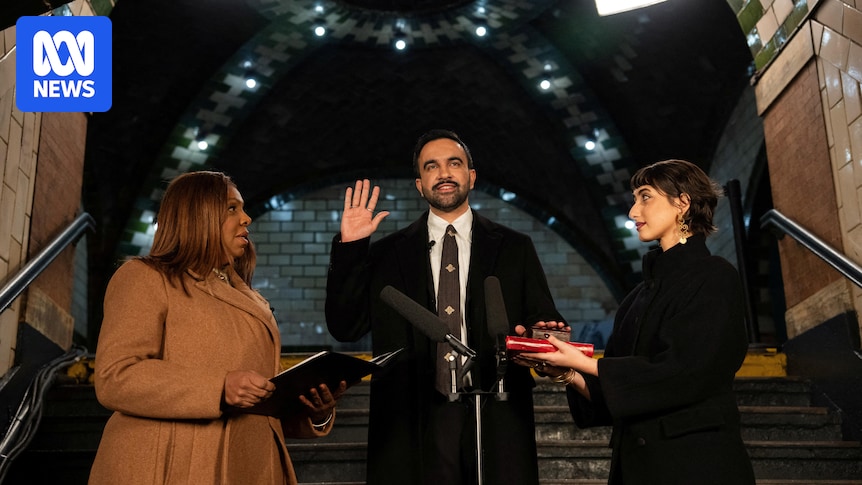
As he paces the stage in a dimly lit room with a microphone in hand, Trump-loving comedian Ron Barba is about to get political.
“I am MAGA for Mamdani,” he booms.
It’s a concept that gets a laugh from the audience, but the 55-year-old headliner at this intimate Manhattan comedy show is sincere.
He voted for US President Donald Trump twice, but in New York City’s recent mayoral election, he proudly supported Democratic socialist Zohran Mamdani.
“I’ve become a radical centrist,” he tells the crowd, declaring his Republican friends have a bad case of “Mamdani derangement syndrome” — a nod to the president’s that insistence those who don’t like him have “Trump derangement syndrome”.
While Trump and Mamdani are on opposite ends of the political spectrum, Barba sees similarities between the two.
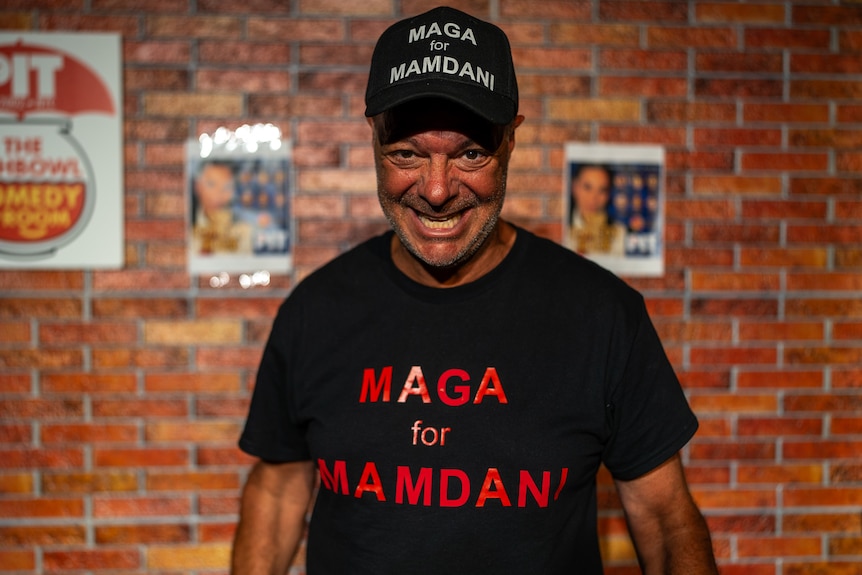
Ron Barba voted for Donald Trump twice but also supported Zohran Mamdani. (Foreign Correspondent: Bruno Federico)
They were both populist outsiders who took on the party establishment with promises to up-end the system and make life better for their constituents.
They engaged disillusioned voters and energised their base in a way few other politicians could.
And they’re both from Queens, he jokes.
“[Mamdani is] the Messiah for the Democrats in my mind,” he tells Foreign Correspondent.
“[Trump and Mamdani] are so good at what they do, at delivering their message, that the opposing party has no answer for them.”
At 34 years of age, Mamdani is New York City’s youngest mayor in a century and the first Asian American and Muslim to hold the role.
His policies centre around stopping rent rises, building more houses, making groceries cheaper and providing free buses and child care.
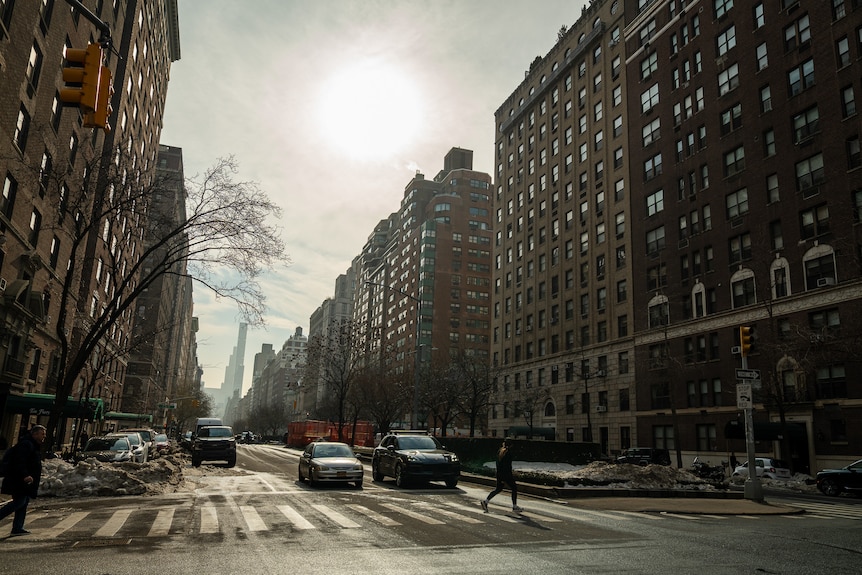
New York is America’s richest city but also one of its most unequal. (Foreign Correspondent: Bruno Federico)
He has remained resolute and on message with his promise to address the affordability crisis New Yorkers face, living in one of the most expensive cities in the world.
In the Bronx neighbourhood of Mott Haven, in one of the poorest congressional districts in the US, there are luxury apartments going for more than $US6,000 ($8,700) a month.
“The prices are getting out of reach now, where housing is just so high that people are feeling as if they can’t afford to live in the neighbourhood they grew up in,” says Brian McFadden, a barber who’s been cutting hair in Mott Haven for more than 40 years.
New York is the largest and richest city in the US, and also one of the country’s most unequal.
It’s a city with 384,500 millionaires, 818 centi-millionaires and 66 billionaires, but where one in 16 residents lives in public housing.
That inequality has only become more pronounced, according to Ron Barba, who says Mamdani’s pledge to get living costs under control had been key to getting his vote.
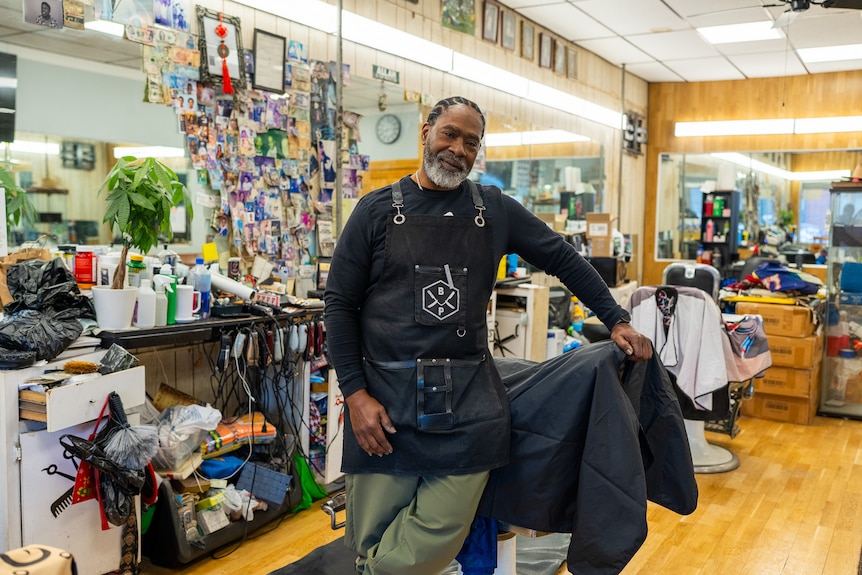
Brian McFadden has seen the neighbourhood gentrified in recent years. (Foreign Correspondent: Bruno Federico)
“It’s just harder and harder for people to live in New York City anymore,” he says.
‘”The stress is so heavy, so it’s pushing people way out into new places.”
In the past, “the charm of the city didn’t have to do with money”, he says, “it had to do with the culture and different economic backgrounds kind of meshing together. Now it’s just one big corporate blob.”
New York’s mayoral election last year saw the highest voter turnout in 60 years.
Mamdani himself points out one in 10 of his supporters also voted for the president. Like Trump, he’s made big promises and now the pressure is on to deliver in a system that will throw barriers up at each turn.
A reality check for expensive promises
Nearing a hundred days into the job, Mamdani has already made inroads on one key campaign promise: free universal child care.
He struck a deal with the state government to receive funding for free child care for two-year-olds across some parts of the city, as well as money to boost the program that already exists for three-year-olds.
Brooklyn couple Mallorie Ekstrom and her husband Andy, whose daughter Valentina is two, say it means they can start thinking about having a second child.
“We would not be able to afford two day cares,” says Mallorie, adding the mayor’s childcare changes are “huge” for their family.
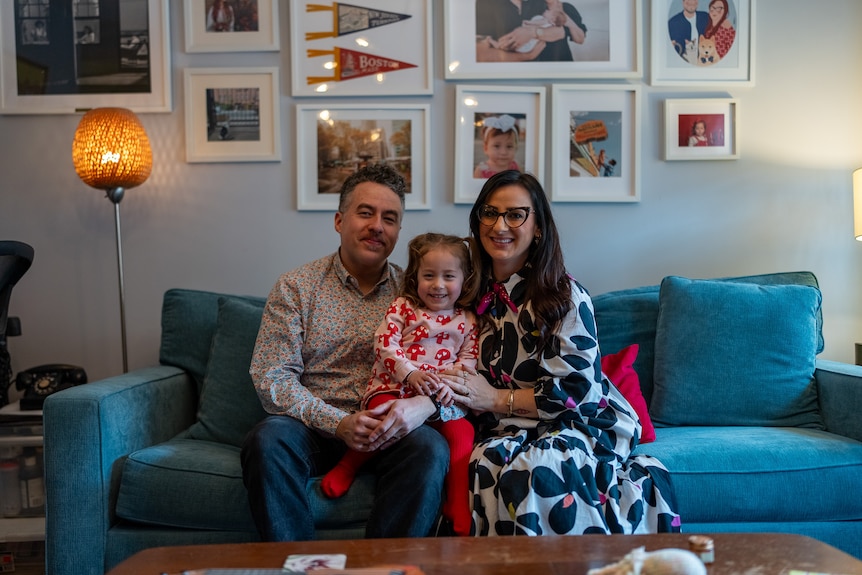
Andy and Mallorie Ekstrom with their two-year-old daughter Valentina. (Foreign Correspondent: Bruno Federico)
The couple live in a two-bedroom apartment a short walk from Valentina’s daycare centre.
Child care alone costs them $US2,000 a month, and that’s after they have secured a discount.
Despite earning a combined $US250,000 a year, they say there is little left in the bank at the end of each month.
“After rent, day care, I still have student loans, our regular bills, groceries, car — it all adds up and then we’re left with nothing,” Mallorie says.
“We make enough money that we don’t get any assistance for housing or food or for child care, but all of our money gets wiped into paying all those things.”
Mamdani’s signature policies are costing billions and have added to a growing problem — the budget.
The mayor inherited a $US5.4 billion deficit when he took office in January.
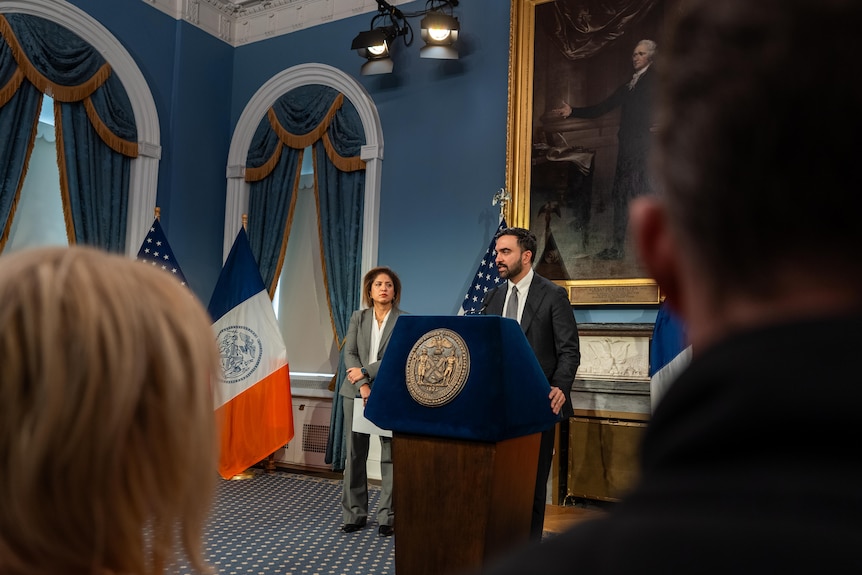
Zohran Mamdani speaks at a press conference in New York. (Foreign Correspondent: Bruno Federico)
During his campaign, he said he could fund his pledges by raising taxes on millionaires by 2 per cent and increasing the corporate tax rate to bring it in line with neighbouring New Jersey.
But the problem is, the city mayor doesn’t have the power to raise such taxes.
That power lies with the state government, and so far Democratic Governor Kathy Hochul has refused to increase those taxes, meaning Mamdani needs to find the money elsewhere.
He’s warned he will have to go down a “more harmful path”, using some of the levers in his control to balance the budget, like jacking up property taxes, which would hit landlords and middle-class residents hard.
The rich in revolt
Mamdani has already made some powerful enemies, including a growing number of landlords, with one of his biggest promises: to “freeze the rent”.
The city has a unique housing situation where rent increases for about a million apartments are regulated by a mayor-appointed city board.
It’s the reason many people can still afford to live in New York despite soaring rents.
Mamdani wants an immediate rent freeze to give tenants a reprieve, but critics say that’s unsustainable and, paired with increased property taxes, will bankrupt some landlords.
“You freeze the rent and you destroy the landlord. What did you accomplish? You now made more buildings unaffordable to own, and then who gets them? The bank,” says Humberto Lopes, who owns more than 100 buildings across New York City.
About a quarter of his property portfolio consists of rent-stabilised apartments.
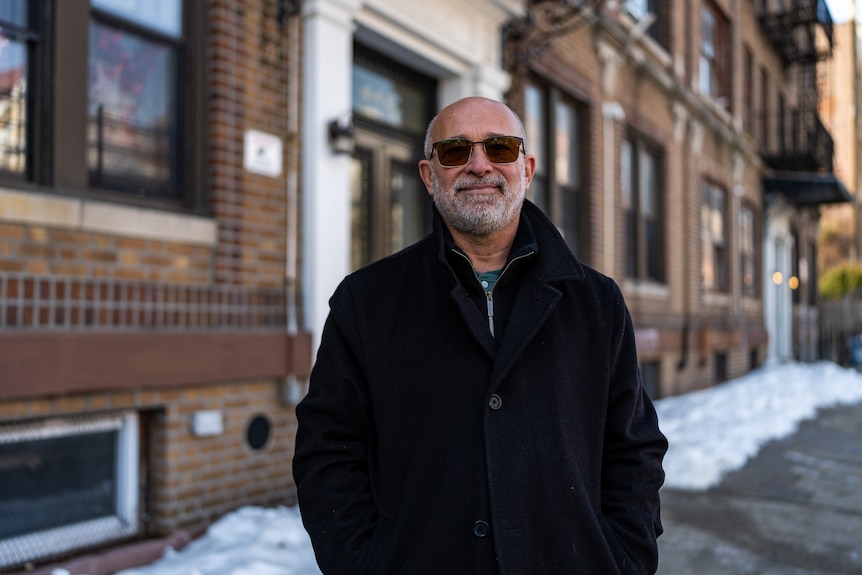
Humberto Lopes opposes Zohran Mamdani’s plans to freeze rents and tax the rich. (Foreign Correspondent: Bruno Federico)
He says property taxes on those buildings have risen eight years in a row, and alongside repair costs and mortgages, landlords are being left with little choice but to board up apartments that no longer make money.
“Mathematically, it doesn’t make sense. It’s not worthwhile fixing because we can’t get no [rent] increase for it,” he says.
The Rent Guidelines Board tasked with capping rent rises found that after operating costs were paid, landlords had a 6.2 per cent increase in income for buildings with rent-stabilised units in 2023-2024, and a 12.1 per cent increase the year prior.
But Lopes disputes those findings and has formed a coalition of landlords and property owners to fight Mamdani’s rent freeze.
“People forget that real estate is a business … so if I invest this money in it, I have the right to get my money back,” he said.
“It’s America. You afford it, you pay for it. You can’t afford it, find another apartment.”
He’s also a millionaire who’s vehemently opposed to Mamdani’s ambitions to tax the rich and says he’ll just pass on any tax increases to his clients.
“Who pays now? The f***ing poor,” he says.
“Stop this bullshit, you’re broke for a reason, figure out your own life. I’m tired of this. Your life doesn’t have to be my taxpayer burden.”
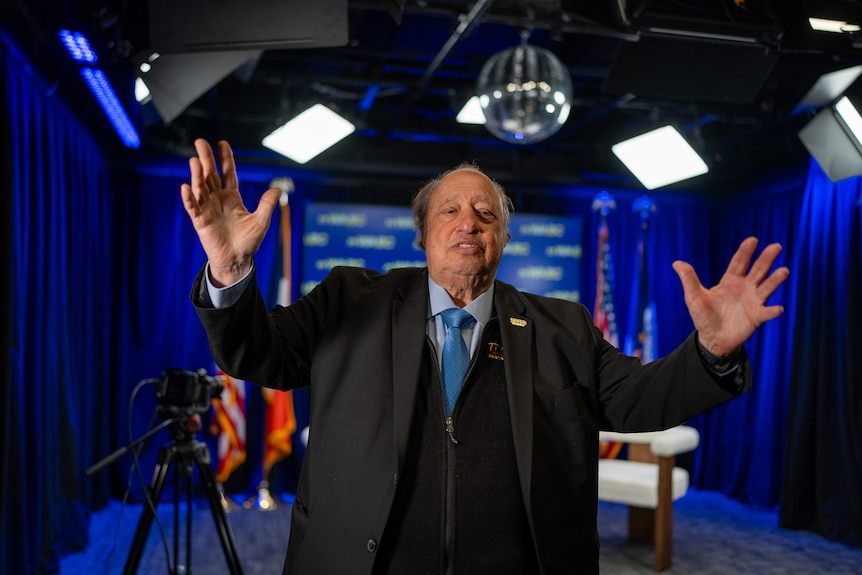
Billionaire supermarket chain owner John Catsimatidis says the rich will leave New York if Zohran Mamdani hikes taxes. (Foreign Correspondent: Bruno Federico)
Even though raising taxes are out of Mamdani’s control, the policy has put a target on his back.
Billionaire supermarket chain owner and prominent Republican John Catsimatidis financially supported Mamdani’s opponent during the campaign.
He’s now pledged to work with the new mayor to improve the city, but warns tax increases will lead to an exodus of rich residents.
“There are people that say, ‘Why should I pay a lot of extra taxes?’ They’re going to Florida, Tennessee, Texas, big time,” he says.
Watch Foreign Correspondent’s Celtic Waves
“Two per cent of the people [in New York City] pay 48 per cent of the taxes already. At a certain point, people reach the ‘oh crap’ level.”
One of Catsimatidis’s many business ventures is supermarket chain Gristedes.
Mamdani intends to roll out a pilot program of city-run grocery stores that will sell produce at wholesale prices to give New Yorkers a cheaper option.
Catsimatidis thinks it’s a “PR gimmick” that retailers like himself can’t compete with and will lead to some stores closing shop.
“There’s an old expression; you can’t fight City Hall. Gristedes is 138 years old. If he wants to come and compete with us, we surrender.”
A bromance with Trump
After months of verbal barbs calling each other names such as “fascist” and “communist”, the president and the mayor have developed a surprisingly chummy relationship.
Mamdani has appealed to Trump’s real estate background.
The pair have discussed the city’s bloated regulatory system, as Mamdani faces hurdles to achieve his promise of 200,000 new affordable homes over the next decade.
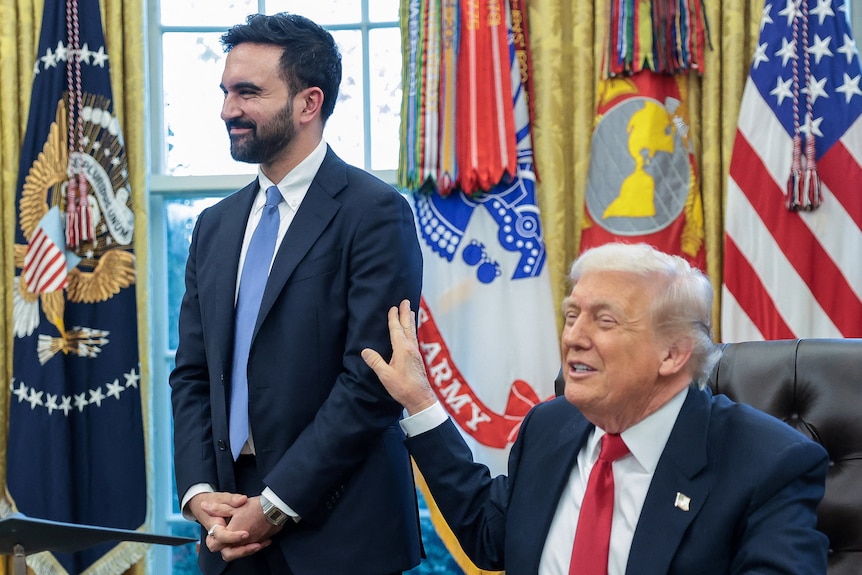
Donald Trump and Zohran Mamdani in the Oval Office at the White House last November. (Reuters: Jonathan Ernst)
“This is a man that right now I think is focused on New York City. I really think he has a chance to do a great job and we’re going to help him,” Trump said to a pack of stunned reporters at the Oval Office in November.
Political analysts saw this meeting as a moment where Mamdani’s charm, media attention and popularity won over the president, who has himself dominated headlines for decades.
Republican Curtis Sliwa, who ran against Mamdani for mayor, and has known Trump for decades, is more sceptical.
“We got played,” he said. “See, with Donald Trump, it’s all about the money.”
Sliwa believes the president’s praise is not “sincere love” but rather a recognition that he can work with the new mayor to advance his business interests in the city.
The Republican wants Mamdani to succeed but believe he’s “naive” and won’t achieve everything he sets out to do.

Curtis Sliwa believes the US president’s praise for Zohran Mamdani is not “sincere love”. (Foreign Correspondent: Bruno Federico)
“I run across people all the time who want him to fail and I have to chastise them; I have to educate them and say that would be the worst possible thing that could happen to us,” he said.
“That means New York City fails, it hurts our state of New York, and it hurts the country.”
Political analysts are watching the new mayor closely to see if there is an appetite for more drastic measures to tackle the cost-of-living crisis — particularly ahead of the mid-term elections in November.
Voters like Ron Barba believe Mamdani faces an uphill battle in implementing his ambitious agenda but if he succeeds it could shape the future of American politics.
“It’s going to be tricky what he’s doing … so we’ll see. I think he can, but I don’t know if he can,” he said.
Watch The Other Disruptor tonight on Foreign Correspondent at 8pm on ABC TV and ABC iview.