
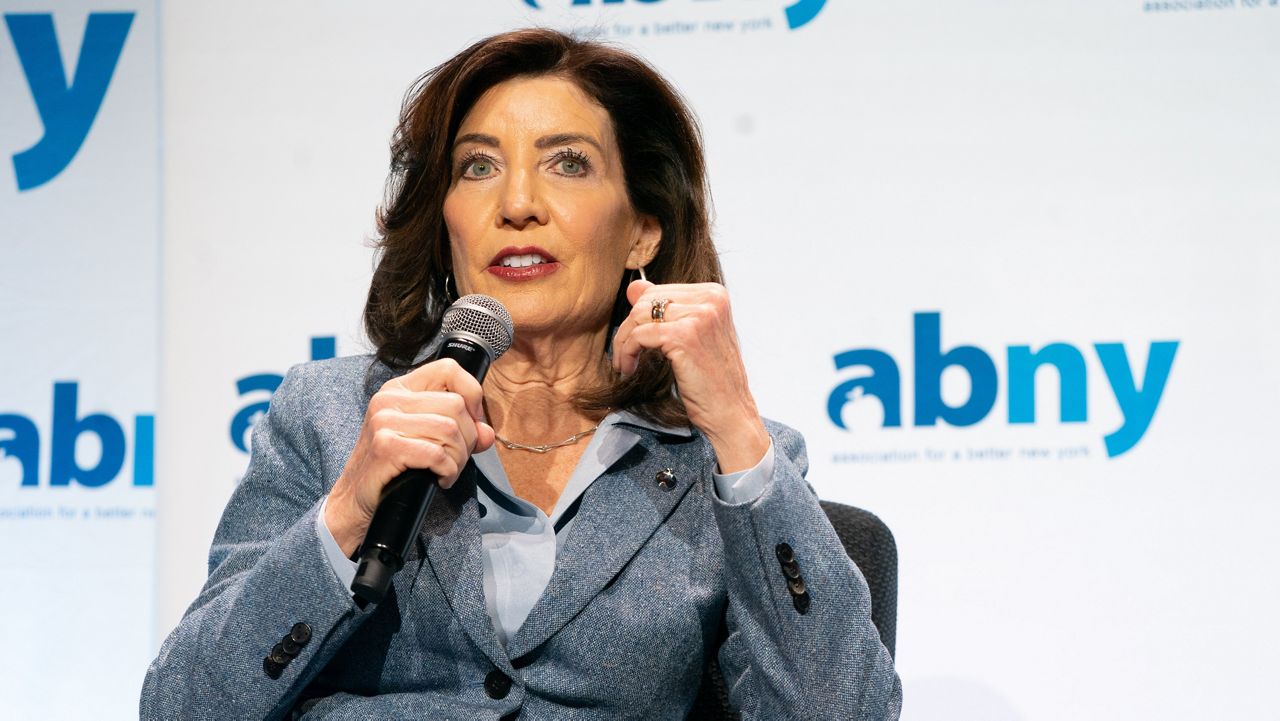
Gov. Kathy Hochul’s push to reform the state’s car insurance laws as part of the week-late state budget appears to be at a standstill in Albany, as representatives from the state’s trucking industry gathered nearby and offered support for her plan, often viewed strictly in the context of personal policyholders.
The car insurance battle is proving to be a tough one to overcome in a year when state lawmakers appear to be giving Hochul a bit more leeway as she battles for her policy agenda.
It comes as Deputy state Senate Majority Leader Mike Gianaris told reporters that “baby steps” have been made in reaching a consensus around Hochul’s push to change the state’s 2019 climate law, with little to no progress on her proposal to change New York’s environmental quality review process in a bid to spur housing development — and not much progress at all has been made on the car insurance issue. Lawmakers approved a one-week budget extender, keeping state government funded through next Monday and allowing budget negotiations to continue.
“A late budget is not ideal but as long as we’re moving extenders and it’s not too long lasting, it’s very manageable,” Gianaris said. “That’s also keeping in the pattern with this executive. Budgets are late but they’re not too late. Hopefully we’ll be able to shut it down,” adding that lawmakers are expected to spend more time in Albany next week rather than finishing off the rest of their pre-scheduled holiday break for Easter and Passover.
Gianaris told reporters that Hochul and state lawmakers are deadlocked over the car insurance plan, which is a centerpiece of the governor’s affordability agenda and focuses on lowering rates largely by weeding out fraud and limiting litigation.
“I don’t think we’re close,” he said when asked if conversations had even reached a point where there was an idea of what a middle ground could look like.
Gianaris echoed comments made last week by Senate Majority Leader Andrea Stewart-Cousins that the governor’s office has yet to provide data that proves, to their satisfaction, that fraud is a key driver of skyrocketing rates.
“One of the reasons we haven’t made a lot of progress is we keep asking for data to justify the claim that fraud is driving higher insurance rates,” he said.
Hochul’s office fired back, urging lawmakers to take a closer look at the basics.
“The numbers are clear. There has been an 80% increase in suspected auto insurance fraud over the last five years, and when fraud goes unchecked, everyone pays the price,” a spokesperson said. “These costs don’t appear out of thin air; they are driven by people gaming the system. When fraud increases, rates rise. Every inflated claim and needless lawsuit pushes rates higher for hardworking New Yorkers.”
As members of the Senate and Assembly returned to Albany to pass the one-week extender on Tuesday, the Trucking Association of New York was holding its Safe-T Safe Trucking Symposium 35 miles up the Northway in Saratoga Springs.
While much of the conversation around the governor’s proposal has focused on how insurance rates impact families, companies that operate commercial and fleet vehicles are also in search of rate relief. Several at the conference stressed that Hochul’s plan is an antidote to affordability issues up and down the supply chain.
Brian Brundige, vice president of operations at Terpening Trucking Co., told Spectrum News 1 that regardless of what lawmakers say, companies like his wouldn’t be building infrastructure into their budgets to guard against fraudulent claims and litigation — on top of sky-high insurance rates for their fleets — if it weren’t a widespread problem.
“The challenge is, on the road, exonerating ourselves from accidents. We spend a lot of capital on having all the new technologies in the trucks in order to protect ourselves,” he said. “We run cameras, inward- and outward-facing, to mitigate some of the issues we incur, but the lion’s share of our accidents are things that are beyond our control. We get implicated, but in some of those cases people come after us because we’re a trucking company, and over time, settlements and so forth beyond our control increase our premiums.”
Joe Fitzpatrick, president of Lightning Express Delivery Service, added that not addressing the issue in its current form, as proposed by Hochul, constitutes a threat to small businesses.
“If insurance rates don’t come down — whether it’s workers’ comp or auto liability — I don’t know how much longer I can go on,” he said.
The car insurance proposal is part of Hochul’s broader affordability agenda.
Trucking Association of New York President Kendra Hems stressed that concerns from truckers at the conference are about affordability not just for them, but for those they serve and their customers.
“Many of these companies are small, family-owned, generational businesses. They operate on like a 1% profit margin. They cannot continue to absorb those costs, so the only thing they can do is build that into their rates, which ultimately trickles down to our consumers,” she said.
The governor’s proposal has faced stiff opposition from the state’s trial lawyers, who say not only will its efforts to crack down on at-fault payouts potentially prevent injured people from having their day in court, but they have also cast doubt on whether insurance companies will actually lower rates if the reforms work.
Hochul has worked to assure New Yorkers that her proposals have been road-tested in other states like Florida, where insurance prices have come down. But state lawmakers continue to express doubt that they will force insurance companies to voluntarily make changes.
“There is no guarantee in anything she’s proposed that any savings that accrue to the insurance companies will be passed on to consumers at the end of the day,” Gianaris said.
On Monday, Hochul doubled down, adding that she intends for the final deal to hold insurance companies responsible.
“It’s not me saying so, it’s proof from other states with the same reforms implemented,” she said. “They have seen their prices, their premiums, go down. That is what my expectation is, and I’m convinced that will happen. We’re also looking at what we are capping insurance companies at. I don’t want excessive profits made by the insurance companies. I don’t want the trial lawyers lining their pockets from all of these outrageous cases they bring, because you know who is paying for that? Our drivers.”
Hochul’s push to examine — and, as she said Monday, potentially lower — the state’s excess profit cap has raised questions because it is calculated over six years and would not immediately reflect higher profits.