
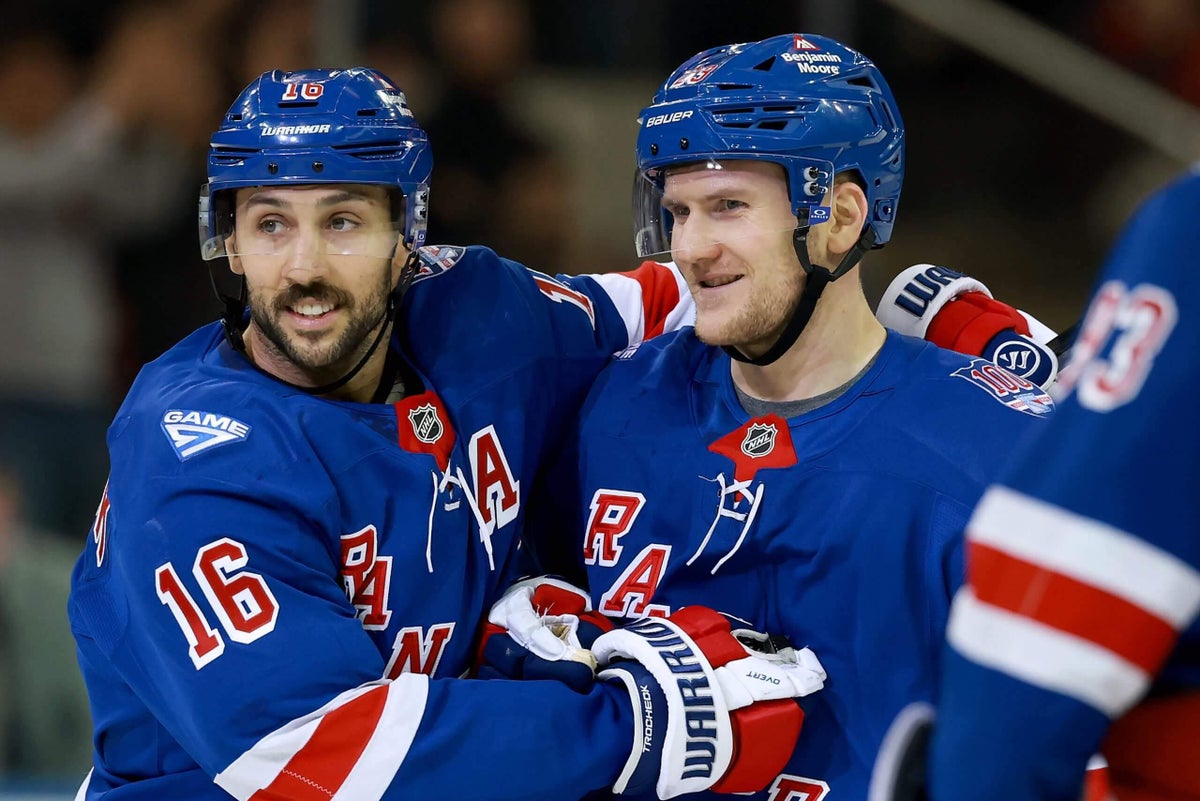
The 2025-26 season will go down as a major disappointment, no matter how strong the New York Rangers finish, but it’s worth wondering how much the team’s post-Olympic break surge will influence team president Chris Drury’s plans.
There are essentially two paths for Drury to take.
The first is one of prudence and patience, with a focus on building for the future. In that case, the Rangers should:
• Prioritize the draft, where they own two first-rounders and 11 total picks (their highest number since 2004).
• Trade away more pieces who can help replenish young talent.
• Avoid temptation to sacrifice prime assets for a quick fix.
• Weaponize cap space (projected to be near $30 million) if opportunities arise but don’t jeopardize long-term flexibility.
• Continue to lean on the youth that’s given the team such an obvious shot in the arm in recent weeks.
The Blueshirts could hope to be a scrappy 2026-27 wild-card team in this scenario — they’ll have a puncher’s chance as long as Igor Shesterkin is in net. But the main goal would be developing a new core while accepting that it may be a few years before they’re ready to truly contend.
Some will argue that’s what Drury should do. The Rangers’ upside will be limited until they add high-end play-drivers, and the best way to find those is by picking high in the draft for multiple years. In the meantime, they can staple Gabe Perreault to the top line; allow Alexis Lafrenière and Will Cuylle to fully spread their wings in all situations; and foster healthy competition for depth roles from a group that includes Noah Laba, Tye Kartye, Jaroslav Chmelař, Adam Sýkora and others. All the while, E.J. Emery, Drew Fortescue, Liam Greentree, Malcolm Spence and a likely top-10 pick in the upcoming draft can work toward fortifying the roster as part of the next wave of prospects.
It wouldn’t guarantee future success — the Rangers’ shaky track record of drafting and developing is reason for skepticism — but it would give them the best chance to build something sustainable.
The second path would aim for a quicker turnaround. In this scenario, expect Drury to aggressively add.
According to two league sources, Drury has established a preference to acquire young, NHL-ready players as the centerpiece in any trade that sends Vincent Trocheck, Braden Schneider or others out of New York. That’s why the Rangers balked at trading those players before last month’s deadline, when no one met Drury’s asking prices, but he may look to take it a step further this summer.
The Rangers had long planned to use their forthcoming cap space to target a premium free agent, but that well has dried up with Connor McDavid, Jack Eichel and others re-signing with their current clubs. Perhaps they’ll pivot to the best remaining option, Buffalo Sabres right-winger Alex Tuch, or try to pluck a few from a tier below him. But this franchise always seems to have stars in its eyes, which is why no one should be surprised if it enters the sweepstakes on any big-name players who hit the trade block. (Like the Rangers most recently did with Quinn Hughes.)
I’d closely monitor anyone with connections to USA Hockey. Drury, coach Mike Sullivan and captain J.T. Miller were all part of the American team that just won gold in Milan and could use those relationships as a selling point.
It’s no secret that New York covets Ottawa Senators captain Brady Tkachuk, with lots of smoke around his situation lately, while the outlook has also gotten murkier for Auston Matthews and the Toronto Maple Leafs.
Of course, wanting those stars — or even recruiting them — doesn’t mean the Rangers have the ammunition to pull off a trade of that magnitude. They probably don’t, unless one of those players wields contractual power to force his way to New York.
If so, would that be enough to catapult them back into the NHL’s upper echelon? I’d contend it will require more than one splashy addition, but they may convince themselves that teaming Tkachuk or Matthews with Shesterkin, Miller, Adam Fox, Mika Zibanejad and some of the budding prospects is worth taking the shot.
Even if New York doesn’t land a big fish, my early expectation is that Drury will lean more in the aggressive direction. There are a few reasons for that, starting with his position. He’s approaching the five-year anniversary in the big chair and coming off back-to-back seasons with no playoffs — and while owner James Dolan has publicly (and privately) backed his handpicked GM, Drury must be feeling pressure to clean up the mess he’s presided over.
There’s also pressure from the veteran core — nearly all of whom hold full no-movement clauses — to not let this downturn linger and waste their remaining prime years.
The team’s recent play, with an 11-7-2 record in their last 20 games and wins in five of their last six, seems to be inspiring confidence and possibly influencing what comes next. But let’s not forget how the Rangers framed their situation on Jan. 16, when Drury issued his letter to fans.
“This will not be a rebuild,” it read. “This will be a retool built around our core players and prospects.”
That was not by accident.
Promising signs from Fox
One of the players who seems encouraged by New York’s recent uptick is Fox.
On Feb. 26, Fox responded to a question about his commitment to the Rangers by saying, “That’s a conversation when we’re done playing.” Then, later, he told The Athletic he wanted to “evaluate the landscape” after he had more time to process the direction of the team. But Fox sure sounded like someone who plans to be here following Sunday’s 8-1 thrashing of the Washington Capitals.
“We’re still trying to build on something and gain momentum and establish something that we can take positively into the summer,” he told reporters.
The February trade that sent Artemi Panarin to the Los Angeles Kings hit several Rangers hard, Fox chief among them. He’s a gifted playmaker who needs skilled teammates to maximize his capabilities, which made losing the team’s leading scorer difficult to stomach. But the emergence of Perreault and other enthusiastic youngsters, coupled with the improved vibes that stem from finally stacking wins, may be quelling fears of Fox wanting out.
Having the 28-year-old on board would seriously increase the odds of a successful retool.
Fox was on pace for his best season in years — possibly since winning the Norris Trophy in 2020-21 — when a left shoulder injury derailed his promising start in late November. He returned for only three games before a lower-body injury shelved him again from early January until after the Olympics.
He struggled to recapture that early-season form, with Sullivan noting, “It’s hard when you miss that much time. It takes time to get your conditioning, your timing and all of those things back.” But while Fox hasn’t looked quite as dynamic, the numbers show that he’s still quite effective.
The 5-foot-11, 185-pounder has collected 22 points (four goals and 18 assists) in 21 games since rejoining the lineup, including 13 during his current seven-game point streak, and his 57.38 percent expected goals-for rate ranks best among New York’s regular skaters during that span, according to Natural Stat Trick. That’s pushed his season total to 50 points (eight goals and 42 assists) through 51 appearances.
But here’s the most telling stat: The Rangers are 25-20-6 with Fox in the lineup this season and 8-16-3 without him.
Brodzinski heads toward free agency
After trading Panarin and defenseman Carson Soucy, the Rangers are down to only three pending UFAs on the NHL roster: forwards Jonny Brodzinski and Conor Sheary and goalie Jonathan Quick.
Sheary, 33, recently told colleague Peter Baugh he has no plans to retire but understands New York has a wave of young players vying for a similar bottom-six role. Quick, 40, was less committal, telling reporters he’ll “figure that out when it’s time” following what could have been his final Madison Square Garden start Saturday.
I approached Brodzinski on Friday to find out where his head is as his two-year, $1.58 million contract draws to a conclusion.
“Definitely keep playing,” the 32-year-old forward said. “Especially with the amount of years I’ve had healthy scratches, I feel like I have younger legs. I mean, you can see with the guys we have on the ice right now, I’m still going out there for these (optional) skates. So, I still feel young. My body’s in great shape. I still feel like I can go for a lot longer.”
Whether that will be in New York or elsewhere remains to be seen. Brodzinski said there haven’t been any extension talks with the organization where he’s spent six seasons, including the last three as a full-time NHLer. That’s being tabled until the offseason, when he’ll begin to weigh his options.
“We’re just going to wait on that,” he said.
The 6-foot, 206-pounder has appeared in 52 games this season, collecting 16 points (six goals and 10 assists) while playing all three forward positions on multiple lines. That versatility has added to his value, as has his readiness to contribute whenever called upon — even after extended periods out of the lineup. But above all, Brodzinski’s ability to take all the ups and downs in stride and remain a popular locker room mentor will serve as his lasting Rangers legacy.
“Earlier in my career, it definitely bugged me a lot more, because being young, I felt like (I) had something to prove,” he said of the healthy scratches. “Now I’ve kind of proven what I can do when I’m in, but I think the more important part — especially if you want to change a culture in here — is being (a) good teammate.
“If I’m getting scratched for a younger guy, it’s not the end of the world for me. I’m happy for him. I’m so happy that he can get in the lineup and prove what he can do, because this is his dream, too. It’s little things like that I think go a long way as a teammate and kind of drive a culture in the right direction.”