
A Brooklyn day care owner whose license had been revoked by the state was allowed to open another program a few months later — only to have the second facility shuttered amid allegations of child abuse.
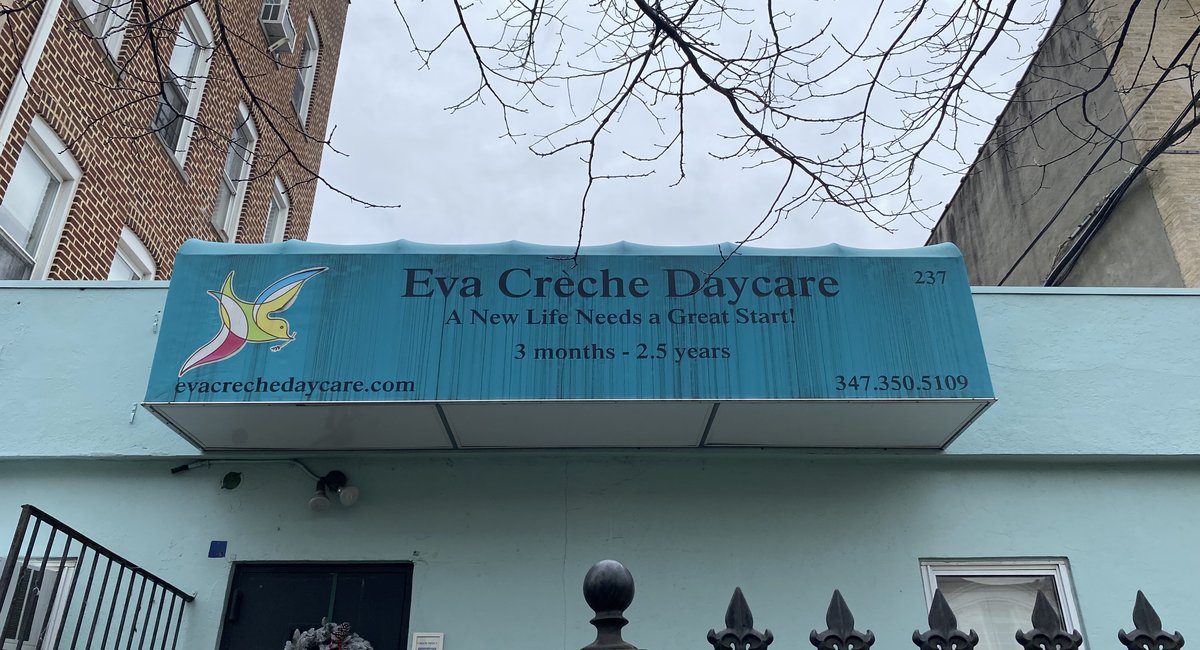
The Eva Crèche Day Care Center in Prospect Lefferts Gardens closed earlier this year after an employee recorded videos showing one worker grabbing and tossing a toddler and children napping and eating on the floor of a private residence that parents had not given permission for their kids to visit. The program was also over overenrolled.
Public records obtained by parents at the now-defunct facility show that in 2020, the same owner had her license revoked at a day care she then ran in Crown Heights — that time for failing to let inspectors inside, and leaving too many kids with one worker.
Five months later, she opened Eva Crèche a mile away.
The Eva Crèche abuse allegations, and several other headline-grabbing incidents at local day cares in recent months, come as the city plans a major expansion of child care. The city shut down one of the Manhattan locations of Bright Horizons, one of the largest child care providers, after an employee gave bleach to children and another sealed a girl’s mouth shut with packing tape. Authorities have charged several workers from Bright Horizons and Eva Crèche for endangering children.
Early education experts said these incidents — while outliers — underscore a broader challenge facing the city’s child care expansion plan. New York City’s 10,000 providers are overseen by a patchwork of state and city agencies, creating inequities across the system in terms of pay, training and quality of care. In some cases, this can create environments where abuse happens, the experts said.
Parents at Eva Crèche said the city agencies that were supposed to keep their kids safe failed to stop abuses.
The Mamdani administration said creating high-quality programs is a key tenet of the city’s expansion plan and officials are working to create a more cohesive system for parents and providers. Health officials said the city has rigorous regulations, and the majority of programs are providing safe spaces for kids.
A second chance
Just a day after state officials revoked Shareece Duke’s child care license at her day care Inspiring Minds in Crown Heights, city inspectors were touring another location where they would eventually allow Dukes to open a new facility.
In 2020, the state’s Office of Children and Family Services cited Inspiring Minds for deliberately barring inspectors from coming inside. Once the inspectors were admitted, they found one teacher’s assistant caring for six children younger than 2, records show. State regulations mandate a ratio of one caregiver for every two children younger than 2.
State officials revoked Dukes’ license. But she was already in the process of obtaining a city license to open Eva Crèche. That license was granted in 2021.
The attorney representing Dukes, the former owner of Eva Crèche, didn’t respond to a request for comment.
Officials with the city’s Department of Health and Mental Hygiene, which licenses child care centers, said providers who apply for a license undergo a tough review process and are subject to unannounced inspections once open.
City officials said prior license revocations are not always grounds to deny a new one and in Duke’s case her prior violations were not enough to deny her a license because there was no immediate harm to kids.
Agency spokesperson William Fowler said the decision to grant Dukes a license was made under the previous administration but added, “as soon as allegations of safety violations at Eva Crèche were made, the department stepped in and is monitoring that the program remains closed with no children on site, and that the provider and staff do not attempt to open a new child care program.”
He said the city is working with state officials to make sure they don’t grant Dukes a license, either.
But parents whose children attended Eva Crèche said the city should have never granted Dukes another license, and if they did, they should have put her under strict monitoring. Gothamist previously reported the center enrolled three times the number of kids allowed, kept kids in a basement that wasn’t approved for children, and took toddlers off site to eat and nap in a private home not authorized by parents.
City inspection records show health inspectors failed to catch overenrollment at Eva Crèche and never cited the location for caring for kids in an unauthorized basement. Records show inspectors were on site on the day parents said their children were taken to a private home. Eva Crèche voluntarily shut its doors when parents began pulling their children out.
“If you are going to give a second chance, which I believe in second chances, why wasn’t [Dukes] properly inspected?” said Cora Griffin, whose child attended Eva Creche. “ How did they not see the basement? How did they not do a proper inspection of [Dukes] if there are already clear violations in the past?”
Parents said they only found out Dukes had a prior closure after a parent filed a public records request through the Freedom of Information Law. Those records were shared with Gothamist.
Ensuring quality
New York City has some of the strongest standards for child care programs and the state often ranks in the top tier for stringent oversight, child care experts say.
“ You can have whatever shiny laws you want on the books. You can pass whatever laws or city rules you want to pass. But if those laws are never enforced, then for practical purposes, they don’t exist,” said Adam Birnbaum, whose son attended Eva Crèche.
On the flip side, providers, have also complained that city inspections can be onerous and inspectors are often inconsistent in their interpretations of regulations, according to a report by the Center for New York City Affairs at The New School.
Corinne Schiff, deputy commissioner for environmental health at the Department of Health and Mental Hygiene, said the city’s goal isn’t to close every program that racks up violations, but rather help providers meet strict requirements. The agency oversees health and safety regulations for child care facilities.
“ We are in the business of cultivating safe environments for children and childcare, not to make it impossible for programs to operate or to close them down without good reason,” she said. “But where we see that a program isn’t safely caring for children, we will close it down. We will require changes to be made.”
Early childhood advocates said key steps toward preventing abuse and ensuring high-quality programs are ensuring better pay and training for workers.
“If you really want to extinguish bad behavior, you need highly qualified, well-supervised people,” said Steve Barnett, founding director of Rutgers University’s National Institute for Early Education Research.
But he said it’s also important to hold program leadership accountable. “Instead of focusing alone on the individual that did the bad things, who is it that was responsible for supervising them?” he added.
Many child care workers are earning minimum wage and qualify for Medicaid or rely on food assistance programs to make ends meet, according to the Center for New York City Affairs. Low wages lead to high turnover rates and make it hard for providers to find qualified staff; providers are also often operating on thin financial margins, which can create an environment where abuse can happen, experts said.
“Someone might feel stressed out or feel tempted to say, ‘well let me add a couple more kids, even though I’m only supposed to have 10. Let me add three or four or 10 more kids because that’s going to bring in some funding that I desperately need not only to run my program and my business, but also just to survive,” said Dona Anderson, executive director of the New York Early Childhood Professional Development Institute at CUNY.
“It’s a pathway to bad choices.”
And the stakes are high: a child goes through the fastest brain development in their first few years of their lives, which can determine achievement gaps later on, early education experts said.
City officials said they also have early education specialists who visit programs and monitor how much screen time or outdoor time children have, which are regulated under city health code. Children also aren’t allowed to remain sedentary for long periods of time, such as strapped to high chairs for more than 30 minutes outside of meal time.
Emmy Liss, who heads the Mayor’s Office of Child Care, said creating high-quality, safe programs is an essential part of the administration’s vision for universal child care.
“We will do it in a way that both creates access for more families and ensures quality in all those settings,” she said. The city earlier this month announced a child care map that will include a list of prior violations for every facility, a move toward streamlining the system for parents.
Parents at Eva Crèche said it’s a good tool but it should also include whether the owners had any prior closures or revocations, like Dukes. They said while pay and training is important, the city also needs to better enforce the laws it already has, and hold the owners who profit off their children accountable.
“The management that made this whole thing happen and is actually the mastermind behind it, they’re getting a free get out jail card,” said parent Kai Sass-Hauschildt.
Jessica Gould contributed reporting.