
The Special Supplemental Nutrition Program for Women, Infants, and Children (WIC)—one of the few federal programs open to applicants regardless of their immigration status—provides food to children under 5 years old, as well as to low-income pregnant, postpartum, and breastfeeding women.
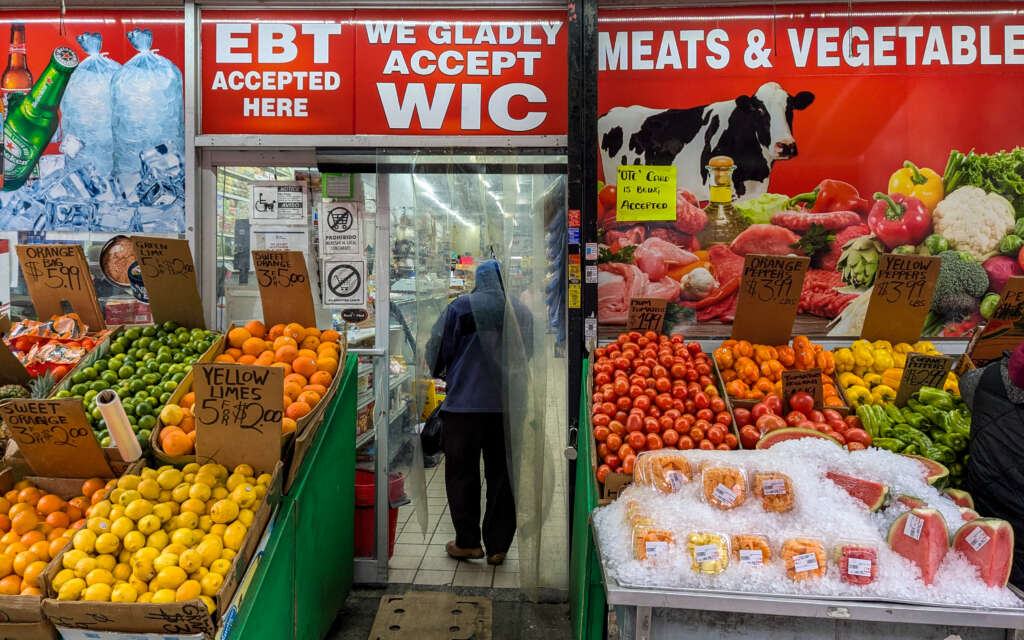 A shop on Jerome Avenue in The Bronx that accepts WIC benefits. (Adi Talwar/City Limits)
Few federal programs are open to applicants regardless of their immigration status. Among them is the Special Supplemental Nutrition Program for Women, Infants, and Children (WIC), which provides food benefits to children under 5 years old and to low-income pregnant, postpartum, and breastfeeding women.
Unlike the better-known Supplemental Nutrition Assistance Program (SNAP), WIC is a block grant program relying on Congress’s authorization of a specific yearly amount. It was founded in 1972 to help combat malnutrition.
In New York, it provides participants with an eWIC card they can use to buy certain pre-approved foods—like milk, whole grains, fruits and vegetables—at participating stores.
Maximum monthly spending amounts ($11 for infants; $26 for children; $48 for pregnant or postpartum participants; $52 for breastfeeding participants, and $78 for participants breastfeeding multiple infants) are set by the federal agency in charge of the program, the U.S. Department of Agriculture.
“WIC participants use an eWIC card to purchase specific foods in prescribed sizes and quantities based on their age, category (pregnant, postpartum, breastfeeding), medical needs, and preferences,” explained the New York State Department of Health, which oversees and administers the program locally.
In addition to access to food, WIC also offers nutrition education, infant formula and baby food, nutrition classes and workshops, breastfeeding support—including breast pumps—and acts as a stepping stone for connecting individuals to healthcare and social services.
“We are an adjunct to health care,” said Michelle Harding, WIC director at Urban Health Plan, which runs community health clinics across the city. “People who participate in WIC not only get checks or food or benefit EBT cards; the WIC program ensures healthy pregnancies, healthy birth outcomes, healthy growth and development for our children.”
After talking with officials and local WIC providers, City Limits prepared this guide to provide an overview of the program, who can apply, and how.
Who is eligible for WIC?
The program is designed for low-income pregnant women and children under 5, regardless of their immigration status. To qualify in New York, participants must live within the state, meet income requirements and belong to one of the following categories:
Infant or child under 5
Pregnant women
Breastfeeding woman
Guardian of a child under 5
Additionally, if someone has delivered a baby or had a miscarriage, they are considered postpartum and can get into the program for six months.
If you are already in Medicaid, SNAP, Temporary Assistance for Needy Families (TANF), the Essential Plan, or Head Start, you’re automatically income eligible for WIC.
What are the income limits?
You can also participate in WIC if you belong to one of the above categories and earn less than 185 percent of the federal poverty level (a sample of income thresholds are listed below).
Household SizeAnnual Income1$28,9532$39,1283$49,3034$59,478
After the applicant is found to be eligible based on their category, income, and residency, the next step is to determine if they have a nutritional risk—such as anemia or a high-risk pregnancy—which may include measuring height, weight, and hemoglobin or iron levels, and asking questions about diet, pregnancy, or breastfeeding status.
How can you apply for WIC?
Appointments are available by phone (518-402-7093) or in person at a local WIC provider. Some WIC providers explained that applicants typically conduct the pre-screen process by phone, and then go in person for a certification appointment.
The Department of Health explained that appointments for new participants are usually scheduled within two weeks. Participants are enrolled and certified during the appointment, and can start enjoying their benefits right away.
“If the applicant has never been on NYS WIC and does not have an eWIC card, to avoid delay between certification and using benefits to shop, it is best to come in person to get the card,” said Helene Rosenhouse-Romeo, WIC program director at Ryan Health, a network of Federally Qualified Health Centers providing affordable services regardless of insurance status.
“From that point on, you can start using your benefits immediately and will need to attend periodic follow-up appointments to remain enrolled in the program, usually every three months,” explained Olga Tkachenko, program director at Public Health Solutions.
What documents are required?
Eligible applicants must provide verification for:
Which stores can WIC participants use their benefits in?
This link takes you to a map of the state showing all authorized stores, where one can enter an address or ZIP code to find the nearest ones.
How often do participants need to renew or recertify?
The health department said that renewal periods vary, but most participants will need to recertify—which in essence is the same as the initial certification—at either six months or 12 months.
“Attending your follow-up appointments ensures the continuity of benefits, and applicants are encouraged to consult WIC staff at any point to fully understand program policies, food packages, and eWIC card usage,” Tkachenko said.
The department and advocates said WIC does not impact participants’ ability to participate in other benefit programs.
How do you check your eWIC balance?
You can check it on the ebtEDGE Mobile App (for Apple or Android), the WIC2Go app (for Apple or Android), call customer service at 1-844-540-3013 or view it online through the eWIC Cardholder Portal ebtEDGE.
To reach the reporter behind this story, contact [email protected]. To reach the editor, contact [email protected]
Want to republish this story? Find City Limits’ reprint policy here.