
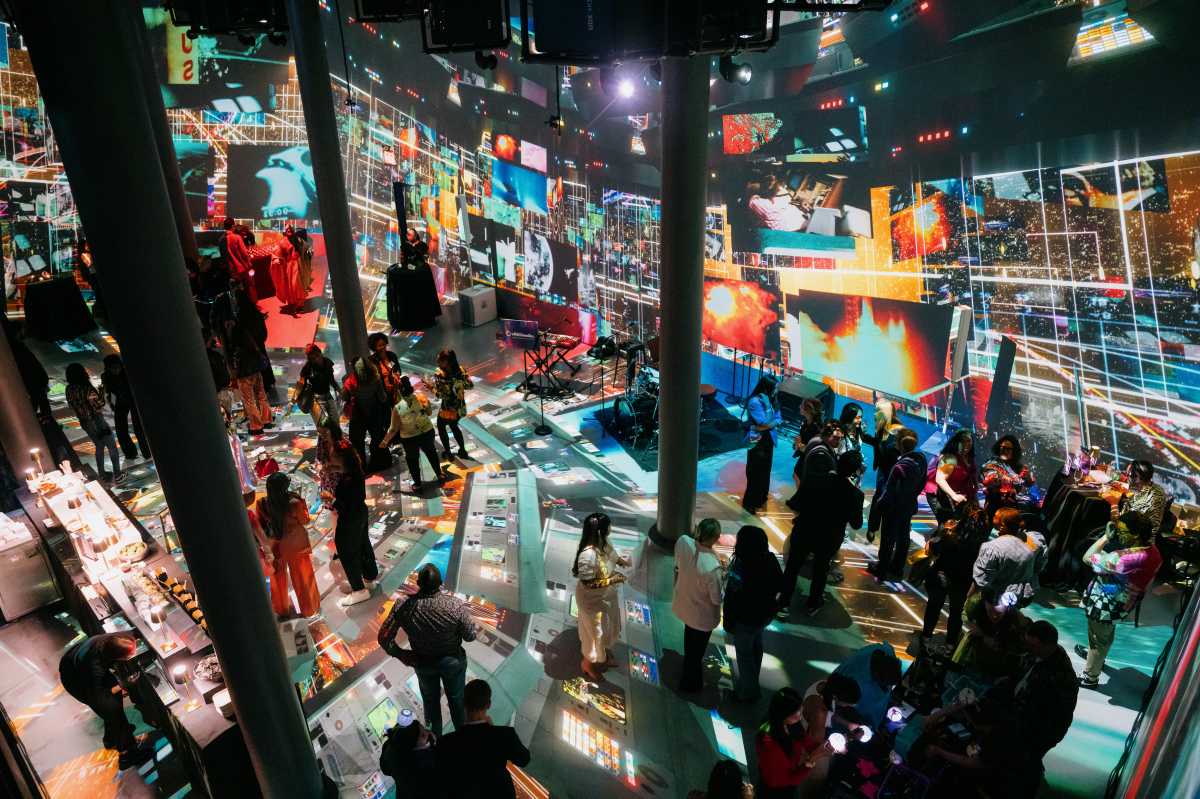
Benefit for ArtsConnection
Photo courtesy Brian Hatton
Education, as it is increasingly structured, has become, arguably, a system of efficiency—measured, standardized, optimized toward outcomes that can be quantified and reported. Teachers are asked to deliver, rather than to see. Art and music are, unsurprisingly, among the first to be reduced or removed, and with them goes something far more essential than programming: warmth, intuition, the human exchange that allows a young person to recognize themselves as someone of consequence. What remains may function. It does not, in any meaningful sense, form.
Most people can, if pressed, name one or two teachers who altered them. Not through curriculum, but through recognition.
Before sixth grade had even begun, I sat in the car outside a school that felt too large for who I was at the time, listening as my mother distilled presence into something non-negotiable: look them in the eye, introduce yourself clearly, do not shrink. It was not comfort she offered, but calibration. Though my parents had long conveyed my autonomy, my independence, my intellect, it was Mrs. Leroy who, without question, fixed it in place. I walked into her classroom—my sixth-grade geography teacher, Southern, composed, with bright blue eyes that held your attention just long enough to measure you—and introduced myself as instructed, steadying whatever tremor sat beneath the surface. She looked me in the eyes and called me a leader, and did so consistently for the entirety of middle school, much to the chagrin of my classmates and entirely to my becoming.
Her sister, Ms. Roe, moved differently—blonde, perceptive, with a wilder, more intuitive energy that lived just beneath the order of the school’s structure. Where Mrs. Leroy defined, Ms. Roe felt. Together, they created a rare balance of discipline and instinct, expectation and humanity. They saw something in me early and, perhaps more importantly, held it in place long enough for me to begin recognizing it myself. By eighth grade, a letter I wrote to Mrs. Leroy revealed something back to me with startling clarity: that my voice had reach, that what I created could move beyond me, that it carried weight.
That awareness—of agency, of power, of authorship—did not come from a system. It came, quite simply, from being seen.
That distinction sits, critically, at the center of what ArtsConnection is working to protect, and more urgently, to restore. In conversation with Executive Director Rachel Watts, one point emerged with particular clarity: the arts are persistently treated as enrichment, when in reality they function as infrastructure. They are where literacy is strengthened, where language expands, where students learn to interpret, to collaborate, to think critically, and to engage with perspectives beyond their own. Remove that, and what is lost is not simply creativity, but the capacity for empathy and fully realized thought.
The numbers, unsurprisingly, make the argument unavoidable. More than 300 NYC public schools do not have a single arts teacher. In a city that defines itself through culture, that absence is not incidental. It is structural.
ArtsConnection: mentorship, professional access and understanding
ArtsConnection intervenes precisely there. For over 47 years, the organization has embedded artists directly into public school classrooms, ensuring that students are not merely exposed to art, but understand themselves as capable of shaping it. The work extends, quite deliberately, into teen programs and career pathways, where students are introduced to the full architecture of the arts economy—mentorship, professional access, and the tangible understanding that creative work is not peripheral, but viable and necessary. Watts describes this shift not as exposure, but as authorship: a reframing that allows young people to move from observation into participation, from audience into agency.
This is not enrichment. It is, more accurately, intervention.
On May 5, that intervention takes visible form at The Golden Hour: The ArtsConnection Masquerade Benefit at the Prince George Ballroom. The evening brings together artists, educators, and patrons in a setting that reflects, quite intentionally, the ecosystem ArtsConnection builds within schools—performance, interaction, multiplicity, identity in motion. Evenings like this are often interpreted at surface level. A more considered reading reveals something else entirely: a mechanism for continuity, a way to ensure that the moments which shape a person—the quiet recognitions, the naming of potential, the awakening of voice—are not left to chance.
Most people can trace their lives back to one.
The question, then, is whether the next generation will have the same opportunity.
That is what ArtsConnection is working to secure.
That is precisely why it matters.