
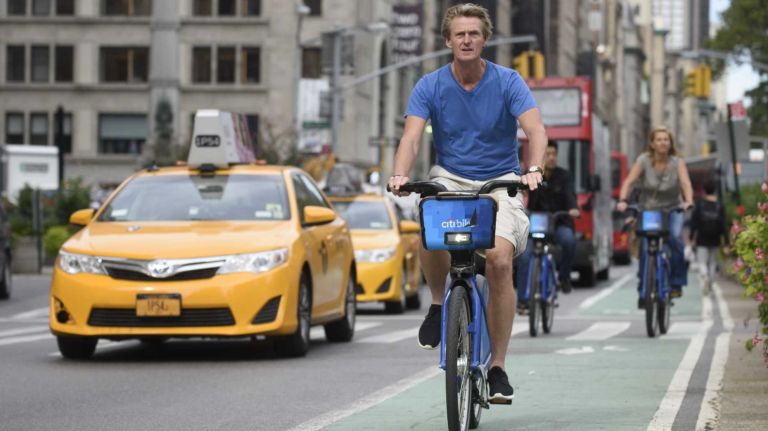
Mayor Zohran Mamdani announced on Tuesday the creation of a new Office of Curb Management to organize what is perhaps the city’s most chaotic and sought-after piece of real estate: its 6,300 miles of streets and around 3 million curbside parking spots.
The city’s curbs — once thought of as exclusively for motor vehicles — are now the subject of wider conversations, spurred by views on street safety, walkability and the impact of the pandemic-era outdoor dining program.
“How we manage our curbs is how we show our streets are for everyone — from cyclists and drivers to sanitation workers and delivery workers to food vendors and outdoor diners,” Mamdani said in a statement. “This new office will centralize planning so that our curbs can keep up with the new and growing ways New Yorkers enjoy our city. By modernizing curb management, we’re delivering a streetscape that is the envy of the world.”
Mamdani, along with the NYC Department of Transportation (DOT), said the new office aims to unify interagency planning efforts and streamline the process of revamping and diversifying NYC’s curbs for uses like loading zones, microhubs, vehicle pick-up and drop-off zones, secure bike parking, and waste containerization.
The office, which falls under the DOT’s realm, along with Mamdani’s budgetary priorities, may be a positive sign of the mayor’s promise to make good on transportation infrastructure improvements, such as protected bike lanes legally required by the 2019 Streets Master Plan, something his predecessor was heavily criticized for failing to deliver.
Mamdani is far from the first mayor to attempt to tame the city’s curb lanes. Former Mayor Eric Adams came up with a 10-point “Curb Management Action Plan.” Former Mayor Bill de Blasio implemented the first major “Vision Zero” plan in the United States and launched the “Open Streets” and “Open Restaurants” programs as a response to the COVID-19 pandemic. Under former Mayor Michael Bloomberg, the city began experimenting with converting public spaces, such as roadways, into temporary, then permanent, pedestrian plazas through the “NYC Plaza Program.”
‘Streets continue to evolve’
Deputy Mayor for Operations Julia Kerson said it is time to reframe how the city views curbside spaces.
“As our streets continue to evolve — from better bike infrastructure to growing demand for outdoor dining — the way we manage our limited curb space is critical,” said Kerson. “Our curbs are more than just where our sidewalks meet the street, they are a reflection of how we want our streets to be used — streets that need to work for all New Yorkers.”
The announcement also promised to prioritize street safety, a contentious issue that has often divided New Yorkers over competing concerns.
In 2025, in Williamsburg, the high-profile injury of a child running into a protected bike lane on Bedford Avenue sparked a heated political debate, as the young girl appeared to enter the lane after getting out of a double-parked vehicle and was struck by an oncoming e-bike.
Eventually, complaints from neighborhood parents drowned out those of transit advocates, who argued that the protected lane had actually made the neighborhood safer, resulting in former Mayor Adams ordering the bike lane moved next to the traffic lane— instead of curbside.
Meanwhile, the DOT said it will begin forming the new office “immediately,” including posting key leadership roles in the coming days.