
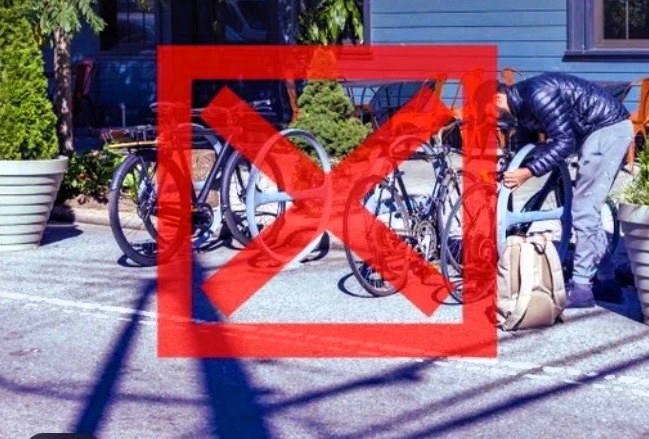
CITYWIDE — The New York City Department of Transportation caused a stir last week when the agency posted this unexpected message on its social media accounts: “NYC DOT to remove bike racks to make more room for car parking.”
DOT added, “Why use so much curb space exclusively for storing property?”
The message was accompanied by a photo of bike docks obscured by a big, red “X,” and a link to a website, “NYC.GOV/byebyebikes.”
This was a surprising reversal of city policy. Parking spaces have been disappearing by the thousands over the past few years, to the exasperation of car owners.
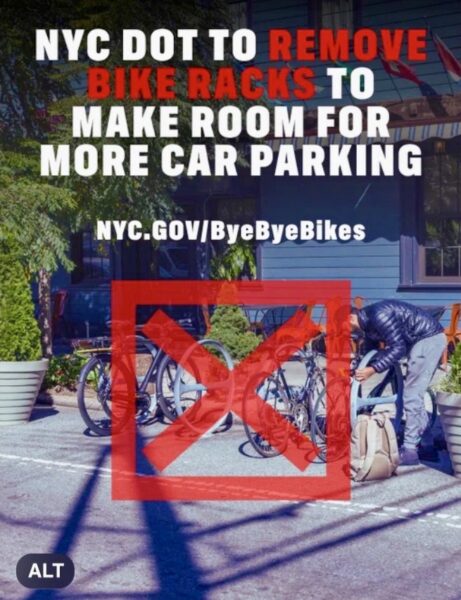 This is the Department of Transportation’s social media post that set off a kerfuffle last week. Graphic: NYCDOT
To make sure the message about DOT’s bold new initiative got out, the city’s Department of Buildings boosted it on their own social media accounts.
The message did indeed get out, and the reactions — hundreds of them — were swift.
“Hell yeah!” responded beleaguered drivers, while the bike clan sputtered in disbelief, warning ominously that Transportation Alternatives “is not going to approve of this.”
Eventually, it became clear that Wednesday was April Fools’ Day — and the post was just a joke, folks!
“I literally had a minor heart attack,” one cyclist confessed in relief. (For some reason, many car owners did not express the same relief.)
The post touched on New York City’s existential battle over asphalt: the feud between the bike clan vs. the car clan, which at times reaches Hatfields vs. McCoys intensity. (Only instead of shooting shotguns at Tug Fork they are flipping the finger on Court Street.)
Like many classic April Fools’ jokes, the pranksters chanced throwing a match onto dry tinder. DOT has been accused of waging a “war on drivers,” in the immortal words of the New York Post, as it has removed thousands of parking spaces to make room for Citi Bike docks, dining sheds and garbage bins.
In response to DOT, the anti-car crowd posted messages like (and these are actual words): “Imagine if you put your sofa on the sidewalk in front of your building and declared that it was just for you to sit in and it would remain there for as long as you felt like it. … Why should private cars be able to take up public space?”
Supporters of street parking countered this assertion in their own posts (these are also actual words): “It’s called the STREET. It’s where cars, trucks, buses, ambulances, service vehicles of all kinds, and bikes go.”
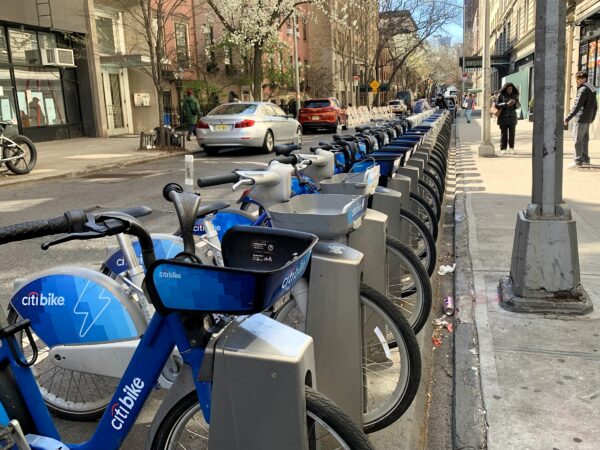 Bike docks loom large in the city’s turf war between drivers and bikers. Photo: Mary Frost/Brooklyn Eagle
Just a joke, folks!
The friction between the farmer vs. the cowman — oops, the cyclists vs. the drivers — has led to lawsuits, bike-lane reversals and reinstatements, even as the city failed to meet its own mandate for new bike and bus lanes under the Adams administration.
In an attempt to bring some sort of overall coordination, Mayor Zohran Mamdani and DOT on Tuesday announced the creation of a new “Office of Curb Management.” The office will “oversee curb policies across the city’s 6,300 miles of streets and roughly 3 million curbside parking spaces,” according to a release from the Mayor’s Office.
With this divisive history, why would DOT poke the bear?
Because the agency believes that most residents can still take a joke — at least one day a year.
“New Yorkers have a great sense of humor — and we think government should too,” Nick Benson, DOT’s chief communications officer, told the Brooklyn Eagle.
“Our April Fools’ post got people talking, laughing, and most importantly, paying attention to how we use our streets,” Benson said. “When government agencies communicate in a way that feels human, relatable, and a little bit playful, more people engage — and that means more people learning about the work we do every day.”
He added, “We promise — we’re not coming for your bike racks!”
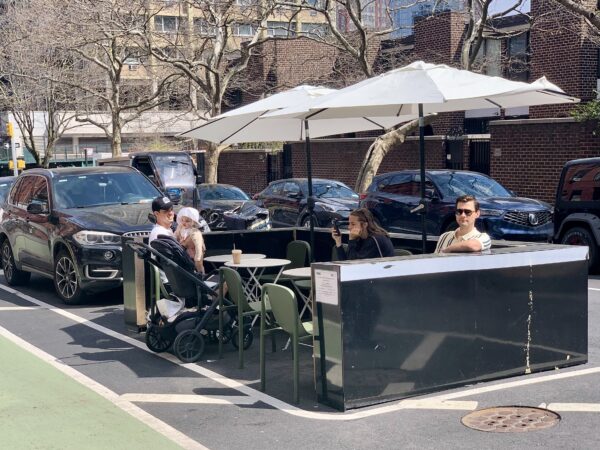 An outdoor dining shed took over a parking space on Henry Street in Brooklyn Heights. Photo: Mary Frost/Brooklyn Eagle
Quirky humor catches attention
While the post rubbed some people the wrong way, it also reflects the quirkier, more humorous style city agencies have adapted on social media in recent years.
DOT was not the only city agency April trickster. The Parks Department joined in the fun by claiming that the department’s newest surveillance system is … pigeons: “Facial recognition. Navigation. Even Self Cleaning,” they boasted. The post winked at the online faux conspiracy, “Birds Aren’t Real.”
Commercial brands have been using humor in their social media campaigns for years, and if done right, it pays off bigly. The NoGood social media site warns, however, that brands should avoid controversy or cringe in their attempts to be funny, at the risk of alienating customers.
Rather than avoiding controversy, DOT stared straight into the maw of the abyss.
What are the April Fools’ rules, if any? Ideally, the prank should make people look “foolish,” but should be funny to everyone involved when it’s all over, according to Hoaxes.org.
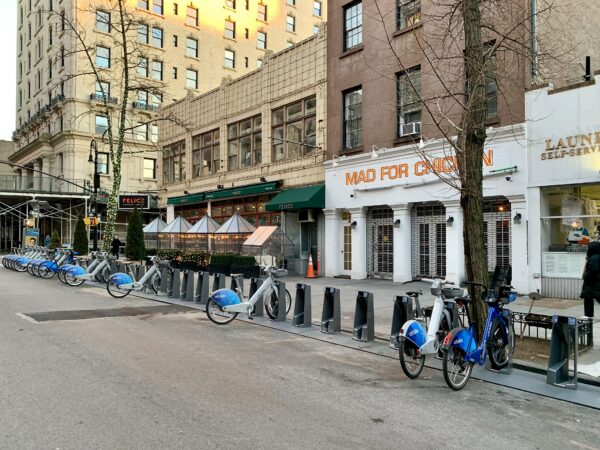 Bike docks where there were once parking spaces, on Montague Street in Brooklyn Heights. Photo: Mary Frost/Brooklyn Eagle
In addition, the prank should end at noon on April 1 — a rule based on an old folk belief. “April Fools’ Day honors the spirit of Folly, which is a powerful force. And as such, it needs to be contained within strict temporal limits,” the website says.
The noon cut-off seems to be honored by many corporate jokesters. For example, Taco Bell once ran full-page ads in newspapers announcing they were purchasing the Liberty Bell and renaming it the Taco Liberty Bell. They confessed to the prank at noon, Hoaxes says.
Beyond that, much leeway is given.
Whether DOT’s April 1 prank was funny or not is a matter of perspective. Likely, it was funnier to cyclists than car owners — some of whom said they felt mocked by the city.
Still, points have to be given for the diabolical humor behind the post, which was truly in the spirit of Folly.
In his release, Mamdani held an olive branch out to the combatants when he said the city’s streets are for everyone, “from cyclists and drivers to sanitation workers and delivery workers to food vendors and outdoor diners.”