
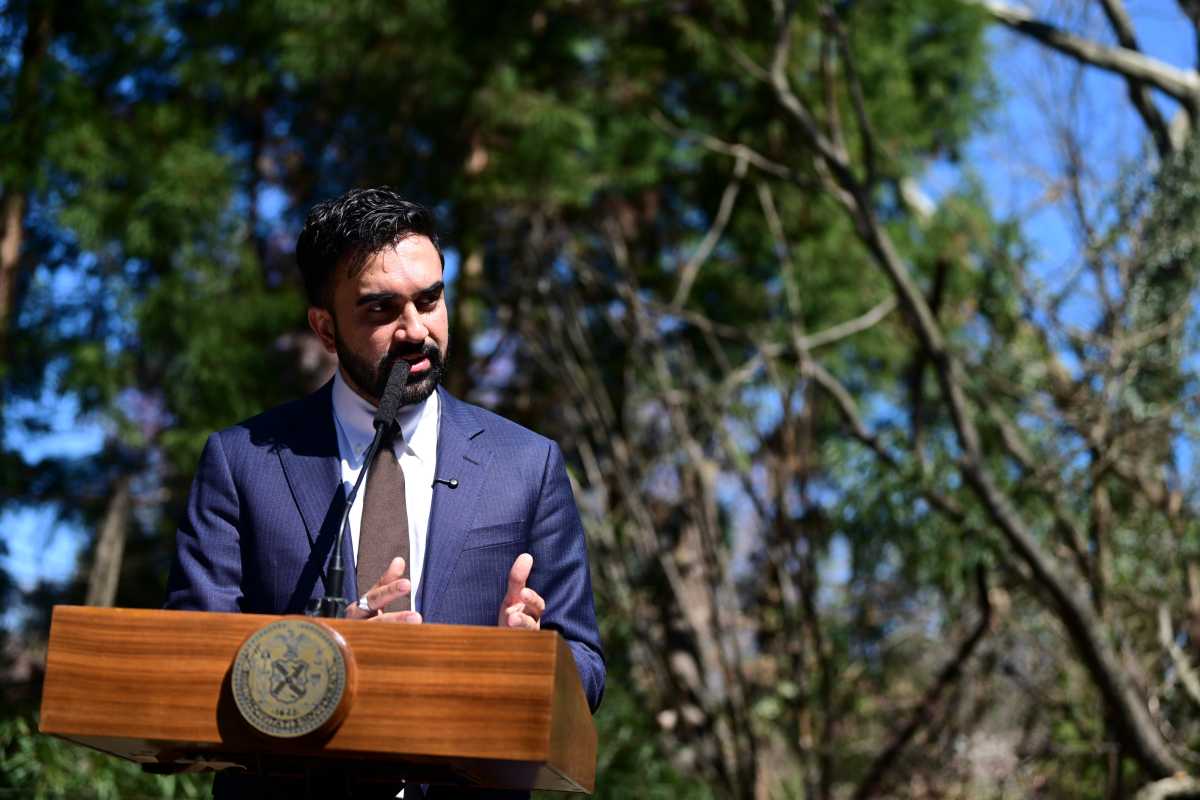
Wednesday, April 8, marks the 98th day of Zohran Mamdani’s term as mayor. amNewYork is following Mamdani around his first 100 days in office. We are closely tracking his progress on fulfilling campaign promises, appointing key leaders to government posts, and managing the city’s finances. Here’s a summary of what the mayor did yesterday and today.
Mayor Zohran Mamdani said Wednesday that he “was not aware” that his nominee to lead the city’s Department of Investigation (DOI) had donated to and canvassed for his mayoral campaign after City Council members raised concerns this week about whether the pick could independently lead the city’s anti-corruption watchdog
Mamdani made the remark at a Prospect Park Zoo press conference announcing the city’s settlement with HungryPanda, a delivery app accused of charging illegal fees to immigrant-owned restaurants.
Asked whether he knew about DOI commissioner nominee Nadia Shihata’s campaign support before appointing her, the mayor said the administration chose her because of its “confidence in her integrity, in her independence, and, frankly, her track record.”
“We are looking to have that independence and that integrity in the leadership of DOI, and we see her as exactly the right person, and we’re looking forward to that process,” he added.
Pressed by POLITICO on whether he knew about her support of his campaign for mayor, he said: “I was not aware of that.”
The question came two days after a City Council confirmation hearing in which lawmakers pressed Shihata over her ties to Mamdani. During that hearing, Shihata acknowledged that she had donated to Mamdani four times, totaling $700, and had also spent about an hour canvassing for him during the campaign. Council members asked whether those ties would undermine public trust in DOI, the city’s anti-corruption watchdog, if she were confirmed to lead it.
Shihata told council members this week that any investigation under her watch would be guided by the facts and the law, not politics or personal relationships. But she stopped short of promising blanket recusals from matters involving Mamdani or senior officials in his administration, saying she would seek legal guidance if conflicts arose.
Mamdani puts HungryPanda on notice
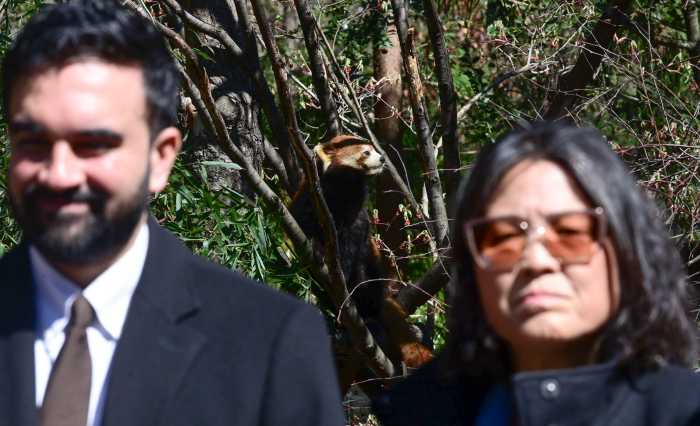 A red panda peers out between Mayor Mamdani and Deputy Mayor Julie Su. Photo by Lloyd Mitchell
The main purpose of Mamdani’s appearance at Prospect Park Zoo on Wednesday was to announce a city settlement with HungryPanda, a third-party food delivery app accused of illegally overcharging immigrant-owned restaurants through hidden fees and misleading deductions.
The city said the settlement totals more than $875,000, including more than $580,000 in restitution for more than 380 restaurants and more than $294,000 in civil penalties and fees.
Standing in front of the zoo’s red panda enclosure, Mamdani leaned into the setting, joking that the animals behind him were “very hungry pandas” but, unlike the app, were not interested in “bamboozling hard-working New Yorkers.” He used the moment to cast the case as both a consumer-protection action and a small-business enforcement push, saying neighborhood restaurants already face steep costs for labor, rent, equipment, and utilities, and should not also be hit with what he described as fraud disguised as app fees and deductions.
The administration framed the settlement as a precedent-setting case. According to the city, it marks the first time the Department of Consumer and Worker Protection has enforced the city’s Third-Party Food Delivery Service Laws against a delivery app for harming business owners.
Investigators found that HungryPanda, which is used predominantly in New York’s Asian immigrant communities, violated the city’s fee-cap law by imposing unlawful charges, including by bundling multiple fees into one line item, frequently relabeling charges, and describing illegal overcharges as “promotion deductions.”
Mamdani, Deputy Mayor for Economic Justice Julie Su, and DCWP Commissioner Sam Levine all used the announcement to send a broader warning to app-based platforms doing business in the city. Su said the company had counted on restaurant owners being too small and too busy to fight back, while Levine said the city would not allow delivery apps to hide “junk fees” behind confusing receipts and opaque accounting. Mamdani, for his part, said the settlement showed the administration had “no tolerance” for exploiting either workers or small businesses.
Under the settlement, HungryPanda must pay restitution and penalties, and also change its practices going forward. The company is required to comply with the city’s fee-cap law, provide clearer fee disclosures to restaurants, adopt internal compliance policies and training, and submit annual certifications attesting to its compliance with the law.
The administration also tied the case to an earlier $5 million settlement involving HungryPanda, Uber Eats, and Fantuan over minimum-pay violations affecting more than 49,000 delivery workers, reinforcing City Hall’s effort to present the app crackdown as part of a broader campaign against exploitative platform companies.
amNewYork has reached out to HungryPanda for comment.
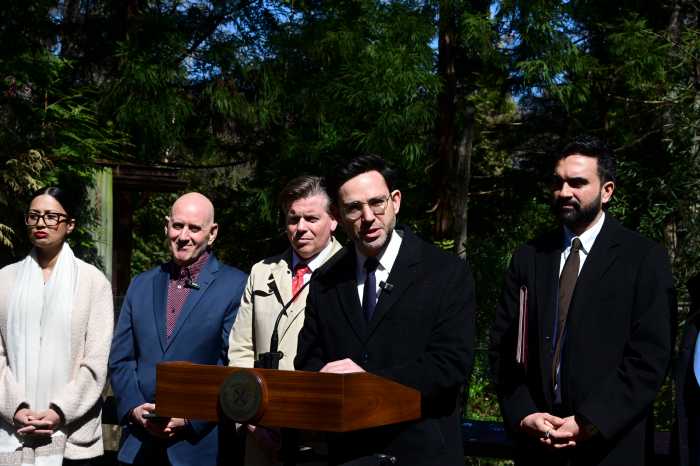 Commissioner Sam Levine speaks at Prospect Park Zoo, flanked by Assembly Member Bobby Carroll, Council Member Harvey Epstein and Council Member Shahana Hanif.Photo by Lloyd Mitchell
The settlement announcement also underscored a growing fight over funding for the DCWP. Manhattan Council Member Harvey Epstein, who chairs the Council’s Committee on Consumer and Worker Protection, used his remarks at the press conference to argue that the agency deserves more support, saying its enforcement work is returning money to workers, consumers, and the city and that its staff is “paying for themselves.”
The comment came days after Epstein joined union members at a City Hall rally urging Mayor Mamdani to fully fund DCWP following reductions proposed in the mayor’s preliminary budget plan. Labor advocates and council members at that rally said the proposal would reduce the agency’s funding from $85.5 million in the current year to $74.7 million in the next fiscal year, though City Hall disputed that characterization and said the proposal represented an increase over the prior administration’s November plan.
Mamdani did not address any specific funding change afterward. Instead, he emphasized that the budget process was still underway and that “those conversations are ongoing.” He added that what would “never be in doubt” was DCWP’s “central place” not only in receiving complaints but in acting on them.
World Cup impact on parkland events
On Wednesday, Mamdani also defended the administration’s plan to limit some public events during the FIFA World Cup, after the New York Post reported this week that he had signed an emergency order that could block some concerts, food festivals, and other newly permitted events on parkland during the tournament.
According to the Post, the Parks Department adopted the rule at the request of the NYPD, which said staffing would be stretched by World Cup-related demands and events tied to the nation’s 250th anniversary.
The mayor framed the move as a logistical response to the demands of hosting World Cup-related events and visitors, rather than a broad restriction on park use. He said the city is less than 70 days from the start of the World Cup and described it as a “once-in-a-generation opportunity” that will require enough public-sector capacity to manage the volume of related events.
As a result, he said, the city is looking to move some regularly scheduled events to alternative dates so it can handle the tournament at what he called an “excellent level of quality” across all five boroughs. He also cast the World Cup as a multibillion-dollar economic opportunity for the city.
Mamdani also sought to narrow the scope of what would be affected. He said ordinary park use was “not in question” and drew a distinction between routine recreation and “large-scale events” requiring permits and police presence. “If you’re going to barbecue, you can barbecue,” he said.
Approval rating
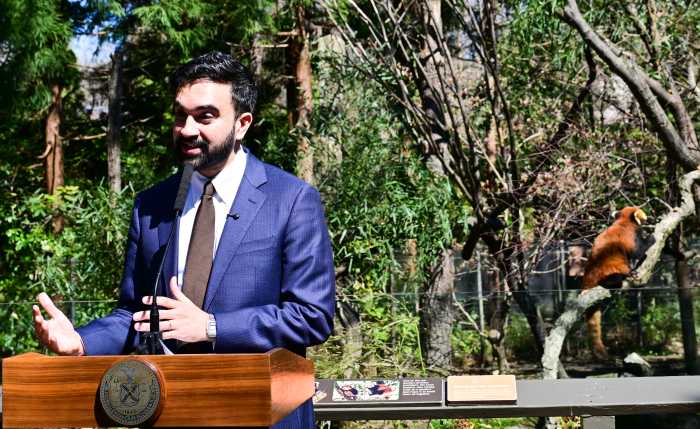 Photo by Lloyd Mitchell
The latest Marist Poll found that Mayor Mamdani is nearing the end of his first 100 days, with more New Yorkers approving than disapproving of his performance, though he still trails the standing Eric Adams held at a comparable point in 2022.
The survey found that 48% of New York City adults approve of the job Mamdani is doing as mayor, while 30% disapprove and 23% are unsure. Marist also found that 55% of residents have a favorable view of him, 56% say the city is moving in the right direction and 58% say they have at least a good amount of trust in him to make decisions in the city’s best interest.
At the same time, the poll found that Mamdani underperforms Adams’ early approval rating, noting that 61% of city residents approved of Adams ahead of his first 100 days, compared with 48% for Mamdani. The Marist survey of 1,454 adults was conducted March 26-31 and has a margin of error of plus or minus 3.3 percentage points.
Asked about the polling at Wednesday’s press conference, Mamdani did not engage directly with the comparison to Adams or the topline approval figure. “I will always leave the grades to New Yorkers themselves,” he said, before pivoting to a list of accomplishments he said would define the administration’s first 100 days.
He pointed to $9.3 million in settlements, more than 6,000 apartments being repaired as part of more than $30 million won from bad landlords, $1.2 billion secured with Gov. Kathy Hochul for universal child care, and more than 100,000 potholes filled.
He then ended on a joking note, saying the city would pave more than 1,000 miles of road, which he said, while quoting Pitbull, is about the distance from New York City to Miami.