
Sign up for Chalkbeat New York’s free daily newsletter to get essential news about NYC’s public schools delivered to your inbox.
A few years back, a groundswell of Brooklyn parents in District 13 wanted to ditch gifted and talented classes, concerned about sorting and segregating children starting in kindergarten.
Then-Superintendent Kamar Samuels, now chancellor of New York City schools, wanted to find an alternative that offered rigorous academics for all students in a school rather than a select few. He settled on the International Baccalaureate, or IB, program and encouraged schools in District 13, which spans from Brooklyn Heights to Bedford-Stuyvesant, to pursue the yearslong authorization process, using a grant to support the shift.
The IB approach embraces inquiry-based, transdisciplinary learning that allows students to go deep into a specific topic across classes, connecting global issues to their own experiences. Educators are trained to facilitate these connections and foster ways for students to become independent thinkers and leaders.
“It means something for a teacher to be an IB teacher. It means you’ve gone through a process,” Samuels said in 2021, when introducing the initiative, “and you’re really pushing the envelope as you think about all your students.”
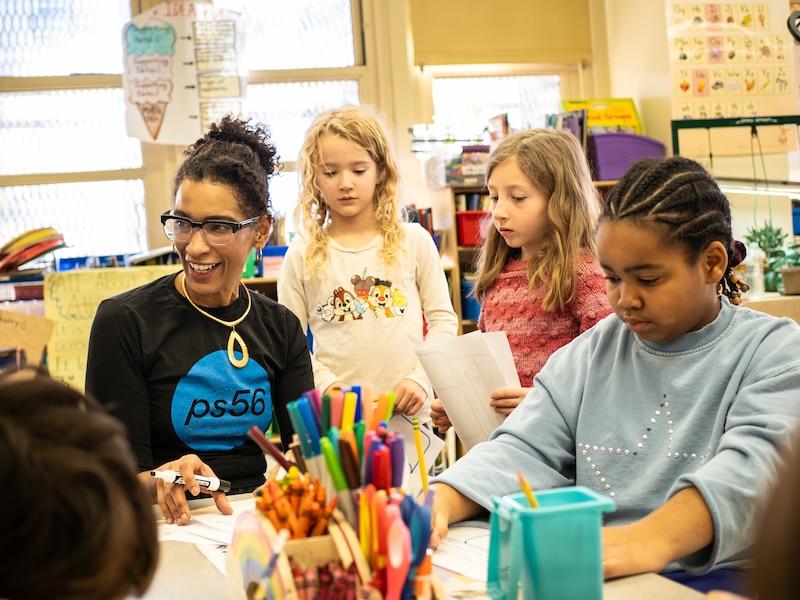 Amy Hamberry and her second grade students at P.S. 56 in Clinton Hill, Brooklyn, on March 9. (Yunuen Bonaparte for Chalkbeat)
The district now has five elementary schools and two middle schools in the program, representing New York City’s first IB “pathway” designed to serve children from 3-K through eighth grade. (The district also hopes that students continue on to the handful of public IB high schools in the city, including those in neighboring districts.)
The IB model might soon gain in popularity as schools grapple with the state’s graduation requirement overhaul, as the Portrait of a Graduate framework replaces Regents exams for diplomas starting in the 2027-28 school year. The approach closely aligns with the state’s six key qualities students must demonstrate (such as being creative innovators, effective communicators, and global citizens). And as schools await the state’s guidance on how to assess students under the new framework, IB schools already have a well-developed system of project-based assessments.
The schools also boast strong post-secondary outcomes: 71% of IB students in the U.S. enrolled in college compared to the average of 56%, the IB Schools and Colleges Association found.
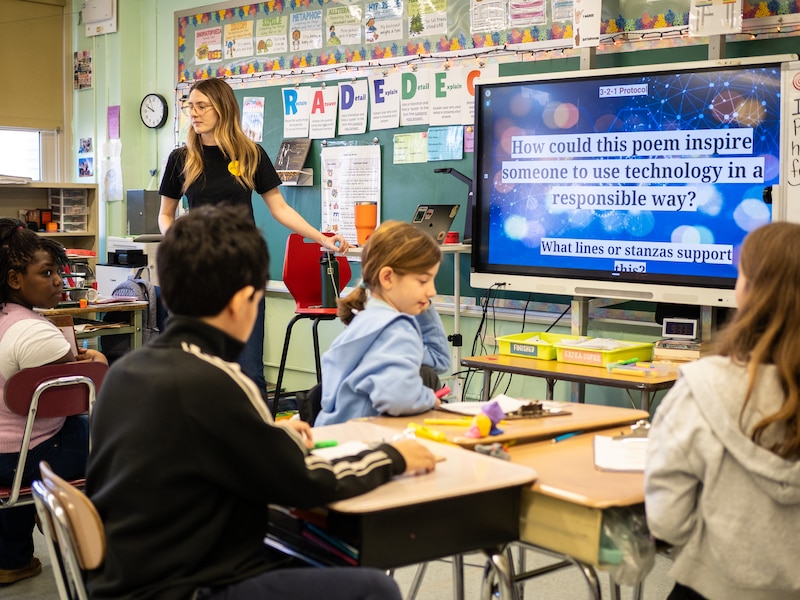 Fifth grade students at P.S. 56 on March 9. (Yunuen Bonaparte for Chalkbeat)
On a recent Monday at P.S. 56, in Clinton Hill, second graders hummed as they worked on a project for a unit on self-expression. The kids were creating shapes to use for fabric construction, incorporating math, writing, and social-emotional learning as they jotted down the way the colors they used made them feel.
In a fifth grade room down the hall, students — also doing a unit on self-expression — tackled a poem about technology, as they discussed the effect technology is having on education. Another fifth grade class read a poem about bullying, and students were asked to write their own poem about a problem they wanted to change.
Jayda, a fifth grader, wrote about concerns with the increase in immigration enforcement across the nation. She recently participated in an anti-ICE protest that Lucy, another fifth grader, organized. They and their peers talked about how they struggled with writing when they were younger but have since blossomed as writers, especially as they’ve been able to work on more creative writing.
“Now it’s my passion,” fifth grader Noah said. “I couldn’t imagine life without it.”
Tracey Scronic, the instruction lead and coordinator for District 13’s IB schools, sees the shift to the IB model as an “equity tool” to ensure all of a school’s students are exposed to enrichment. She said it “de-prioritizes traditional testing’s emphasis on regurgitation of information.”
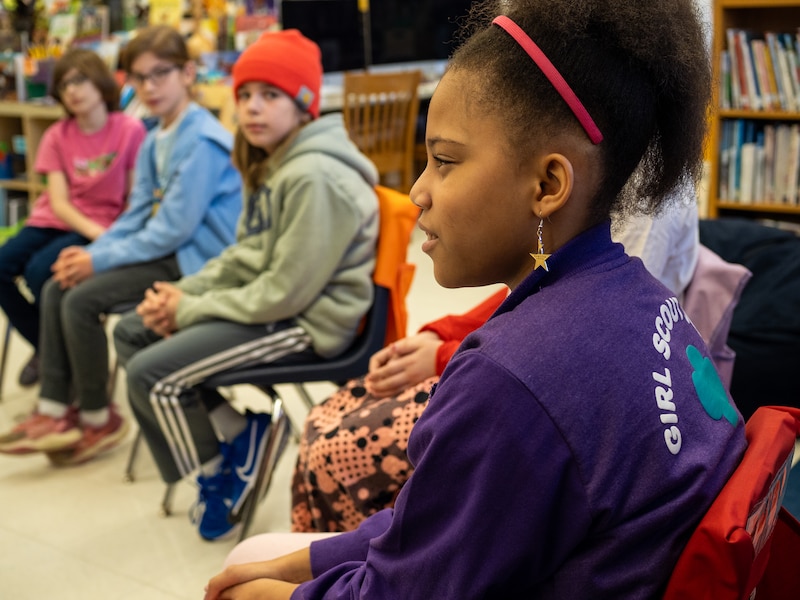 Jayda speaks about her experience learning through the IB program at P.S. 56 on March 9. (Yunuen Bonaparte for Chalkbeat) Leaning on IB to tackle enrollment declines
The IB program at P.S. 56 has helped prop up enrollment, its principal, Eric Grande, said.
Just before Grande became principal of P.S. 56 a decade ago, the Clinton Hill elementary school tried to bolster enrollment, then hovering below 200 students, by adding a gifted and talented program. Grande added a “world language” program, focusing on Spanish, hoping that would attract more families. But the school didn’t feel cohesive.
“Even though we had a relatively small school, there was almost like schools within the school,” Grande said. “You had your world language Spanish program, your gifted and talented program, you had your special education classes and your gen ed classes, and it just started to feel a little bit off.”
We’re on a need-to-know basis.
Every weekday morning, Chalkbeat New York is bringing thousands of subscribers the news on public schools and education policy that they need to start their day. Sign up for our free newsletter to join them.
Students within the school, which is more racially diverse than most New York City elementary schools, were not integrated within the different programs, he said. (Last year, about 36% of its students were Black, 36% were white, 17% were Latino, and 1% were Asian American; roughly 47% of children came from low-income families.)
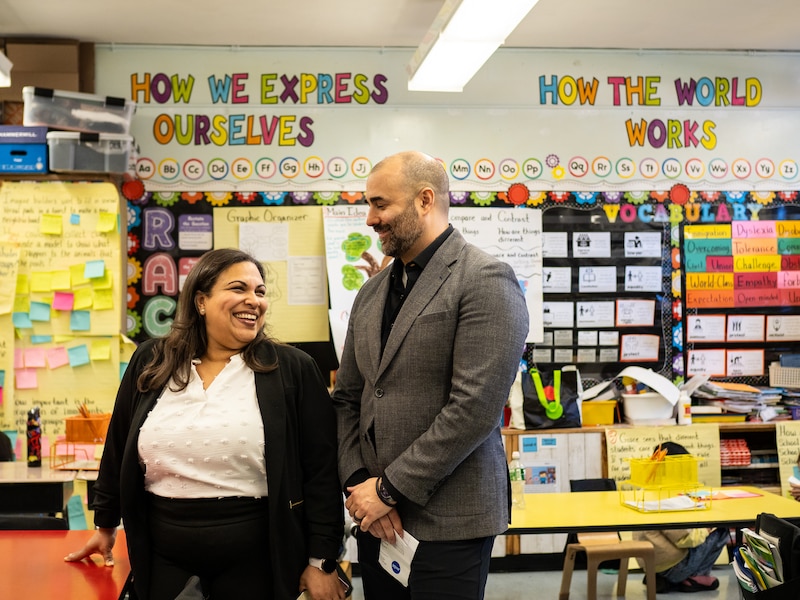 Principal Eric Grande and Arelis Jimenez, IB coordinator, in a third grade classroom at P.S. 56. (Yunuen Bonaparte for Chalkbeat)
Grande began looking for a model to bring everyone — and all of their different programs — together, appeasing families who wanted a foreign language and those who wanted a project-based approach to teaching. IB offered the “perfect synergy of all things that we were doing.”
The school is now in its second year as an authorized IB school following three years as a candidate school. Enrollment has increased, with about 230 students last year.
And while Grande said his school has never been too focused on test prep, he was proud to see a shift in state test scores since his teachers transitioned to the IB framework, from about 35% proficiency on reading in 2019, the year before the pandemic, to more than 60% last year.
The move to IB can be challenging
The buy-in from teachers on IB takes some time, said Scronic. They needed training to shift practices and must do more in-depth planning around the new units. They also needed to figure out how to meld the IB framework with the mandated literacy curriculum for their district, EL Education.
“It is a bit more cognitively intense for the teachers,” Scronic said. But after a while, she said teachers feel like they’re being respected again for their craft and facilitating connections between the curriculum and students’ own lives. “I feel like the passion that a brand-new teacher brings to the profession then kind of gets squashed sometimes, IB has brought that back.”
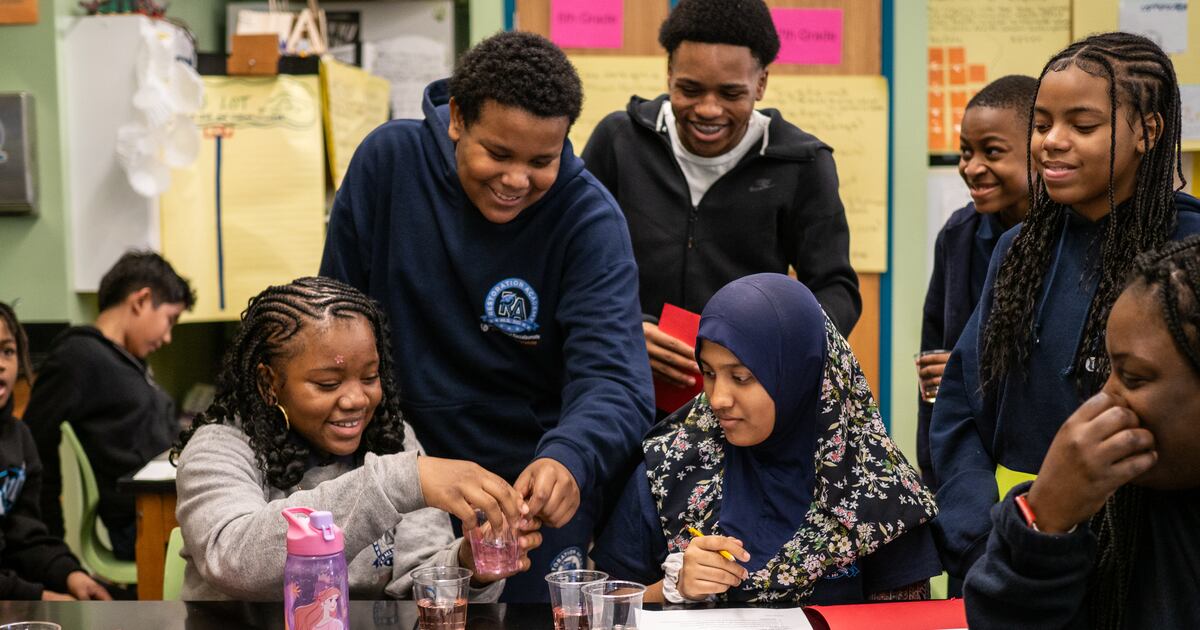
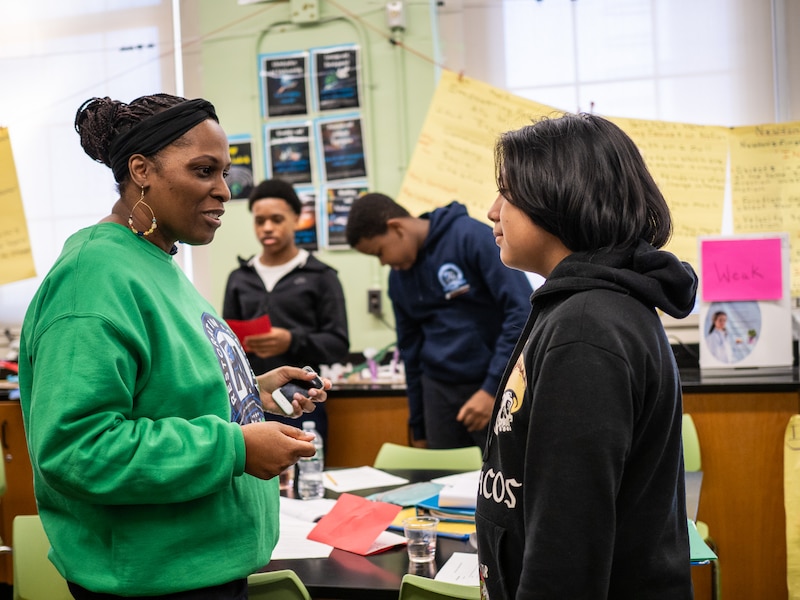 Rosa Davis and her seventh grade students during science class at Restoration Academy on March 9. (Yunuen Bonaparte for Chalkbeat)
Becoming an authorized IB school is not easy. Schools have to pay the Switzerland-based nonprofit that oversees the IB program about $9,000 a year to start the training and candidacy process. It’s about $10,000 each year once a school is authorized to support the implementation and maintenance of IB programs, according to the organization’s website. District 13 used a grant to cover the costs for the initial training for the schools, though the schools have had to foot the bill for new teachers.
Though Scronic leads District 13’s IB initiative, she’s started holding monthly Zoom meetings for about 40 IB elementary and middle schools in the city, a grassroots effort to provide support and create a community to share best practices and resources.
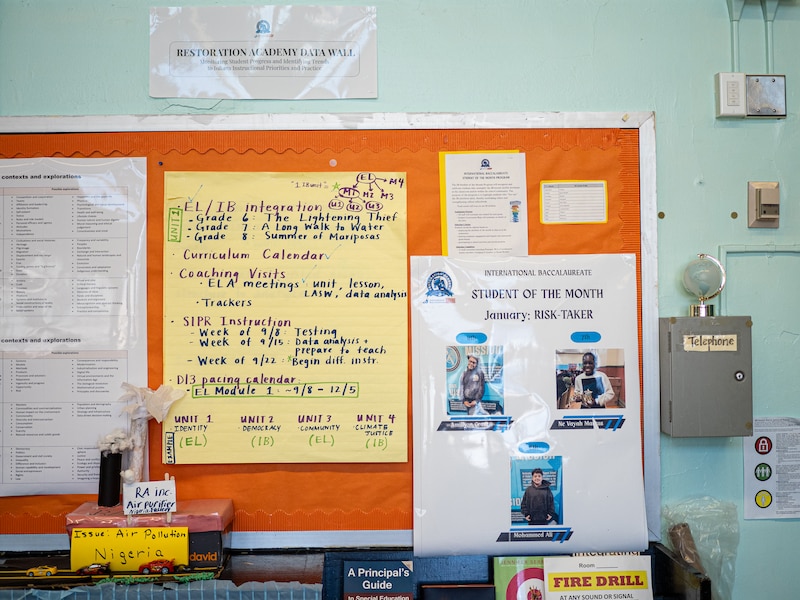 Restoration Academy Principal Adele Simon’s office displaying IB program notes and a diorama created by students. (Yunuen Bonaparte for Chalkbeat)
Samuels continued to promote IB schools when he left his Brooklyn district to become superintendent of Manhattan’s District 3. He encouraged schools in Harlem to adopt the IB model as a way to tackle declining enrollment in a part of the district facing heavy competition from charter schools. (District 3 used a grant to cover the costs as well.)
But Samuels acknowledged the challenges in pursuing IB authorization.
“I do believe in a lot of the work of IB, but it really takes a big investment,” he recently told K-12 Dive. “It takes principals being onboard. It takes teachers being onboard and willing to go and get a lot of background and content knowledge, and to be able to personalize for young people and the kids in your school.”
A middle school IB program helps students find their ‘voice’
Sanai Gary, an eighth grader at Bedford-Stuyvesant’s Restoration Academy — which is in its first full year as an authorized IB school after its yearslong candidacy — said the IB approach has helped her deepen her learning.
“I like how the topics transmit over to other classes. I feel like it helps me learn better,” said Sanai. “It gives me more time to focus on it.”
Last year, she and her peers became clean water advocates after diving into a unit on global sustainability.
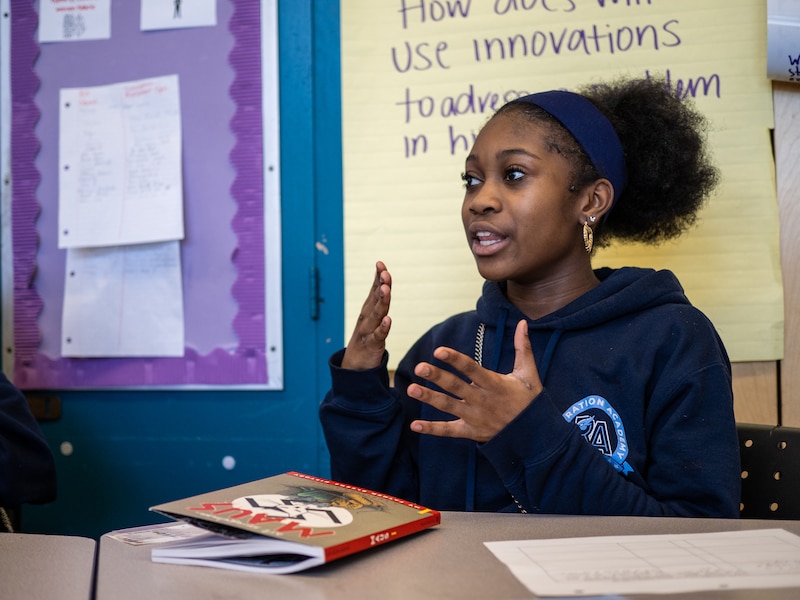 Sanai Gary, an eighth grader, speaks during her language and literature class at Restoration Academy. (Yunuen Bonaparte for Chalkbeat)
It started after they read a novel in English class, “A Long Walk to Water,” about the struggle in South Sudan for clean water. In their Individuals and Societies class (akin to social studies), a student brought up questions about the water crisis that started in 2014 in Flint, Michigan, that got the students wondering about the water quality in their own school. So, in science class, they tested their school’s water fountains and created makeshift filtration devices.
Concerned about the color and clarity of their school’s water, back in English class, the students mounted a letter-writing campaign to city officials demanding changes.
Restoration Academy has struggled with enrollment and has long served marginalized students. The middle school currently has roughly 80 middle schoolers; about 80% are Black and Latino, and more than 90% are from low-income families. Pre-pandemic, about 20% of its students were considered proficient in reading. Since transitioning to IB, the scores have improved, rising to about 30% last year.
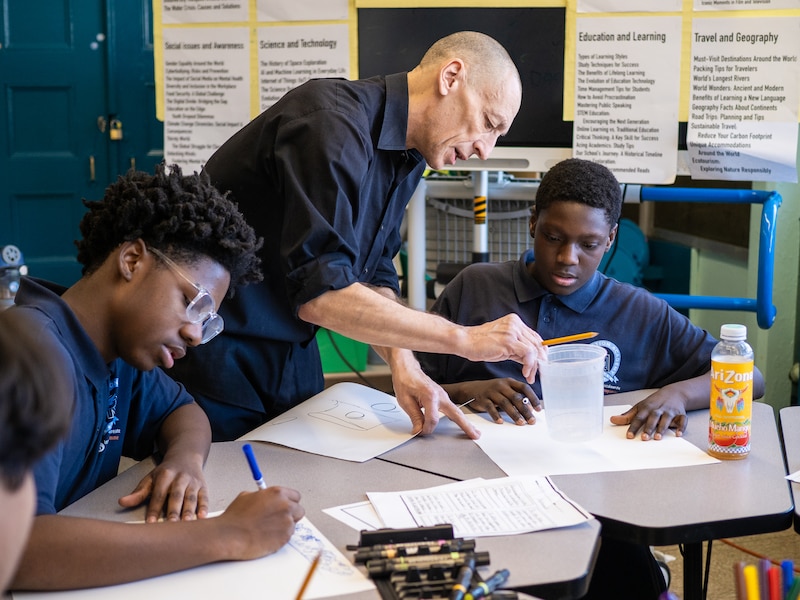 Tomaso Millian and his eighth grade students during design and art class at Restoration Academy on March 9. (Yunuen Bonaparte for Chalkbeat)
But more importantly, Principal Adele Simon said, students are increasingly linking what’s happening around the world to their own lives and finding their voices to advocate for change based on what they’re learning in school.
“It’s the connection between what they’re reading,” Simon said, “and not just reading it for the purpose of reading it, but reading it for the purpose of, ‘Okay, what am I going to do with this? … Who’s in power and who is not in power? And how can I make sure that the people in power represent me and my community?”
Their school is getting new water fountains with filtration devices this spring.
Amy Zimmer is the bureau chief for Chalkbeat New York. Contact Amy atazimmer@chalkbeat.org.