
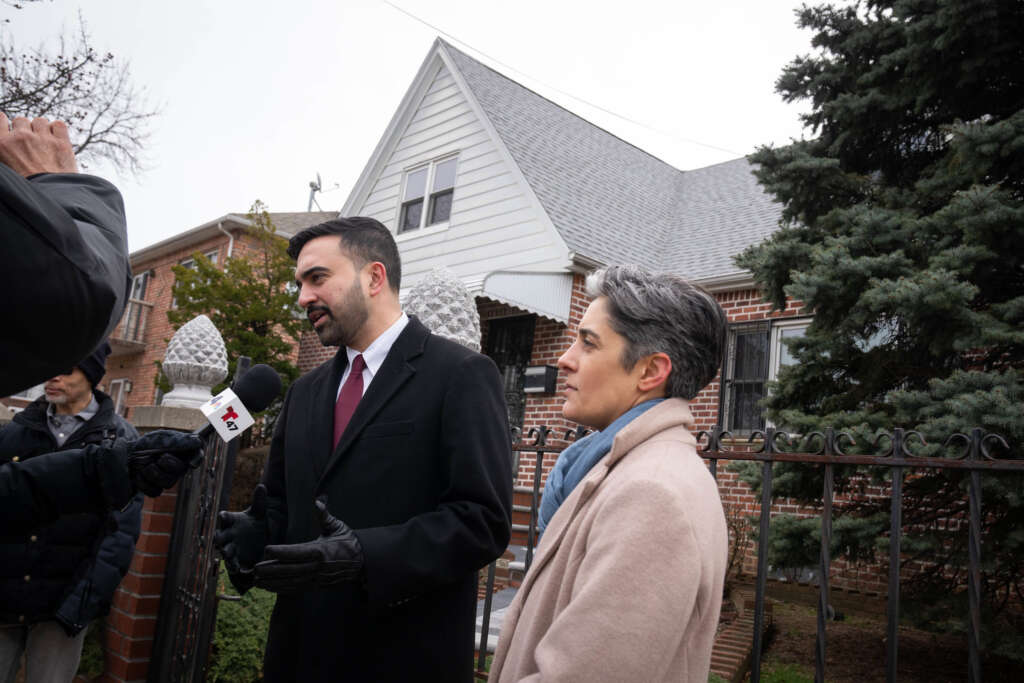
“I reject the premise that us going after bad landlords is the same thing as not working with the real estate industry. They are two different things,” said Deputy Mayor for Housing and Planning Leila Bozorg in an interview about the administration’s housing policies after 100 days in office.
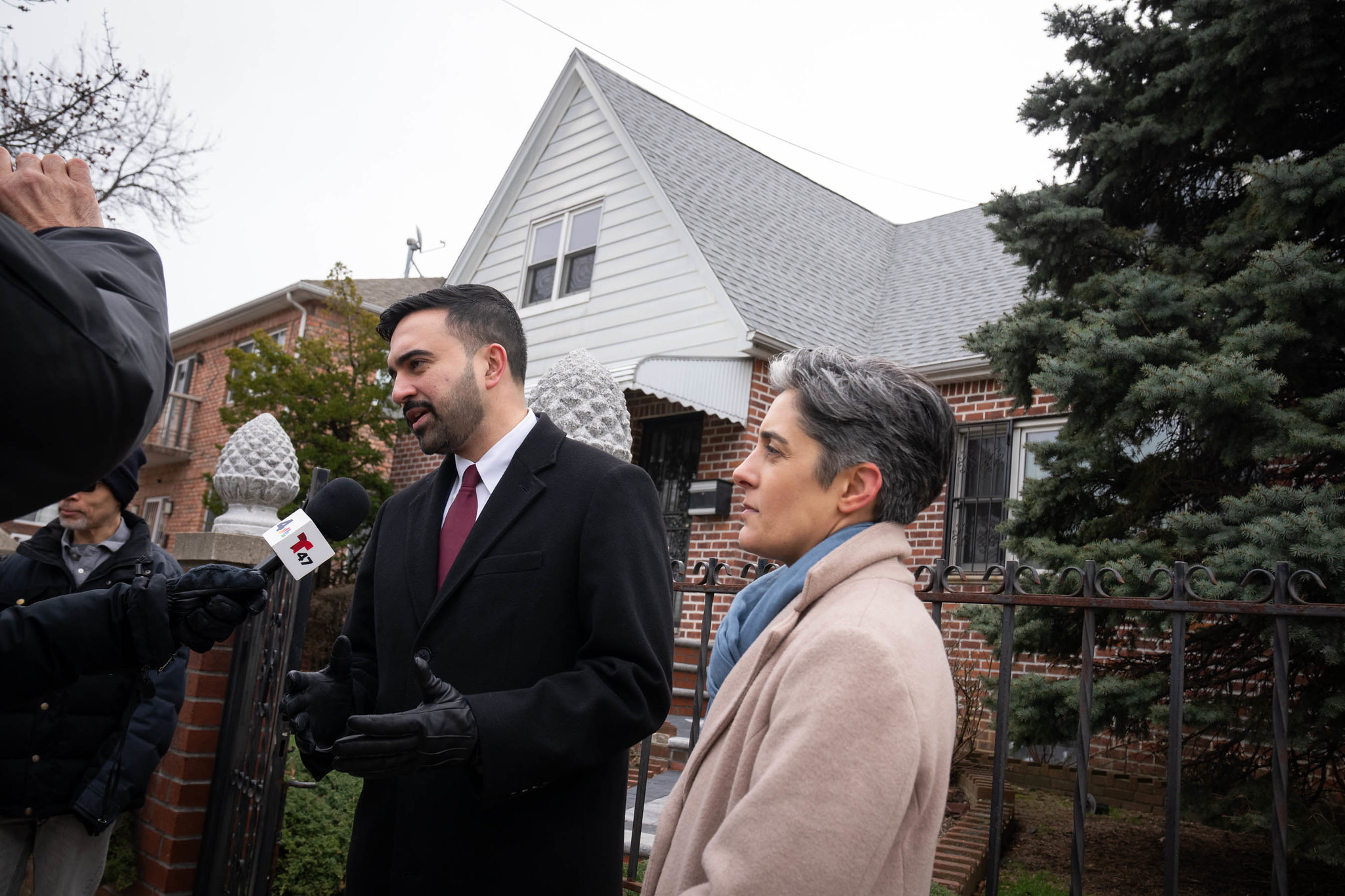 Bozorg with Mayor Mamdani at a press conference in March. (Ed Reed/Mayoral Photography Office)
From the first days of his fledgling Mayoral campaign, Zohran Mamdani was talking about housing. His “rent freeze” promise for rent-stabilized tenants, for example, helped catapult him to Gracie Mansion.
His first 100 days have been characterized by that tenant-centric housing policy—like going after “bad landlords,” holding “rental ripoff” hearings, and standing up for tenants in court.
Many of those stances have frustrated real estate power brokers.
But his administration has also tried to strike a delicate balance: standing with tenants while leveraging the real estate industry to help the new mayor make a dent in the city’s affordability crisis.
Mamdani and his team have also embraced “yes-in-my-backyard” policies that seek to build more housing across the city, and build it faster. He’s set ambitious housing production targets, and even sketched out development plans with one of New York’s big real estate players: President Donald Trump.
One of his first appointments—Leila Bozorg, deputy mayor for housing and planning—sat down with City Limits to discuss the first 100 days of the Mamdani administration’s housing policy.
This interview has been edited for length and clarity. Jump to:
On the first day of the administration, Mayor Mamdani made several announcements about housing. 100 days later, how has the administration prioritized housing so far?
The first day was really illustrative of the ways in which we want to broadly address the housing crisis. The fact that we focused on housing day one also illustrates how central we see the housing affordability crisis to the broader affordability crisis that the mayor spoke so eloquently about on the campaign trail and really hit a note with so many New Yorkers and voters.
That continued through the first 100 days. We know what it takes long-term to bring down housing costs—to be building more housing everywhere in the city—but that has to be balanced with an acknowledgement that New Yorkers need relief right now and today. Whether that’s with building or housing conditions or issues they’re facing with their landlords.
The three day-one [executive orders], one was around re-establishing the Mayor’s Office to Protect Tenants. The other was around the SPEED task force—that’s also really a recognition that there’s things we can be doing today to reduce the friction people are facing. We’ve been looking soup to nuts, from environmental review all the way to the lease up process, at the various challenges people are facing in either building or getting into housing. That third [executive order] was about the land inventory fast track and making sure we’re leaving no stone unturned when it comes to identifying places to build housing.
 Bozorg and Mamdani signing a housing-related executive order at a press conference with tenants in the Bronx in January. (Michael Appleton/Mayoral Photography Office)
The real estate industry has long been a powerful political force in the city. The mayor has also been changing the dynamic between landlords and renters—intervening on behalf of tenants in cases like Pinnacle, hosting “rental ripoff” hearings and promising a freeze for rent stabilized apartments. Real estate groups have been critical of these. But your work also relies heavily on partnerships with developers and landlords. How are you managing a charge to uplift tenants and maintain relationships with real estate?
We are ready and willing to work with any and all stakeholders who want to help address the broader housing affordability crisis that New Yorkers are facing. I reject the premise that us going after bad landlords is the same thing as not working with the real estate industry. They are two different things. There’s a lot of solid, good partners we have in real estate and in the affordable housing development community that we will continue to work with to build more housing. We need to continue to build on those relationships and partnerships.
But this administration is also going to be focused on ensuring that bad actors in the marketplace are held accountable to provide safe, adequate housing. Especially if some of these landlords are conducting illegal activity or harassing tenants. We’re not going to turn a blind eye to bad actors in the housing space.
That’s going to be one pillar of our work, but we have to take this “all of the above” approach. We have to both hold landlords accountable while also supporting responsible owners in the work that they need to do to ensure they’re able to maintain safe and quality and decent housing for New Yorkers. Strong partnership across the board is going to be required to do everything we need, and I think we can do both.
Picking up on that—the state of rent stabilized housing has also been of concern to both tenants and landlord groups, especially in light of the mayor’s rent freeze promise. A lot of landlords say they can’t cover expenses given low rents in a lot of these buildings. What role do you think the city has to play in helping steward these properties—either through more punitive means like housing code enforcement, or supporting landlords who are struggling with high operating costs?
We were proud to be able to appoint six of the [rent guidelines board] members. They are an independent board and they’ll be considering all the factors and making their decision independently.
That being said, we’re coming off of four to five years of rent increases for tenants. And even with those rent increases, a lot of buildings still remain in distress. Part of the challenges that some owners are facing with an increasing inflationary environment, increasing operating costs—insurance costs have undoubtedly been a huge strain on the industry, and have gone up I think over 100 percent in a very short amount of time.
Those are not issues that can be solved simply by raising rents on tenants. They require policy approaches. So while we believe that tenants shouldn’t have to take on the burden of the rent increases to solve system-level distress in the industry, we also have to be working with owners to develop solutions that actually address some of the real challenges they’re facing.
Sometimes we need to do that punitively. We also do that through HPD preservation programs. We have tax incentives for owners to use to rehab their building. We have loan programs that owners can come in and use to rehab their buildings in exchange for subsidy and regulatory agreements we’re also exploring. We’re looking very much at the insurance issue, and whether or not the city can use its purchasing power and balance sheet to actually intervene in the insurance market or play a bigger role in the insurance market in New York. We’re looking at property tax reform, which we know is a huge strain for a lot of owners, and we do have ways of facilitating preservation purchasers to step in and help make the types of interventions that tenants need and put buildings on better financial footing. So there’s a range of tools that we have that we want to lean into, and we’re looking to develop new policies and tools.
Bozorg, center left, with Mamdani in the lobby of an apartment building in Brooklyn, where he announced plans to restore the Mayor’s Office to Protect Tenants. (Michael Appleton/Mayoral Photography Office)
The administration has also taken an interest in tenant organizing, especially through the Mayor’s Office to Protect Tenants, which you oversee. But you also oversee the Department of Housing Preservation and Development, the agency responsible for responding to tenant issues. Do you think it’s the city’s role to support tenant organizing? To what extent should it do so?
It’s absolutely the city’s business to be supporting tenants and ensuring that building owners and landowners are kind of upholding their responsibilities to provide safe, quality housing. We have the housing maintenance code. HPD helps enforce it. We have the building codes. [The Department of Buildings] enforces building codes.
I’m excited about the reinvestment in Mayor’s Office to Protect Tenants, because a huge part of what it does, and is going to be doing, is coordinating efforts across agencies and being a central point of contact for tenants who are facing issues that they’ve been facing for a long time but haven’t received the kind of responsiveness that they deserve from their city government. That’s not any one agency’s fault. It’s often the case that these issues can fall through the cracks just because of the way interagency coordination does or doesn’t work.
The other important factor here is that tenant organizing in general is really important. It’s an important way for the city to learn information from tenants. We do want tenants to be organized. We want them to know what their rights are, so that they can help enforce their own rights. And we need tenants and tenant groups to know what to do when their landlord’s not being responsive to issues that they call in. The information we get through 311 is critical. What happens after that is also critical. So the Mayor’s Office to Protect Tenants is really going to be playing this central role, both in coordinating responses, but also figuring out where the gaps exist in services so that we can start filling them with new policy ideas.
The cold spell was one of the first big housing challenges for the administration, and the city received more calls about tenants without heat than ever before. How would you evaluate the administration’s response to it?
As a city government, we were really focused on the various challenges that New Yorkers were facing during this unprecedented cold snap and the unprecedented snow. The unfortunate fact that some people passed away means there’s always more we could have done. But it did help shine a light on the fact that a lot of New Yorkers face ongoing housing quality issues that show up when you have a cold spell like that, heat outages, hot water outages. We were tracking those calls every day and doing everything in the city’s power to be able to respond to them quickly, including folks working overtime, not only to inspect but to conduct emergency repairs. We were working closely with the American Red Cross to help people get into hotels.
While there’s always better that city government can do, I was really proud and impressed with our response, and a lot of that came from the mayor’s leadership and focus on ensuring public excellence during that unprecedented time for the city.
New York City Mayor Zohran Mamdani visits a warming center at Bellevue Hospital during the city’s extreme cold stretch in January. (Michael Appleton/Mayoral Photography Office)
Any other challenges you would highlight?
I’ve been in public service for some time now, and we are constantly having to make decisions with imperfect information. The mayor’s focus on bad landlords and tenant harassment comes out of that Pinnacle case, actually. That was a day one announcement—some folks tried to spin that as unsuccessful, because the sale ultimately went through—but I saw that as a success, because our action and the mayor’s focus on it helped unlock $30 million for ongoing repairs in the buildings.
There’s always stuff to learn when you work in government and have to work for 8.5 million people, which is a privilege and a great responsibility, but I’ve been really invigorated by this focus on public excellence in this administration. And really demonstrating the power of the mayor’s focus. People can and will respond depending on what he decides to highlight.
A number of the administration’s initiatives so far have focused on getting more housing built faster and cutting regulation that you’ve said is costly, in both time and money, amid a housing shortage. Has the administration gone full YIMBY? How important is housing production to the mayor’s agenda?
Housing production is incredibly important to the agenda. I think the mayor has been very clear, the way out of our housing crisis is to build more housing and to build more affordable housing. We’re very committed to the mayor’s campaign promise of working to build 200,000 new [affordable] units over the next 10 years across the whole city. That’s an incredibly ambitious and appropriately ambitious target to set, but it speaks to the recognition that a huge part of the solution to bringing our overall costs down is building more housing.
But we are very much coupling that with all the strategies that we need to employ to ensure New Yorkers get more relief today and now and in the shorter term with their housing challenges. So it’s a real “both and” approach, where we will be working aggressively to build more housing in every neighborhood while also working to protect tenants now and make the types of investments that, including across NYCHA, that tenants need in the shorter term.
One of the big legacies of the prior administration was the “City of Yes” for housing citywide rezoning, as well as neighborhood rezonings in the Metro North corridor of the East Bronx, Midtown South, Jamaica, Atlantic Avenue, and Long Island City. But the new mayor has been quiet so far about any larger scale changes to zoning. How does the administration plan to use that power in the future? What parts of the city will you focus on?
We are 100 days in and very much in the lab on how we want to use zoning tools but it’s absolutely going to be one of the key pillars that we’ll focus on. We’ve talked about the need to build more affordable housing and more housing, but with that comes the need to implement new policies and ideas that unlock more housing in every neighborhood and all across the city.
We’ll roll out [those new ideas] over time. Visionary ideas like trying to bring the Sunnyside Yards back helped demonstrate that we want to be able to do both things, invest in new housing while being very visionary about the types of big moves we need to address the broader housing crisis.
NYCHA is facing tremendous repair needs and many developments are facing a crossroads when it comes to their futures. Whether that be through votes about entering the Trust or PACT or staying in Section 9—or the Fulton and Elliott-Chelsea redevelopment project that has caught attention. How is the administration approaching engaging residents and, when it faces opposition, how strongly will you be willing to insert yourself in those debates and say “this is the right path forward”?
We plan to be pretty bold in tackling NYCHA’s challenges, and that requires a real balancing act. At Fulton and Elliott-Chelsea, there’s pushback right now, but that’s been a project seven years in the making, and there’s been extensive resident engagement through that process. The 100 or so residents that temporarily have to move for that first phase to happen, the vast majority have already moved. So it really depends on the specifics.
Broadly speaking, resident voices matter deeply to this administration, but how we engage NYCHA residents on what types of issues that they’re facing and what types of questions becomes the real question. For the Trust, we have a whole process for voting whether or not you want to go in the Trust or PACT or stay in Section 9.
NYCHA residents are New York City residents. We want to engage them on things that go beyond just their developments to the extent that they want to share feedback with us. They were invited, for example, to the rental ripoff hearings—even though there was a lot of rumoring that they weren’t.
We’re very interested in resetting how city administration works with NYCHA residents, and are talking to the Citywide Council of Presidents about that. We’re talking to resident roundtables about that. So we definitely plan to take a much bigger role than past administrations have when it comes to engaging residents directly on the decisions that impact their lives.
To reach the reporter behind this story, contact [email protected]. To reach the editor, contact [email protected]
Want to republish this story? Find City Limits’ reprint policy here.