
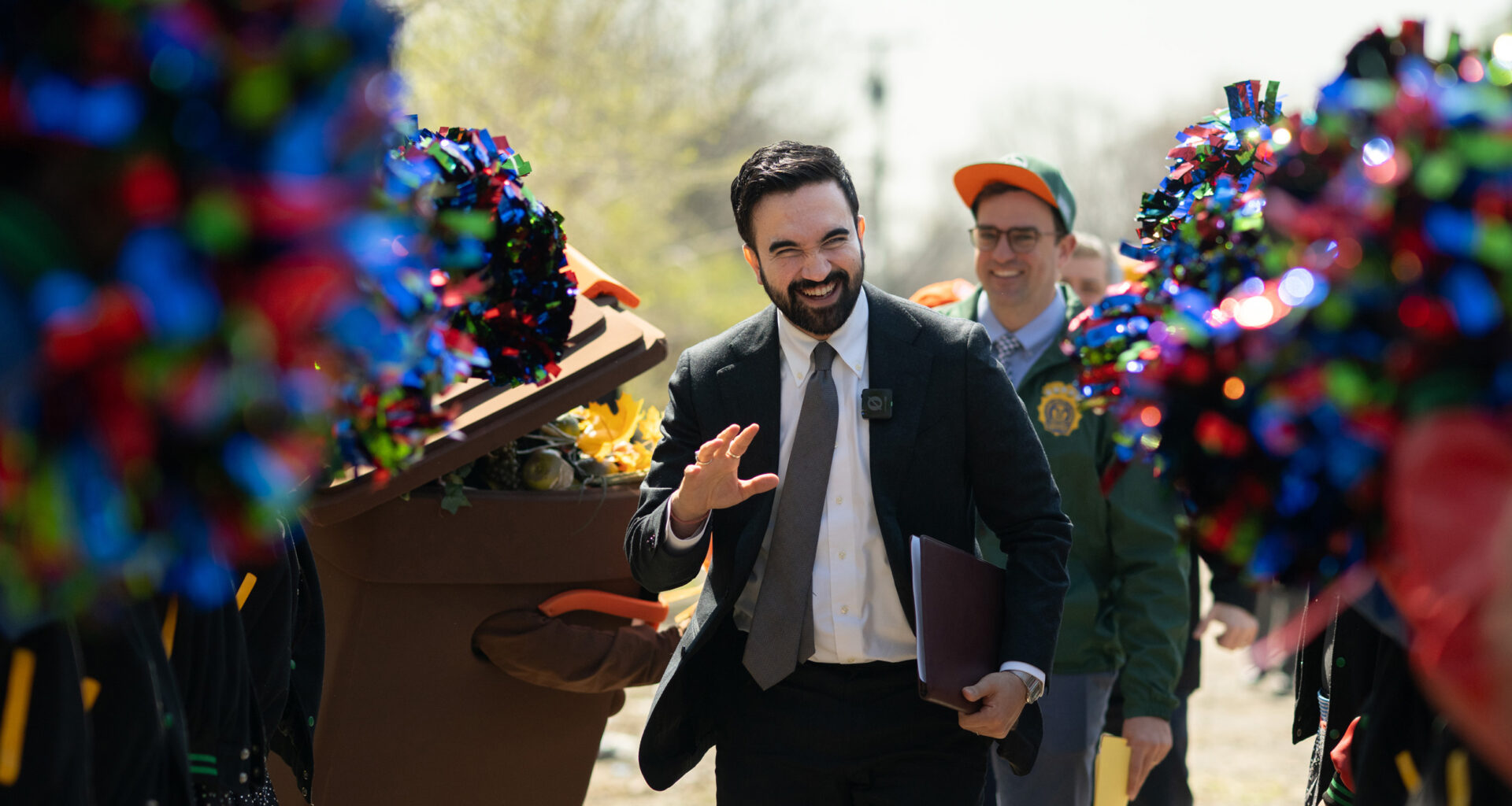
During his New York City mayoral campaign, Zohran Mamdani courted votes from environmentalists. He promised to expand green spaces in public schools and equip them with renewable energy, to meet the demands of the city’s building electrification laws and to increase investments in city parks.
Mamdani also promised to meaningfully improve residents’ lives. For many New Yorkers, that means taking meaningful action on the environment in which they live, such as reducing emissions and fortifying the city against the worst of climate change’s impacts.
During Mamdani’s first 100 days in office, progress on his environmental agenda has been slow.
“It’s… more of the same,” said Adam Ganser, the executive director of New Yorkers for Parks, an advocacy organization that has pushed for 1 percent of the city budget to go to parks.
In his preliminary budget, Mamdani cut $33.7 million from the Department of Parks and Recreation—all but guaranteeing job losses if the plans go through, Ganser said. The department that cares for the city’s green spaces and natural areas—which are 14 percent of city land—has long been understaffed and underfunded.
Further cuts could complicate efforts to keep the spaces clean and safe, especially for parks in low-income neighborhoods that are not maintained by prosperous nonprofits like the Central Park Conservancy. Parks in a dense city like New York cool residents down in the summer, improve air quality and soak up rainwater, which is especially crucial as the city encounters more severe weather.
The city must also meet the requirements of its Urban Forest Plan, which is set to be released under Mamdani. It will detail a vision for reaching 30 percent tree canopy—currently, only 23 percent of the city is covered—to further offset the impacts of air pollution and hot summers. But cuts to the Parks Department could prevent the city from adequately caring for its trees.
Many residents are also vulnerable to extreme heat and flooding. Discussions of fortifying the coast against big storms or mitigating the impacts of inland flooding have been absent from the mayor’s speeches.
But it’s still early, said Tyler Taba, the director of policy and government affairs at the Waterfront Alliance, an organization that advocates for coastal communities in New York and New Jersey. New York City’s first big storm under the new administration will test Mamdani’s leadership, Taba said.
Elizabeth Yeampierre, the executive director at UPROSE, a community environmental justice organization, said that her organization has had “productive” and “promising” discussions with Mamdani administration officials about bringing clean energy to her community and protecting locals from extreme weather events.
Mamdani has not yet appointed someone to lead the New York City Economic Development Corporation. The corporation has released a proposal to build a climate innovation hub on the waterfront in Brooklyn’s Sunset Park.
The hub will serve “cleantech” and energy startups, which Yeampierre says runs contrary to the needs of the community and the push to involve locals in the transition away from fossil fuels. Yeampierre vehemently opposes the plan. “We’re really concerned that while that position remains open, that EDC will continue to follow the real-estate market and to bring in uses that are inconsistent with local and regional needs,” Yeampierre said.
The Mamdani administration’s work on the city’s building electrification laws is also still in its early stages. The administration has made incremental additions, such as replacing gas infrastructure in public housing in Queens with electric heat pumps, but there is still little word on any comprehensive city policy to address private homeowners’ concerns about the cost. The city’s Local Law 97, passed in 2019, fines buildings that emit too much greenhouse gases.
Chris Halfnight, the COO of the Urban Green Council, which researches and advocates for building electrification, is not worried about the slow rollout. The Mamdani administration, he said, should focus on ensuring that buildings meet their 2030 emissions limits, which will be more stringent.
According to his organization, over 90 percent of covered buildings meet the most recent limit, but only 43 percent of them meet the 2030 target.
These are still early days for the mayor, so most environmental advocates have just been tracking budget discussions to glean how Mamdani’s New York will handle climate and environmental pressures. So far, some said, he has not given them much to work with, but there are still multiple rounds of negotiations left.
“How they invest in the agencies that are responsible for carrying out the kind of day-to-day operations of resilience adaptation—that, to me, will be very telling [on] where the administration is going to go beyond the first 100 days,” Taba said.
About This Story
Perhaps you noticed: This story, like all the news we publish, is free to read. That’s because Inside Climate News is a 501c3 nonprofit organization. We do not charge a subscription fee, lock our news behind a paywall, or clutter our website with ads. We make our news on climate and the environment freely available to you and anyone who wants it.
That’s not all. We also share our news for free with scores of other media organizations around the country. Many of them can’t afford to do environmental journalism of their own. We’ve built bureaus from coast to coast to report local stories, collaborate with local newsrooms and co-publish articles so that this vital work is shared as widely as possible.
Two of us launched ICN in 2007. Six years later we earned a Pulitzer Prize for National Reporting, and now we run the oldest and largest dedicated climate newsroom in the nation. We tell the story in all its complexity. We hold polluters accountable. We expose environmental injustice. We debunk misinformation. We scrutinize solutions and inspire action.
Donations from readers like you fund every aspect of what we do. If you don’t already, will you support our ongoing work, our reporting on the biggest crisis facing our planet, and help us reach even more readers in more places?
Please take a moment to make a tax-deductible donation. Every one of them makes a difference.
Thank you,

Reporter, New York City
Lauren Dalban is a New York City-based reporter with a background in local journalism. A former ICN fellow, she now covers environmental issues in all five boroughs. Originally from London, she earned a B.A. in History and English from the University of Virginia, and an M.S. from Columbia Graduate School of Journalism.