
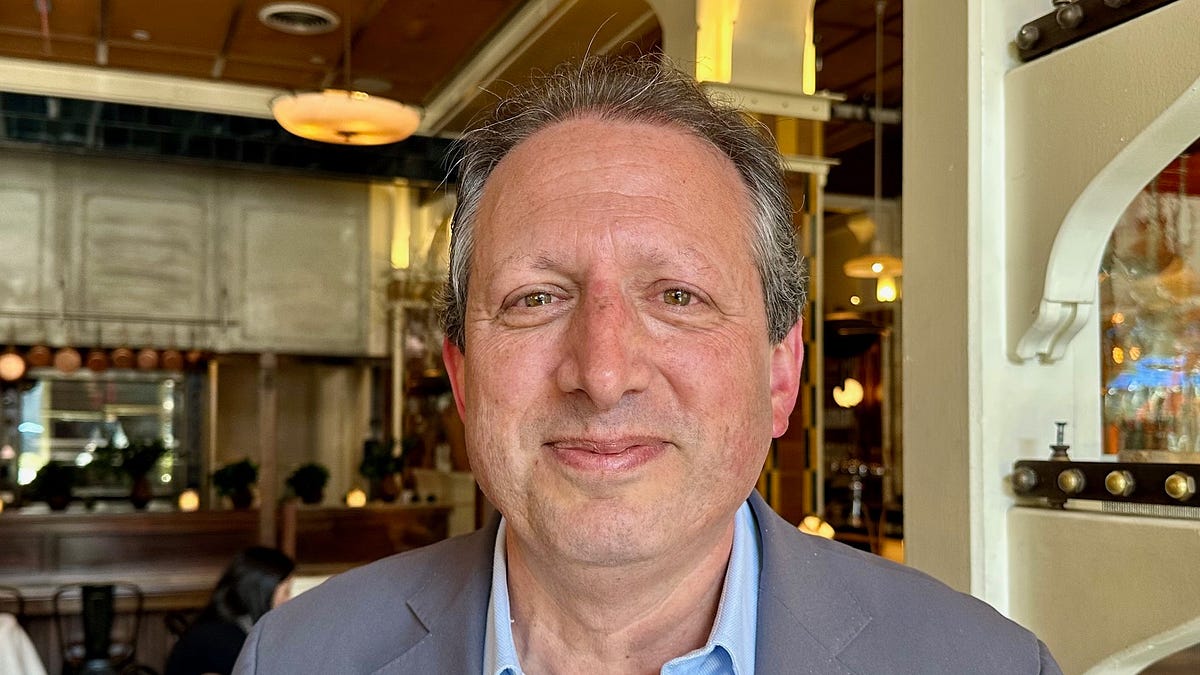
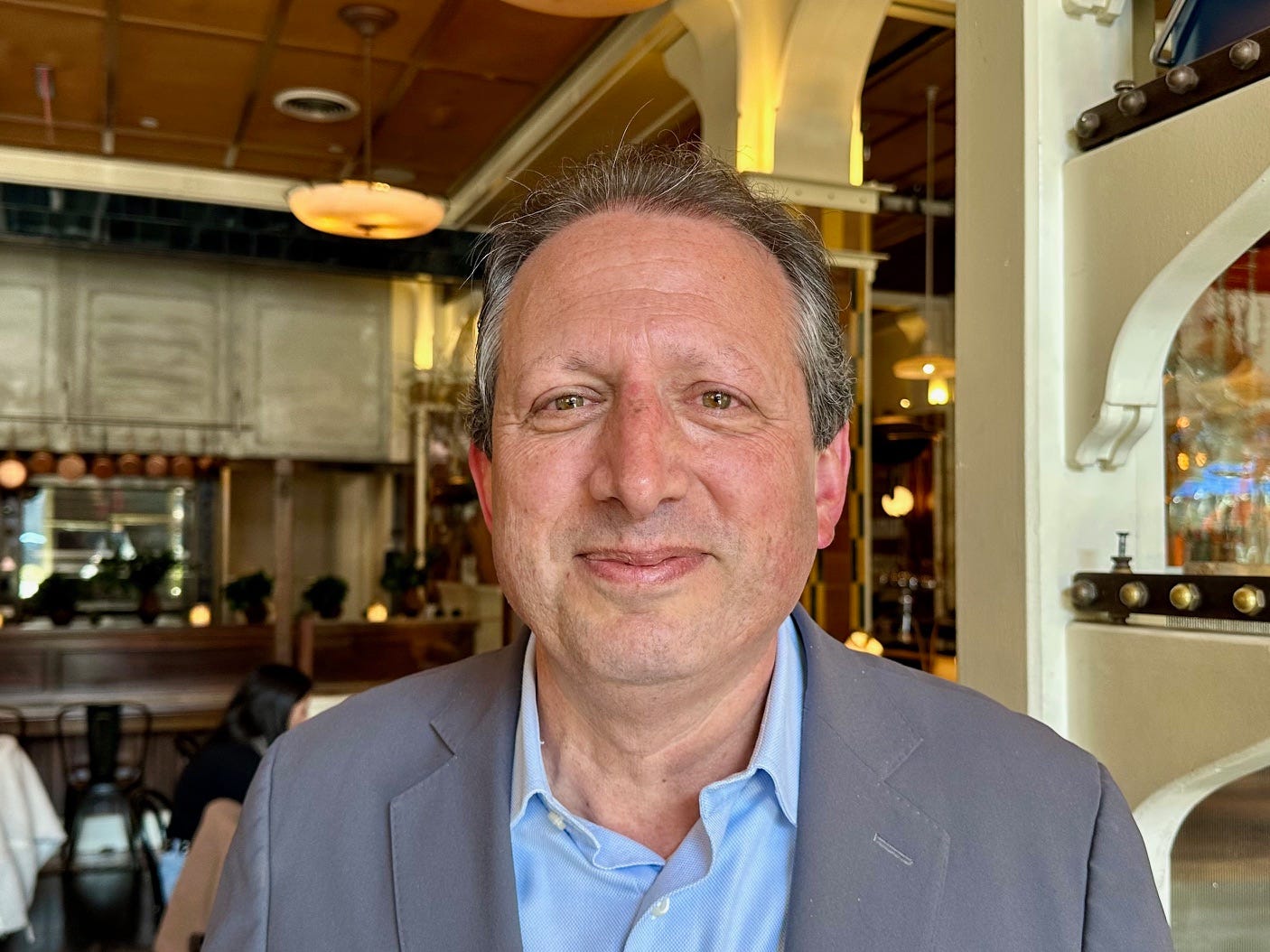
The New York Editorial Board spoke with former New York City Comptroller Brad Lander, a Democrat running a primary campaign against Rep. Dan Goldman in New York’s 10th Congressional District (Lower Manhattan and parts of Brooklyn), on the morning of April 9, 2026. The primary election will take place in June. (photo by Liena Žagare)
Participating journalists: Nicole Gelinas, Alyssa Katz, Ben Max, Akash Mehta, Myles Miller, Harry Siegel, Ben Smith, Liena Žagare.
Full Transcript
Ben Smith
We’re grateful for you coming the first time and setting the expectation that everyone running for office in New York has to come answer some questions. Thanks for coming in.
Brad Lander
Thank you. I’m honored to be here. I’m grateful you guys have created this.
Ben Smith
I don’t know if you want to kick off by explaining yourself at all, or…just taking our questions.
Brad Lander
Up to you!
Ben Smith
OK, Nicole’s question here: What is Congressman Goldman doing so wrong in office to justify losing his seat?
Brad Lander
Well, this is a five-alarm fire for our democracy, for working families and for human beings on planet Earth. And in my opinion, status quo politicians, including establishment Democrats like Dan Goldman are not able to fight it. They aren’t getting the job done.
I will say it’s also a democracy. It’s not “his seat.” That seat belongs to the voters of the 10th Congressional District, and he’s out of step with those voters at this moment.
This is a moment at some points where Democrats need to unify and stand up to fight Donald Trump to protect our immigrant neighbors and people that are being kicked off of food stamps and having their health care premiums done.
But Democrats also have to reckon more seriously with our failures that opened the door to Trump, and I think those are in two categories, and Dand Goldman has failed in both of them.
The first is in standing up to special interests and delivering for American working families who are facing an affordability crisis and don’t see people fighting for them or holding anyone accountable. And a quarter-billionaire largely backed by Wall Street and crypto and AIPAC can’t rise to the moment. This is someone who’s voted for Wall Street deregulation, for crypto expansion, for warrantless wiretaps — not somebody who has a track record of fighting for working families on the core issues that people are so fed up with: for tenants and for affordable housing, for jobs that pay enough for investments in public schools. It’s not just box-checking on, “Did you sign on to some legislation in Washington?” Or, “Can you make up a bill to sponsor to put in people’s mailboxes?” It’s: Do you have a track record of fighting for working families who feel screwed. And I have a 30-year track record of fighting for tenants, of getting legislation passed that makes Uber, Lyft drivers and fast food and retail workers and freelancers better off in New York City because of what government has done for them.
And I think Americans Democrats, 10th Congressional District residents want someone who fights for them. And then — we don’t need to keep going on foreign policy — but I just want to say, at this moment, with the Middle East on fire, having someone who has failed the core foreign policy test of a foreign policy grounded in human rights and international law—
Myles Miller
How do you square what you’re saying about the 10th congressional district, fighting for families, all of that, with the fact that he’s literally set up a clinic for immigrant families in Sunset Park, with the fact that he’s doing a lot of the things that you tried to do when it comes to these immigration issues? Immigration is a big issue in the 10th district.
Brad Lander
I try to say three things. To start, it is an important moment for Democrats to unite and fight Donald Trump on behalf of our immigrant neighbors and our democracy. I’m proud of the ways that I have done that — probably the best moments of the last year have been when people come up to me and say, “I’ve been court watching all year long, and I was inspired to do it when I saw ICE agents arrest you.” And yes, on immigration, he has done good work.
But the other two areas where I think he has failed, and where establishment Democrats have failed, are part of what has opened the door to the crises of the moment: a failure to take on the ways the system is rigged and deliver more broadly to working families on the affordability crisis, the way their jobs suck and don’t pay enough for them to afford their housing or their health care or their child care. Those are issues I’ve been working on for 30 years. I don’t think he has any track record of working on them, and in many cases, has voted with Republicans on the wrong side of them.
And you know, it’s not always the case that Americans are paying attention to foreign policy, but at the moment, they’re paying attention to foreign policy and a foreign policy that talked about human rights and international law, that decided when some lives were worth more than others is a meaningful part of why we are living in a much more dangerous and precarious world. And I think he has failed on number two and number three.
Alyssa Katz
So I want to ask you, and maybe the way you just unpacked it answers the question. But you mentioned AIPAC as among the funders that Goldman is beholden to — in the context of, it sounded like, you talking about the affordability crisis and how working families can’t get ahead. And I just wanted to ask you about that. Do you see a connection there? Certainly some Democrats have.
Brad Lander
I mean, my primary criticisms of him on issues of Israel and Palestine and AIPAC are of utterly failing to meet the moment to see Palestinian lives as just as valuable as Israeli and Jewish lives, which was and remains catastrophic for Palestinian families, but in my opinion is also catastrophically bad for Israel, and catastrophically bad for American foreign policy, and now catastrophically bad for human beings on planet Earth.
The role of money in politics is problematic, and that is often about a particular moneyed interest spending on its own behalf, the way Amazon is spending today to try to defeat the Delivery Worker Protection Act that Councilmember [Tiffany] Cabán is passing. But what AIPAC has done by creating these dark money vehicles that spend against people not even talking about the issue they’re working on, is corrosive for democracy, even though it’s in support of a foreign policy interest and not an economic interest.
Alyssa Katz
But to answer the specific question I was getting to, I think some in the Democratic Party — I’m pretty sure AOC, I think Bernie Sanders has talked about this too — have explicitly drawn a connection between ‘We are spending on the war, we are beholden to AIPAC, and that’s why you can’t get health care,’ and so on. Do you draw that connection?
Brad Lander
I think American working families struggle to understand how there are billions of dollars for bombing Iran and lighting the Middle East on fire and paying for the 2000-pound bombs that destroyed Gaza, and there’s not enough money to pay for their health care or affordable housing or child care. I don’t think that means AIPAC is working against child care or health care or affordable housing.
Money in politics, more broadly, is a problem and I tried to address that in this race by doing what Elizabeth Warren and Scott Brown did in 2012 across the aisle, saying, let’s keep Super PACs out of this race. And I offered that I would, if he would, do this thing called the People’s Pledge, where you say, if outside interest — an independent expenditure or a Super PAC, whatever it would be — spends on my behalf or against my opponent, I’ll take half the amount they spend from my own campaign account and contribute it to an agreed-upon charitable organization. They did that in 2012, it brought down super PAC spending in that race, it set a better tone. If you’re serious about getting money out of politics, don’t just say, “Someday we’ll repeal Citizens United,” show how you’ll do it in this campaign. I offered that, he rejected it.
Alyssa Katz
One more question. You have said that you want to, in Congress, co-sponsor the ban the bombing act. And you’ve also called yourself a Zionist, or a liberal Zionist. I just want to get a sense of how you square those two things, basically denying aid to Israel and then also supporting Israel. Where does that path lead you as a member of Congress?
Brad Lander
Yeah, I mean, first, you know, Dan Goldman has made very clear that unconditional support, unconditional military aid to Israel, regardless of what it does, is his approach to policy. He’s made clear there are no conditions that he’s ever going to put on Israel, regardless of its actions, and that is a catastrophically bad foreign policy that everyone can see the harms of. So yes, I mean I made clear on day one, I will sign on as a co-sponsor of the Block the Bombs Act. I will sign on to [Rep.] Sean Casten’s Inspire Compliance Act, which much more moderate Democrats than me, you know, are signing on to. Dan Goldman isn’t even on that one. He is making very clear he will never put conditions on Israel: maybe an occasional letter to Trump to tell Netanyahu something, or a tweet. That’s just not gonna work.
I mean, American foreign policy to Israel has to change, and it has to condition support based on human rights and international law, like the Leahy Law says we are supposed to do with all countries, and should do with all countries, not only with Israel. But we are never going to be able to move in the direction of the rebuilding of Gaza, an end to settler violence, an independent Palestinian state, and peace between Israelis and Palestinians, so that they can live in peace and security. And that is what I want. I would like to see an Israel which is able to be a safe place, not at war all the time, not fearing bombs and missiles all the time. Where Israeli Jews and other Israeli citizens can live with rights and dignity and safety, and where there’s an independent Palestine, where Palestinians can live with dignity and a rebuilt country that they have sovereignty and freedom in.
And I don’t think Israelis will be safe until Palestinians are free. And I don’t think Palestinians will be safe until they have sovereignty. And U.S. foreign policy currently is pulling us in the opposite direction of that: unconditional U.S. aid for Netanyahu, for Israel, whatever it does. And look, I do consider Israel’s destruction of Gaza a genocide. It was my daughter who brought me the works of Raphael Lemkin, the Polish Jew and Holocaust survivor who developed the term. I didn’t come to that easily, or quickly, but Dan Goldman continues to support a policy which is unconditional support, regardless of what it does. And that is working out catastrophically for Palestinians, for Israelis, for Iranians, for Lebanese folks, for the United States, and for the world.
Ben Smith
Perhaps predictably, the Israel section of this has jumped ahead a bit.
Harry Siegel
So we spoke, you and I, briefly at the Hope Count, about foregrounding AIPAC in your campaign — criticisms of it and all these valid concerns — and how some of this overlaps with more traditional antisemitic concerns about Jews, and how to separate those two currents out. And I was hoping you could talk a little about that, and then maybe in the course of that also respond a bit to this circulated Daily News op-ed from a quote, uh, ‘Concerned Rabbi.’ It sort of touches on the same stuff, you know, urging you to start campaigning, quote, “with integrity and without resorting to rhetoric that echoes antisemitic tropes which fuels resentment towards Jews in the Jewish states. New Yorkers deserve better.”
Brad Lander
OK, so first I want to say I did start with the ways that I think Dan Goldman has failed on economic inequality and delivering for working families and on rigging the system. And that is what I am doing consistently in my campaign. So, you know, as I did today, in general, this is my second area. You know, I think the things Democrats did that opened the door for Trump, were failing to make government deliver for working families, and working families feel it — and I think he [Goldman] is part of the problem there, and that is the number one reason that I’m running — and also I think there are significant Democratic failures of foreign policy that Dan Goldman has also shared some responsibility for. So just in terms of foregrounding that. On antisemitism more broadly, and how to navigate it at this very fraught moment. I’ll start with this—
Harry Siegel
Actually at the very start of your announcement video, and you brought them up a couple of times here. So it [affordability] is not the first thing you’re mentioning.
Brad Lander
Not at the start of my announcement video—
Harry Siegel
The first 30 seconds—
Brad Lander
Not in the first 30 seconds. I think, like, 1:30 of a 2:30 video. We can fact check on that. But I think the ordering matters. Like, I’m foregrounding progressive Democratic critique that is grounded in delivering on the affordability crisis, the cost of living, which matters for working families, as part of standing up to Donald Trump. And I think these issues are important. I’m talking about them. I think they matter, they’re a place that I have a meaningful difference from him, but I do think, when you say foregrounding, I just want to talk about what I’m really foregrounding here.
On antisemitism more broadly. One of the rabbis at Temple Israel in West Bloomfield, Michigan, was my cabin co-counselor at a Jewish summer camp outside of Indianapolis in the summer of 1987. So when an attacker drove a truck full of explosives and tried to bomb and kill the preschool children, I am thinking about Josh Bennett and my Jewish summer campers, you know, in Indiana. Like, I feel this stuff really deeply. A local rabbi said to me at one point recently, the Jewish amygdala is badly dysregulated, and with good reason, and I feel that way. I mean, antisemitism is on the rise, and I take it seriously. How to confront it, talk about it, deal with it, is important and complicated.
That attacker, you know, the FBI found was inspired by Hezbollah, and attacking Jewish preschool kids in a synagogue in Michigan is an antisemitic attack, full stop. Also: his niece and nephew had been killed by an Israeli missile in Lebanon because his brother was alleged to be a Hamas militant, and they launched a missile that killed them. His niece and nephew did not deserve to be killed any more than those preschool kids in Temple Israel in West Bloomfield, Michigan. And you’ve got to be able to talk about it like that. And so I don’t like what Netanyahu is doing, what Israel is doing, and I’m going to criticize it. I support Israel’s existence as a, uh, I believe in the vision of a Jewish and democratic Israel, I think what it is doing is catastrophically bad, and I’m going to talk about those things.
And I want Jewish New Yorkers and American Jews to be safe in this country at a time of rising antisemitism. And I think AIPAC is making us less safe, rather than more safe. I try hard to talk about these issues in a way that, you know, reflect my analysis, politically, of the situation, reflect my values, which happen to be Jewish and American and democratic values — and I’m going to keep doing that.
And, again, just to bring it back to Dan Goldman, I think he has shown, one, that there are no conditions that he will put on American military aid to Israel, no matter how many people’s human rights it violates, And, he is eager to continue taking contributions from AIPAC donors, and would not take a simple step, the People’s Pledge, to keep Super PACs in general, including AIPAC Super PACs, out of this race.
Ben Smith
Do you agree with AOC that the U.S. should stop sending financial and military aid to Israel altogether, including Iron Dome funding?
Brad Lander
So I mean, first, just to restate, you know, the current congressman has made clear that he’ll never, there’s no conditions he’s ever going to put on any aid. And I think that is catastrophically bad for policy. I do support both the Block the Bombs Act and the Ceasefire Compliance Act. More broadly than that, I think we need to follow the Leahy Law and condition all of our foreign policy aid on human rights and international law compliance. At the moment, Israel is very far from complying with human rights and international law. So I would not vote for any more aid at this moment, but I hope it gets there. I want it to be in compliance with human rights and international law. I want the U.S. to be a force for the rebuilding of Gaza under Palestinian leadership, for an end to settler violence, for an independent Palestinian state at peace with Israel, and with security and democracy for Israelis and Palestinians.
Akash Mehta
And just to confirm, under Israel’s current actions you wouldn’t support funding for the Iron Dome?
Brad Lander
At this time, Israel is not, in my estimation, compliant with the Leahy Law of abiding by human rights and international law perspectives. I hope it gets back to doing so.
Ben Smith
One more Israel question for me, having stolen Ben [Max]’s. So, just step back: national American politics right now, both parties are having bitter internal fights about Jews and Israel, and Jews and Israel have somehow become the core fracture in the Republican Party, in the Democratic Party. What is going on, in your estimation? Why is everybody so obsessed with the Jews right now?
Brad Lander
I want to start again by saying in the Democratic Party, I think that the fight that progressives need to primarily be prosecuting, in our internal fights as we get ready to unify and stand up against Trump and Republicans, are about delivering for working-class Americans on the affordability crisis. So there are some differences there, and I want that to be centered in the presidential primaries so we can resolve some of them, get behind some ideas together and go fight and win on them. Those are important differences. And you know, I want us to focus there.
I have two different answers to your question. On the one hand, this week our president sociopathically threatened a genocide against the people of Iran in a Middle East conflict that the U.S. and Israel, that Trump and Netanyahu, have launched. So at the moment, I think there are some straightforward reasons to be looking at this set of conflicts.
More deeply, I mean, antisemitism is a long and deep and nefarious force in human history, and it has many complex roots and causes. You know, I’m standing with people who are sharply criticizing Israel at the moment. And one thing I’m often asking them is, ‘how are we making sure that we are not like arm-in-arm with Tucker Carlson, right? And with fascists who have decided to make this a cause they have of the moment. And how are we building from what should be the foundational idea that, to me, is a very Jewish one: that everybody’s created B’tzelem Elohim, in God’s image. And that means we want human rights and international law.’ And that’s a very Jewish opinion, and Jews are very well protected by it. And I try to fight for it pretty Jewishly. I guess maybe that’s my core answer here. Like I show up to these fights as a Jew. It’s the only way I know how to, and I plan to keep doing it.
Myles Miller
And we have quite the minyan at this table, black, women, everything —
Ben Smith
We can draw a line under this section. We can argue later about who brought it up first…Liena?
Liena Zagare
I wanted to ask about economic policy. You launched your campaign promising to be [Mayor Zohran] Mamdani’s ally in Washington. Mamdani has now met with Trump twice, called him a nice guy, and is asking him for billions for Sunnyside Yards. Being an ally means helping make that deal happen, but you also built your campaign around fighting Trump at every turn. Are there any areas where a compromise would not be possible?
Brad Lander
Well, yes, of course. I mean, I hope the federal government provides billions of dollars to help us build affordable housing at Sunnyside Yards, and I will work hard to be an ally in helping make that happen. I still think the golf courses would be the best place to go first but that’s a place to be an ally. And there’s others. I put out a transit plan. I want to see us get more resources for transit.
I hope that Andy Byford’s leading the redevelopment of Penn Station means federal money will flow into there. It won’t have the architecture or design that I might choose. I’m willing to compromise on the architecture there, if that means we get federal dollars to put money in our transportation infrastructure that we need, and I will look to be a bridge.
But of course, there are places that I would not compromise. Immigration and protection of our immigrant neighbors is the most straightforward of them. I’m taking my case to trial on the DHS arrest at 26 Federal Plaza, and I will put my body on the line again. I would like to see us doing more as a city and a state to defend our immigrant neighbors against Trump and ICE’s abduction and detention, which they just revealed — I mean, [US Attorney for the Southern District of New York] Jay Clayton just put this letter out last week showing that ICE has known for the whole year that they are not authorized to make arrests in immigration court, and they kept doing so, and they say they’re going to keep doing so, and I’m never going to compromise.
Liena Zagare
So you’re fully aligned with Mamdani.
Brad Lander
There are places I disagree with him. I guess I don’t know what you mean. I mean, we want to be strategic. The places to push for resources in Washington are you want to be as aligned as you can. I don’t know the mayor’s position on Penn Station and Andy Byford, but that seems to me a strategic place for New York City to get resources that aren’t primarily about the mayor’s agenda. I’m aligned with him that housing, dollars for affordable housing are a plausible place during the Trump administration to try to get resources for New York City. God willing, after 2028 there’ll be a Democratic president, and there will be a lot more opportunities to think about how to build a bridge in the way that there was a bridge between Roosevelt and LaGuardia in a way that there’s a potential bridge for federal resources.
Ben Max
You said, “There’s things I disagree with him on.” What pops to mind on that? What has [Mamdani] either done or said that you haven’t been aligned on?
Brad Lander
Oh, I mean, I guess I was thinking, you know, I was half-joking — but I do think we disagree about the golf courses, like, I think it might make more sense to pitch for federal resources to build new homes on four the city’s 12 municipal golf courses, which I think we could get done much more quickly than building a deck over Sunnyside Yards. That’s not like a values difference. It’s a pragmatic one. But if the city is deciding to focus on Sunnyside Yards, that’s a place where I can go and fight for the dollars for Sunnyside Yards.
Akash Mehta
I did want to ask where you situate yourself within the left, and with respect to the form of the socialist left that has emerged in the last 10 years. Also, I should disclose that I interned for you when I was 14 — so my real question is about your policy of paying interns.
Brad Lander
[Laughing] I think then we didn’t, but subsequently we did.
Akash Mehta
So for instance, in 2016, in the primary between Clinton and Sanders, you published an essay, “Why I’m a Brooklyn Socialist for Hillary” —
Brad Lander
“Brooklyn Jewish Democratic Socialist for Hillary.”
Akash Mehta
If Bernie were running against Hillary today, who would you support?
Brad Lander
If Bernie were running against Hillary today, I would support Bernie. And in 2020 I supported Elizabeth Warren. When she dropped out, I endorsed Bernie. When Biden won, I robustly and energetically supported him in the general.
Akash Mehta
And so what has changed in your politics or in national politics, from 2016 to now?
Brad Lander
The clarity that Democratic failures to act boldly enough on core affordability, cost of living, economic justice issues, and that the system is rigged against working people and that the wealthy are getting wealthier is just much clearer.
We did a study in the comptroller’s office on ‘what are good jobs?’ We just wanted to know how many jobs in New York are good jobs. And we set a very low bar. It was just like, it’s full-time, it’s year-round, it has health care and it pays the New York minimum wage. Two-thirds of jobs in New York don’t meet those criteria — like two-thirds. That’s a rigged economy, and it isn’t working for people, and I think that’s a big part of why Zohran won the mayor’s race, was speaking to that concern. It’s not working broadly in America, and that precarity is a big part in my estimation of what opened the door to Trump. Because if you don’t fix those problems, and people are pissed off, and they see other people doing well in that system, and they are feeling precarious, you better either show government can deliver, or somebody is going to tell them who to blame — and you are letting fascists in the door.
And it’s clear to me that that is where we are, and that something bolder is required. Now I think you probably would have called me then a “left liberal.” I think you could still today call me a “left liberal.” My politics are aligned with the Working Families Party. That’s how I really ran my Council race, my comptroller race, my mayor’s race, that’s how I’m running this race. So that’s been pretty a consistent throughline.
Akash Mehta
In this political situation where Mamdani is mayor, the DSA is ascendant in New York politics, and you were sort-of the Elizabeth Warren of the mayoral primary against, in some ways, the Bernie of the mayoral primary —
Brad Lander
With a big difference at the end.
Akash Mehta
That Warren didn’t endorse Bernie?
Brad Lander
I mean, ranked-choice voting, which I helped bring to New York, made it possible for us to take a team approach to this mayor’s election, to say neither Andrew Cuomo nor Eric Adams should be the next mayor of New York City. There’s a broad set of progressive goals that’s pretty broadly shared, even if there are some differences within that movement about how to approach it and then ranked-choice voting in general, and the cross-endorsement, helped defeat Andrew Cuomo at a critical moment, offered people a vision of a politics that’s less sour and selfish and ego-driven and more a team effort in pursuit of shared values that requires some compromise, or knowing when it’s time to support someone else, because that’s what’s required.
Akash Mehta
To Ben’s question, do you see pertinent differences between a left liberal who is rooted in, for instance, the Working Families Party, and the socialists who have taken power in recent years, who are more aligned with the DSA? Would you see that as a relevant difference in Congress?
Brad Lander
Well I’m very grateful that those forces are aligned in my race. There was a question earlier in the race about what candidates there would be, and I feel grateful to have the backing of the broad progressive coalition, running against a moderate establishment Democrat. That’s a good way to build a coalition. I think in the mayor’s race, there were those differences. We played them out in the primary in advance. The voters made their choice, and I made a decision to cross-endorse at a moment when I thought it was strategic and important to bring people together so we didn’t risk losing to Andrew Cuomo. And I feel proud of that, but I also feel proud about the race I had run up until then, offering people the vision that I was offering, and I guess that is the kind of strategic coalition politics that I will look to bring to Washington. There are critical moments for all Democrats to unite. I mean, it is a party of moderates and left liberals and socialists.
Ben Smith
What’s the difference, though, between left liberals and socialists? I mean, you don’t think workers should own the means of production?
Brad Lander
I’m not sure those differences are that relevant to this congressional race, because progressives are united behind my candidacy against Dan Goldman.
I have somewhat more of a mixed-market approach. I would like to see more public options, like I proposed in the mayor’s campaign for rooftop solar, and I do support more social housing, but I think there’s a strong role for market actors in broadly the production of enough housing for everyone to live in. I want to see strong and thoughtful regulation.
Let’s take AI for a minute, like just to move us forward in the sort-of directions where there really are going to be important federal policy decisions to make, and where, on the one hand, I think not just Democrats — this is a place I think Democrats and Republicans can come together. Everyone can see that the infrastructure that is set up right now where a tiny handful of companies owned by a tiny set of billionaire tech bros are extracting our data, our privacy, our attention, our money. I think that’s true in sports betting. I think it’s true in the social media algorithms. I think it is true in crypto. I think it is setting up to be more and more true in AI, and there’s a clear need for government to act.
It’s a good issue to build politics around, because I actually think there’s a pretty broad majority of Americans who feel that way, not just socialists or left liberals or Democrats. But like when there was finally a move to get cell phones out of classrooms, people had accepted them, because it just happened along in that direction, in a way that was driven largely by profit, but then also by habits. And when finally people said — I give Governor Hochul her credit here — “Let’s get them out,” Everybody was like, “Yes, that’s the right thing to do.”
And I think there’s an important movement here for bringing people together around, What is the right regulatory approach? You know? What I think we should do is both a whole significant set of regulations that are going to have to have to be developed; but also build some government capacity. We have, like the Fermi Lab on energy, and there’s labs on nuclear and energy kind of science things. We have nothing like that on AI right now. So if the government wants to understand anything about it, we have to buy the understanding from the people who are building the thing for profit.
I’d like to see us have a national lab on AI and build some capacity for understanding it, for regulating it, for deploying it in support of all kinds of things that could be useful on. That to me, on AI, is a left liberal approach.
Nicole Gelinas
So automated vehicles are a subset of AI. The mayor has suspended the Waymo testing. Where are you on that concrete issue of, should we allow AVs to replace our for-hire vehicle drivers in the city?
Brad Lander
Yeah, here’s what I think I would do if I were mayor. This is a little different from what should federal policy be. I think I would offer, let’s call it 1,000 licenses — say 1,000 licenses for Waymos. They will be quite expensive licenses, because we are going to charge, I don’t know, 50%, 75% of the displaced labor cost. You’re putting a Waymo on the street. It’s not going to have a driver. You’re not gonna pay that driver. That driver would have been a New Yorker earning some money. So that license is gonna cost you a pretty penny. You know, let’s say 75% of the displaced labor cost you would have spent over some period of time. And then I think I would say, let’s take that money and offer 1,000 current for-hire drivers, some package that they might be interested in. And I don’t know today whether that’s like a substantial investment in their education and retraining, or a basic income for some substantial period of time — and it would be voluntary, right? Because we’re not actually specifically displacing 1,000 people. We’re authorizing these things. We run some experiments on what will make it possible for people to thrive in new jobs and expenses of their lives on the other side of some tech transitions that have to take place. So that’s just like a pilot program, but maybe it’s an example of how I’m thinking about the kinds of investments that we should make.
Ben Smith
Do you think the Democratic Party broadly is too — I mean, sounds like you are, you think that AVs are coming and are real, and there’s a subsidiary party that I think thinks we should fight these things forever. There should be no data centers. There should be no AVs—
Brad Lander
This actually maybe speaks really well to coalition. I mean, I think it’s smart what Bernie and AOC are doing, saying “No data centers until regulation.” How else are we going to get leverage? I mean, they are moving very quickly. AI is way outpacing anybody’s capacity to regulate. So the risk now is not that we’re going to shut it down, the risk is that it is going to take over everything before we’ve had time to figure things out. So I think that’s a smart move. I’d sign on and say, you know — but then I want to spend lots of time figuring out what the regulatory framework should be. That’s why I think we need more government capacity to understand it. That’s why I would support cities and states doing more regulation until we build enough consensus.
I don’t fully know exactly where it’s going. I don’t know if anyone does. I think it is going to be a very serious set of questions for the forward-going Congress, and I’d like to be one of the leaders that’s serious about taking it on.
Nicole Gelinas
I was just going to follow up on Liena’s question. You brought up Penn Station. Are there conditions that you would require to support the federal Penn Station project? Two would be a no mass-scale clearance of buildings that are already there to give to developers to pay for some of it. And two, do you want to see through-running, where we make this into one regional commuter transportation system?
Brad Lander
To the second, absolutely.
Nicole Gelinas
So you wouldn’t support it if it doesn’t have through-running?
Brad Lander
I mean, the purpose is not to build a glorious new monument. The purpose is an infrastructure and transportation investment that strengthens our capacity to be the center of a metropolitan region. Through-running is a core purpose of the project.
On the questions of what gets demolished and rebuilt, and who benefits from it, I guess I want to get into the weeds a little more. The goal is the transportation and infrastructure project. And unfortunately, often these kinds of projects in the name of transportation and infrastructure become, you know, speculative grabs by real estate interests, and that is not their purpose.
But if something is getting built and look — I guess, one thing I’ll say here is, I have a lot of confidence in Andy Byford. Now, does he survive as the leader of this project? You know, how long can he stay in that job? Those are important questions, but I have a lot of confidence in him. I believe he would quit before he would bring something forward that didn’t meaningfully strengthen the city and the region and the nation’s transportation infrastructure and capacity?
Brad Lander
He doesn’t want to quit. He just quits rather than let bullies and authoritarians make bad decisions that make him do them.
Harry Siegel
You co-sponsored a bill a decade ago urging the federal government not to renew the licenses for the Indian Point nuclear nuclear plant. That didn’t pass. But you know, the plant shut down in 2021.
Brad Lander
That was a mistake. I co-sponsored that resolution?
Harry Siegel
Yeah. So that’s what I was going to ask. Have your views on nuclear changed at all? And more broadly, how would you approach energy policy, which is obviously front and center, given America’s war in Iran, and Israel’s, as congressman?
Brad Lander
Well, I mean, first and foremost, I still think we need the core tenets and outlines of the Green New Deal. We need to invest in renewable and clean energy and have a transition away from fossil fuels to renewables, as far as we can. I still want to do the Public Solar NYC, this public option for rooftop solar. I was in Copenhagen and I saw their offshore wind. I mean, that is what we need to be doing. And our politics at the moment are very far from it. But I do think there is a role for nuclear energy within our transition away from fossil fuels.
And I had not remembered that I had signed on to that resolution, but I’ll view that as a mistake I made, and something I’ve changed my opinion on, I think like a lot of progressives on energy policy, who came out of a time when there were, for understandable reasons, a lot of anxieties about nuclear power plants. But I think we have realized that if we are going to transition away from fossil fuels fast enough to prevent catastrophic climate damage, that safe nuclear energy has a role to play.
Akash Mehta
What do you make of the governor’s push to roll back New York’s climate law and more broadly, how do you square climate policy with the discourse around affordability?
Brad Lander
I think that the governor’s move to roll back the CLCPA [Climate Leadership and Community Protection Act] is terrible, and I strenuously oppose it. We are still facing a climate emergency. I mean, there are a lot of other emergencies in our democracy at the moment, but we are still facing a climate emergency, and we are moving nowhere near fast enough to transition to clean energy, and the CLCPA was an important step in that direction. I was proud to support it, and I still support it, and I don’t like its rollback.
It is important to do that work in a way that delivers more affordable energy for Americans, and shows Americans that it’s delivering more affordable energy for them. And I think we can do that. That’s why Public Solar NYC was one of the things I tried to talk about during the mayor’s race. Like we could be using city and state and federal capital to build rooftop solar on the buildings of New York City in a way that would quickly reduce people’s energy costs and show them more money in their pocket, while we are building out a publicly-owned clean energy utility. And to me, that’s the way to bring together the shift to renewable energy while delivering for New Yorkers on affordability.
Myles Miller
I want to ask you a budget question. The mayor has presented a bleak picture for the budget, really factoring in some of the projections and unpaid-fors by the Adams Administration. You were a critic of Adams, but you know, you have some responsibility and fiscal due diligence in the city.
Brad Lander
And I was very clear about those things at multiple points. I called it out every single budget cycle. I pushed for an automatic deposit into the Rainy Day Fund. I called it out in my testimony to the City Council in April of last year. I called that out at the Financial Control Board in August of last year. I published the numbers people have relied on this year in December of last year.
Myles Miller
So you were this fiscal steward, you were sounding the alarm about the budget. How do you square that with some of the investments in Palantir? How do you square that with divestment from Israel sovereign bonds, and then, you know, continued investment in defense stocks. If you you were this fiscal watchdog who was sounding the alarm about the budget and some of the issues in the Adams administration — why couldn’t you get over the line of divestment from Palantir, divestment from Israel defense with the five pension funds?
Brad Lander
I don’t think there’s any connection between the two parts of your question, so I’m going to answer them as two separate questions.
Myles Miller
Fantastic.
Brad Lander
On the fiscal and budget issues, I did the job as a watchdog over the Adams administration. It is sometimes hard to get attention as New York City Comptroller, and I think in some ways, my critiques of Eric Adams got expected and baked in, and it was hard for me to get people to hear them. But if you ask the Citizens Budget Commission, you know, who was focused on deposits to the rainy day fund, on a thoughtful approach to the city budget, on demanding more transparency on what we’re really spending, and on identifying places for savings without reducing services, I did that job. I’m proud of it. The record reflects it.
On the pension funds. First, the pension funds did extremely well under my watch. We significantly outpaced the benchmarks that are set by the state. That’s like a 7% return. We had over 10% returns in the latter two years and across my tenure saved New Yorkers over $5 billion as a result of a thoughtful, diversified investment approach.
At the same time, we had the boldest, responsible investing program of any U.S. pension in the country, bar none. There’s not even a close second. So we did the largest divestment of fossil fuels, $4 billion out of fossil fuel reserve owners, the biggest investments in affordable housing, significant new responsible property management standards on investor-owned housing around the country, supported workers’ rights at many of the companies that we invested in. And yeah, I feel really proud of the responsible investing.
Myles Miller
So Israel defense stocks —
Brad Lander
So I stopped investing in — I chose not to renew the funds’ investments in Israel Bonds, because what I discovered was the way that prior comptrollers had invested in Israel Bonds was inconsistent with the policies of the pension funds and was favorable treatment of Israel.
We had no investments in any other foreign sovereign debt, and the place that investment was being made from was not actually the fixed income portfolio, it was the cash desk. Prior comptrollers, up to and including Scott Stringer, took cash desk money — that’s money that’s supposed to be an instrument with maturities less than a year, so that you can, like, pay your obligations — and did a thing they did not do anywhere else, put it in investments with two- to 10-year maturities in Israel Bonds that they did not do for any other countries. And when the team came to me and said, “Should we continue to do that?” I said, “No, we should not give Israel favorable treatment, and we should not take cash desk money and use it for…and use long-term maturities.” And I absolutely stand by that position. I think it would be a mistake for Mark Levine to reverse it.
On the other hand, you don’t pick and choose stocks as the comptroller. That is just not the comptroller’s job, to say which companies you like politically or think are good bets economically or fiscally. That would be a terrible idea. And instead, you hire a professional investment staff. They hire asset managers who invest your money broadly across the economy. And when you think there are broad strategic decisions to make, like, let’s divest from fossil fuel reserve owners, you do that with a lot of study, and you do that systemically. And you know, it’s an easy, cheap hit, because there are many companies in the world that investment funds invest in that you can make hay about. But the idea that you’d want a comptroller that picked and chose stocks—
Myles Miller
I mean — Palantir, and you’re anti some of these immigration policies — does not fit with the narrative.
Brad Lander
Do you think it would be a good idea? It does fit — do you think as comptroller, what I should have done was picked and chose stocks, what to buy and what to sell, based on my politics? Is that what you’re proposing? I think that would be a terrible idea, and I didn’t do it.
Ben Smith
It turns out divesting fossil fuels was a bad bet…The stocks have performed great.
Brad Lander
I mean, obviously, that depends on what time-horizon you pick. There were years when it was done well, you know, in the year after Russia’s invasion of Ukraine, those were up.
Ben Smith
But — fossil fuels are on the way out, renewables are rising, just like as an objective fact—
Brad Lander
No, I don’t think so. Actually, at the city level, you can compare, because three of the five funds divested fossil fuels, and two of them didn’t. I mean NYCERS, teachers, and birds divested fossil fuels, police and fire didn’t. Over the time-horizon since the divestment, the three funds that divested have done slightly better than the ones that didn’t.
Ben Max
Can I just come back to this race for a second and what’s ahead, a little bit?
One of Congressman Goldman’s biggest talking points in his bid for reelection is that if Democrats take the House, there will be a lot of accountability work to do related to the Trump Administration, and that he would be particularly strong in that area, given his background as a prosecutor, his work in the first impeachment, and so forth.
Do you agree with that? You gave him credit on the immigration work — you know, that’s one of his core pitches for reelection, do you agree that he would be particularly strong there? And what’s your view on if there is a Democratic House, what needs to be top of the list in some of that oversight, accountability work?
Brad Lander
This is a good and important question. I definitely agree that oversight and accountability of the Trump Administration will be an important role for House Democrats when we win the majority. How to do that is important, and a piece of that is prosecutorial in nature, is tough questions of Republicans for the crimes they’ve committed and the harms they’ve caused.
Let’s be clear, where there are crimes to be prosecuted, prosecutors should prosecute them. And asking questions about them in the well of Congress has a role. What’s more important is at the state and district attorney level, at the U.S. Attorney level, potentially at the independent counsel, prosecutor level, when we take back the White House, for crimes to be prosecuted.
But there’s an important — that’s one element. But you also have to do that work in a way that builds power for the goals we have, that helps build strength amongst Americans to take back our humanity and move away from these dangerous policies, and then sets up the 2028 election in a way that helps us move forward.
So on immigration, I think the first hearing should be in Minneapolis rather than in the Rotunda, because I think the people of Minneapolis, the good neighbors of Minneapolis, to me, have done the best job of anyone of showing how to fight Trumpism. They did it fiercely, but with love of neighbors, and it played, therefore, so well around the country. It helped win people over who had voted for Trump maybe because of, or at least not in spite of, his points of view on immigration. And some chunk of them, it looks like to me, based on polling responses, thought, “I don’t like what’s happening in Minneapolis. I like the way those neighbors are showing up for their other neighbors. That looks like a good way to be American to me.”
So it’ll be great to do our first hearing there, of course, to try to shine a light on who killed Alex Pretti and Renée Good, and to hope that there will then be prosecution and accountability. But also to paint a way forward away from ICE abductions and crimes and toward an immigration policy that we could get together around. And I hope that at the same time we’re having that hearing, Democratic primary candidates running for president, we’ll do a forum that’s televised nationally, but with the good neighbors of Minneapolis.
That, to me, would be a good use of congressional oversight and accountability power, but in a forward-looking direction that helps us get back to a country that can act, humanly, thoughtfully, and deliver for people.
And I think the agenda needs to look like that in other ways as well — on health care. You know, we want to hammer on the ways in which he has doubled the premiums for people on the exchanges and stripped people of Medicaid, and offer a platform to start thinking about how Democrats will deliver now, some of that we could do short-term. I think we could use our budget power to force the subsidies to come back. Right if we have one house, you have some budget negotiation power. That’s the best the Democrats have done collectively this term was when they made that government shutdown fight about the subsidies. I think Americans understood, “OK, I get what the Democrats are fighting for. I get the consequences.” Let’s pick that one back up and win the subsidy restoration and show people we brought your health-care costs down, but also provide a platform for Democratic presidential candidates to say, “Here’s what I’m offering,” you know, whether it’s Medicare For All, or others will have other ideas. So when we win, we could move forward.
So to me, that’s what we should be doing next term. I think I will be better at it than Dan Goldman, because I think he will be stuck in the Rotunda asking the prosecutorial questions, but not thinking about how you strategically build a broader coalition on the issues that really matter to working families.
Nicole Gelinas
We asked Congressman Goldman what should happen to people who have applied for asylum, or who have not applied for asylum, and are found not to have a right to be in the country. So what do you think should happen to people who have failed, or not gone through the proper asylum or immigration process?
Brad Lander
Under the global Convention Against Torture, that’s the controlling international law — it was the global Convention Against Torture that gives us an international obligation to evaluate whether people have a credible fear of persecution if they are deported back to their country.
And like a lot of people at the table, I really don’t want to take us back to the Jewish questions, but I take that very seriously. I’m from St. Louis and that ship called the St. Louis that got turned around and back to Europe, I’m never going to be responsible for that.
I want people’s credible fear of persecution if deported to be evaluated. It doesn’t take 10 years to evaluate. We have a broken immigration system that currently takes — who knows what it’s doing today — but that was taking 10 years to get. Right now, we’re mostly just pre-termitting people’s cases and not letting them even present their credible fear, and saying, “You can go to Uganda if you would like to claim that you have a credible fear of persecution if you’re deported back to Haiti or wherever.”
But it shouldn’t take 10 years. That was a mistake, letting the system become like that, and then failing to get any controls around it contributed to an extremely large number of people coming thinking they would take — some of whom have a credible fear of persecution, and some of whom are seeking economic opportunity because they’re from places of grinding poverty, but don’t, under the global Convention Against Torture, have a credible fear of persecution. I want a system that, in a much shorter period of time, can evaluate that question, and if they have a credible fear of persecution, we should offer them refuge in this country, and if they don’t have a credible fear of persecution, I have compassion for fleeing grinding poverty and wanting opportunity in this country, but that can’t be our immigration policy, and those people have to go back and enter through— try to enter through a different pathway. I would support increased legal immigration pathways that people could apply for. I want a a system that adjudicates more promptly, that does provide refuge for people who have credible fear—
Ben Max
So people here 5, 8, 10, years have to go? They have to go back?
Brad Lander
I mean, that’s a slightly different question. I mean, what the comprehensive immigration reform approach should be: path to citizenship for people who are already here is a different question from the policy for people who enter so…that’s got to be resolved in comprehensive immigration reform.
Ben Smith
I mean, comprehensive immigration reform has been debated at least since like the Bush years. Do you think that there’s anything about the politics of this moment that made you think that Congress could actually get a deal — that President [J.D.] Vance and Speaker [Hakeem] Jeffries are going to be able to hammer this out? How does that happen?
Brad Lander
Well, there are things it will be possible to agree on. How comprehensive they are is a different question.
Ben Smith
The outlines of the thing called “comprehensive immigration reform” have basically been set for 20 years.
Brad Lander
Well, they are different now than they were, because what it was was — stronger border for path to citizenship for everyone who’s here, who’s undocumented. And you know, I still would support some version of that deal for everyone who’s here who’s undocumented.
How to make the system work — the brokenness that revealed itself in Biden, and that Trump exploited, was a little different. It was a system that took so long to adjudicate asylum cases that it created an incentive for people to come and seek asylum, and then the numbers got so big, and that had that impact on our politics — and that could be fixed. It’s in no one’s interest to have a 10-year wait.
Ben Smith
Is there some congressional politics that let that point to 60 votes in the Senate and a majority in the House on some legislation around this.
Brad Lander
I think it’s a good question. There are other areas where I can more easily imagine congressional majorities reaching across the divide. I think there’s some significant economic and workers’ rights issues where that’s possible. I think for Congress to take back some of the Article I power it has ceded, it is given over to an increasingly imperial presidency.
I think [Reps.] Ro Khanna and Thomas Massie, in really interesting ways, are teasing out certain kinds of things that might be, you could imagine building majorities around, even though it’s taken the kind of willingness to say, “Screw it,” on their part that, you know, got the Epstein files released and got the war powers resolution on the floor.
We should try hard to get there on immigration. But it has become one of the issues in our politics around when we’re most polarized. And look, that’s a challenge for Democrats, because, on the one hand, I’m just not going to compromise on, like, our obligations under the global Convention Against Torture. And I think immigration has been fantastic for New York City and for the country, and I recognize that it’s one of the issues around which the country is the most polarized.
Nicole Gelinas
Let me just ask you about Mamdani’s fiscal policies, both the changes in the policies and the funding of them. So you ran a much more moderate [mayoral] race. You weren’t pushing for immediate, universal child care. You were pushing for a more gradual rollout. You didn’t have a free bus platform. You didn’t have a city-run groceries platform. And it’s striking that Mamdani has walked away from all those three things. He said yesterday, he’s not going to get free buses this year, hard to see how he gets them next year. Does that vindicate your more moderate approach?
Brad Lander
No! He won the election.
Nicole Gelinas
Do you think he won based on things he can’t deliver?
Brad Lander
Well, I don’t know. I think he’s set up to deliver in meaningful, concrete ways on the affordability agenda, like universal child care. A path to universal child care is the biggest of those promises, both in the difference it can make in people’s lives and what it can be for New York City, if young families can count on it, and it’s cost. And I, you know, that was one of the top issues on his list. Usually he would say “freeze the rent” first, but that doesn’t have a fiscal cost in the same way. So, and I think he’s on a good path to deliver it. And I think winning Governor Hochul over to make a big step this year is valuable, and so I don’t know—
Nicole Gelinas
And also taxes. Is the local government the right entity of government to sharply raise income and business taxes? Or should this be something you are doing in Congress so where people cannot flee the tax jurisdiction?
Brad Lander
Well, it would be much better to do it at the federal level, but if the federal government can’t or won’t act to deliver, it’s better to do it in New York than not do it at all.
Nicole Gelinas
Why wouldn’t they be able to deliver?
Brad Lander
Well, I’m going to try like hell. But, I mean, today, there is not a federal government that is going to tax the rich in order to fund universal child care for New Yorkers or other Americans. I wish there was. That’s one of the reasons I’m running. I’ll support it in Congress. But in the absence of that happening, I think it’s smart policy for Zohran to have campaigned on it, to be pushing to tax the rich, but also to be working with the governor to make a deal to deliver on it in the short term.
Ben Max
You moved away from calling for those tax increases during your [mayoral] campaign. Now you’re back to supporting them?
Brad Lander
I didn’t move away from them during the campaign, I called for them in the wake of the pandemic. The report I put out the first year as comptroller said we’re about to see a big drop in spending on our public schools because we’re going to see a big pandemic drop off. And I thought in that year it was appropriate to add a surcharge on millionaires or corporate taxes to prevent us from having to make cuts to our public school schools. And the next year, we did not face the same situation. And I didn’t call for the same increases because I didn’t think our schools were going to be cut. And at this moment, I think we can get a big increase to child care this year, even if there’s not some increase in millionaire’s tax or corporate tax in Albany. But to get to universal child care and keep paying for what’s being committed this year and grow to get to full universal two-care, as well as continue pre-K and 3-K, more resources are going to be required.
I hope we could deliver them from Washington. I’m going to go there and fight to tax the rich in Washington. Then, if federal resources will come to pay for that, fantastic. That would be preferable. I hope it happens. If it doesn’t happen, I support increasing those taxes in Albany to pay for it.
Akash Mehta
On the spending side of things, I’m curious if you think that Mamdani is doing enough to find savings. He has proposed finding $1.7 billion in savings. The [City Council] speaker and the governor both think he can find more. On your, I think, second-to-last day as Comptroller, you put out a report on MyCity, which was a social services website that we reported on, and that cost over $100 million. The audit was the closest I’ve seen in comptroller-speak to “this is lighting money on fire.” But Mamdani is not proposing to scale it back. From your four years as comptroller, do you think there are wasteful contracts that Mamdani should more aggressively cut?
Brad Lander
Oh yes, yes, yes. I mean, there are many more savings and efficiencies to achieve in New York City government. We laid out a roadmap to many of them as Comptroller. We did send over to the [Mamdani] transition a whole bunch of other ideas, looking at MyCity, looking at some other contracts, looking at claims against the city, which are $2 billion a year — and no one is responsible for trying to reduce the number of traffic crashes caused by city vehicles or many other things. So yes, I am eager to see it.
I do think he is focusing on those things more than some people thought he would. I think his focus on the day-to-day work of government, the pothole filling and putting chief saving officers in place and drawing attention to it is good. There’s a lot farther to go. I think he’ll probably do much more of that, even by the time the budget is adopted at the end of June. And there’s a lot more work to keep doing there, and you’ve got to do that work to keep your agencies working well, to not be wasting money, to show people you care about it. But at the same time, if you want to expand what social democracy looks like, and give people child care for their two-year olds and, at the federal level, be able to have a system that pays for everybody’s health care, it will also be necessary to tax the rich, and Dan Goldman has shown over and over again, he’s not really willing to do that, and folks in the 10th congressional district want someone who will.
Harry Siegel
A little full circle here. When you met with this board for the first time, you made some news talking about how progressives, including yourself, were slow to respond to the growing sense of disorder coming out of the pandemic. A lot of headlines about that, and this is just after Mamdani got into the race at 0%, before Cuomo was in. Strategist hat on — do you want to look back: What was wrong with your theory of the case, or how things have shifted and where we’re at now?
Brad Lander
I don’t think anything was wrong with my theory of the case. Zohran ran a brilliant campaign that spoke to the cost-of-living needs of New Yorkers and inspired people, and that helped him.
Harry Siegel
His theory of the case was not public safety. Yours was progressives need to get more into that than that, I think—
Brad Lander
I guess what I’m saying is: I don’t think I lost because of that. Zohran won because of the brilliant and effective campaign that he ran.
The number one campaign plan that I had in this space was to end street homelessness for people with serious mental illness in a way that would connect them to supportive housing. So it was not an expansion of policing, but it was a thought about how we could have a city that felt safer and less disordered and out-of-control through a thoughtful intervention that would help mentally ill folks who are sleeping in streets get into housing with the supports they need as well.
I have proposed a federal approach to achieving that for New York City and every other city that I really think we should fight for next term. The federal government, about 15 years ago, did what are called VASH vouchers that offer street homeless veterans a pathway to supportive housing. We used those vouchers in New York City to mostly end veteran street homelessness, and that is great. We could do the same at a quite modest cost for the federal government, for people with serious mental illness, if we had the same voucher, basically. I call them Street-to-Home vouchers. So if the city knew any time that a city worker encountered someone with serious mental illness who is unsheltered, rather than saying, “Can I get you to go into shelter, which often doesn’t work,” you could say, “I can get you an apartment tonight,” a lot more people will say yes. It’s been proven effective 70-90% of time. It’d be expensive for New York City. It’d be a modest amount for the federal government to offer that. And I think it will be great because it’s humane for people not to sleep on the streets who are seriously mentally ill. I think it would be great, because having cities and places that feel safe and don’t feel disordered is much better for living in those cities. And I think it’d be really good for Democratic politics to invest in for all of those reasons. And I thought that in the mayor’s race, and I think it today.
Everyone
Thank you.
Brad Lander
Thank you.