

Nuns claim to assure dignity of dying patients, but won’t comply with New York’s LGBTQ Long-Term Care Facility Residents’ Bill of Rights – nor admit people with “gender dysphoria.”
Featured Image: via Getty Images
For 125 years, the Dominican Sisters of Hawthorne, Congregation of St. Rose of Lima have cared for the dying poor, the lawsuit filing reads. Founded in 1900 by the daughter of novelist Nathaniel Hawthorne, the Sisters’ apostolate is the Servants of Relief for Incurable Cancer (DBA Rosary Hill Home). Located in Hawthorne, New York on a hill overlooking town, the 42-bed skilled nursing facility provides end of life palliative care to financially disadvantaged “persons afflicted with incurable cancer.”
“We cannot cure our patients, but we can assure the dignity and value of their final days and keep them comfortable and free of pain,” the filing states. But the beneficiaries of their mission do not include people with “gender dysphoria” and other categories of LGBTQ individuals who are legally entitled to respectful treatment, per New York ’s LGBTQ Long-Term Care Facility (LTCF) Residents’ Bill of Rights, SECTION 2803-C-2.
New York State has reportedly threatened to shut down the facility if it continues to engage in discriminatory practices.
RHH Video Intro, Dominican Sisters of Hawthorne (YouTube)
The law states that it is unlawful to deny a request by residents to share a room; refuse to assign a room to a transgender resident in accordance with resident’s gender identity; prohibit a resident from using, or harass a resident who seeks to use a restroom available to other persons of the same gender identity; deny a resident the right to wear clothing, accessories, or cosmetics permitted for other residents (described in the filing as “allowing patients to cross-dress).”
The complaint: “The Mandate compels speech and conduct contrary to Catholic values and teaching.”
Specifically, the Servants of Relief for Incurable Cancer are not happy with Section 2803-c-2 which prohibits discrimination by a “long-term care facility or facility staff… against any resident on the basis of such resident’s actual or perceived sexual orientation, gender identity or expression, or human immunodeficiency virus (HIV) status.”
The latter appears to contradict their marketing on application for admissions, which states not only that no payment will be accepted—they depend solely upon the “providence of God and the hourly mercy of the charitable public”—but also: “There is no discrimination on the basis of race, creed, color, national origin, sex, handicap or HIV status.”
They nuns also take issue with requisite Affirming Care for Older LGBTQIA+ Individuals Online training, as per a NYS Dept. of Health “Dear Nursing Home Administrators… ” letter attached to the lawsuit. The are not shy about their position: application to Rosary Hill states up front that they will not accept requests unless they are “consistent with the Catholic moral tradition.”
Transgender people need not apply.
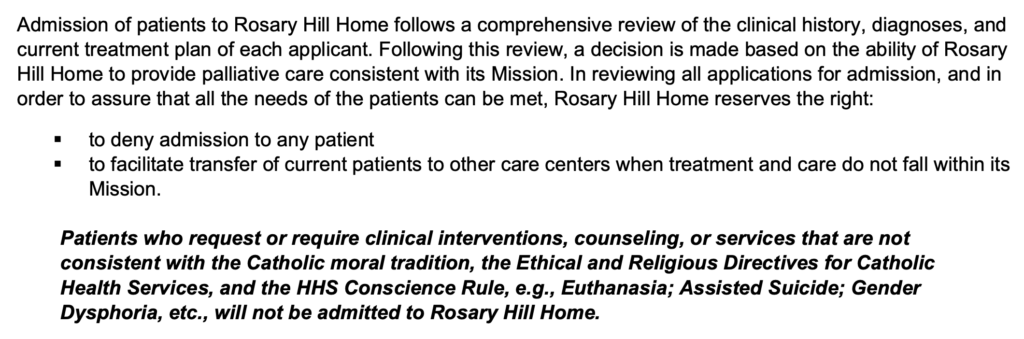
Image: portion of Application to Rosary Hill, Hawthorne, NY
This is a flagrant violation of the law – a law deemed serious enough to mandate that a sign be placed in facilities to spell things out:
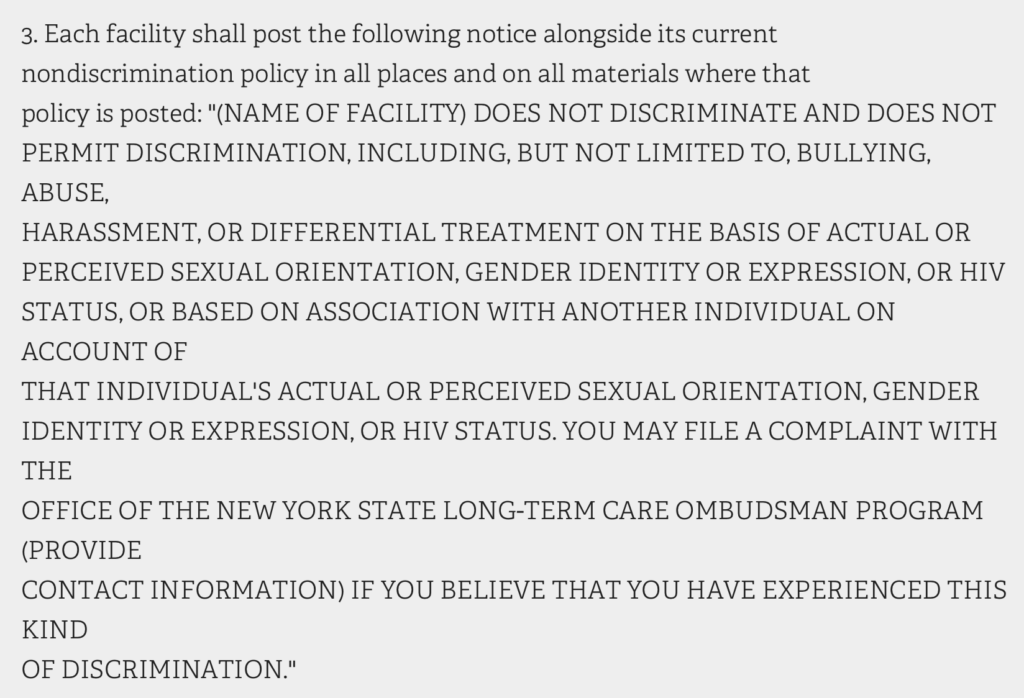
Image: post mandate portion of SECTION 2803-C-2 “LGBT and people living with HIV long-term care facility residents’ bill of rights” via New York State Senate
The sisters note that state law is narrowly tailored to protect the Church of Christ, Scientist – shielding LTCFs from the requirements of Section 2803-c-2. If Christian Scientists can discriminate against queers, why shouldn’t they get to do the same?
The lawsuit, filed in the U.S. Southern District of New York, claims the law violates the First and Fourteenth Amendments. As Dominican sisters, they are under Catholic Church canon law. But their motherhouse in Hawthorne, New York operates under the civil law of the State of New York, as an unincorporated non-profit association.
In their filing, the nuns tout their “incredible work” as described in a New York Times Magazine article ten years ago, where they are lauded for taking in the terminally ill who have been denied necessary 24-hour coverage by insurance. Writer Brooke Jarvis shared impressions of photographer Gillian Laub, whose photos accompanied the article: “She was struck by their tenderness with the dying, how they painted women’s fingernails and combed their hair, changed them into fresh nightgowns and arranged flowers in their rooms.”
Would it be so hard for the Sisters of Relief to extend this kindness to all?