
Ever wonder why that park in the Financial District is called Bowling Green? It’s because when it was officially designated as the city’s first park in 1733, it included a literal bowling green, a regulation stretch of turf intended for one of the world’s oldest surviving games, lawn bowling.
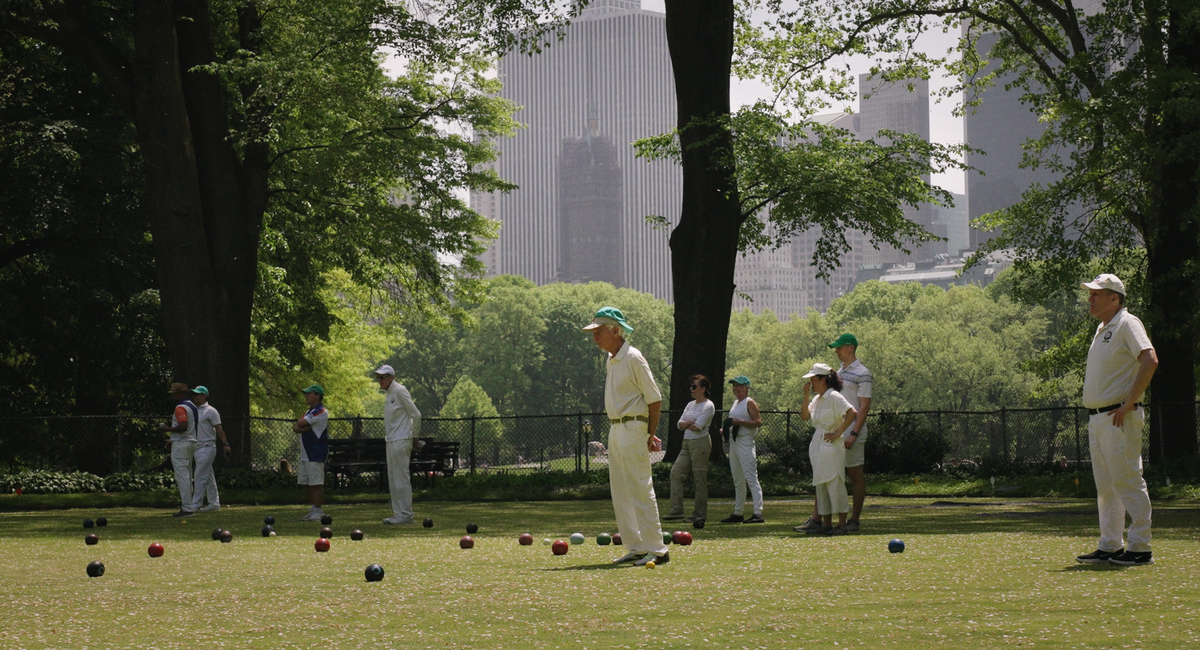
For many years, bowling greens and lawn clubs were common in the boroughs, but today their numbers have dwindled to a single club that plays in just a single location, off West 69th Street, just north of the Sheep Meadow in Central Park.
These two, fenced-in, 15,000-square-foot patches of supremely prime grass were designated as lawn bowls in 1926, and in residence here since year one has been the New York Lawn Bowling Club, which this year celebrates its centennial.
The NYLBC currently has about over 100 members, many of whom found the sport after accidentally coming upon it in Central Park and asking what they were looking at. Lawn bowling is similar to bocce, with players attempting to get their “bowl” close to the “jack,” except instead of the fenced in court in bocce, lawn bowling requires a 120-foot-by-15-foot playing green and uses non-spherical, biased balls, more commonly referred to as bowls.
Joe Kelly, the club’s current president, discovered lawn bowling about 20 years ago with his now-husband “just roaming around on a Saturday morning,” he said. “We leaned over the fence on West 69th Street and saw these crazy people all in white running after a set of bowls and we didn’t know what the hell that was, so we were very intrigued.”
The NYLBC members promptly welcomed the men onto the green and gave them a few lessons. “We don’t play sports, but ever since that day, we’ve been hooked,” said Kelly. He and his husband even moved to Harlem in part because their former home in Jackson Heights “was a bit of a schlep coming into the city,” and they wanted to be closer to the lawns.
NYLBC member Alejandro Delgado, meanwhile, came across the sport after editing a TV commercial for a joint supplement where one of the characters was a lawn bowler.
When he recognized that people in Central Park were “playing this strange game,” he was surprised and intrigued, and decided to give it a go himself.
“I got hooked,” said Delgado, while admitting “I’m a terrible lawn bowler.”
Recently, he directed a short film called “Low And Slow” about the club’s history and its current members, which he hopes to host screenings of soon.
“I think not everybody in the club knows the history of the club,” he said. “My goal was for them to know the story.”
At the end of a private viewing of the documentary, Delgado says, “one of the members, she told me at the very end that she was feeling now prouder than ever to be part of the club. That made my day and this whole experience completely worth it.”
Hanging out on the green often leads to fast friendships among members, who come to play as much as they do to connect, said Delgado. Many of those interviewed in his film shared stories of how being part of the NYLBC community helped them beat cancer, stay fit as seniors, and find meaning, purpose, and friendship.
“ We live in a terribly fast world. Everything changes in five minutes,” said Delgado. “It’s amazing that we can celebrate one hundred years of a sport that is so slow.”
To celebrate its centennial, the Club is hosting an international gathering of lawn bowlers on the green for a one-day tournament and evening gala on Sept. 26.
For those intrigued, NYLBC hosts free lawn bowling clinics in Central Park every Tuesday, Wednesday and Thursday starting May 1 through mid-October (weather permitting). Membership is $125 a year ($65 for those ages 18-29) and includes a Central Park permit, Bowls USA membership, and full use of the Lawn Sports Club House facilities, which the group shares (along with the lawns) with the Central Park Croquet Club, and equipment.
“You will be hooked in no time,” the group’s website promises.