
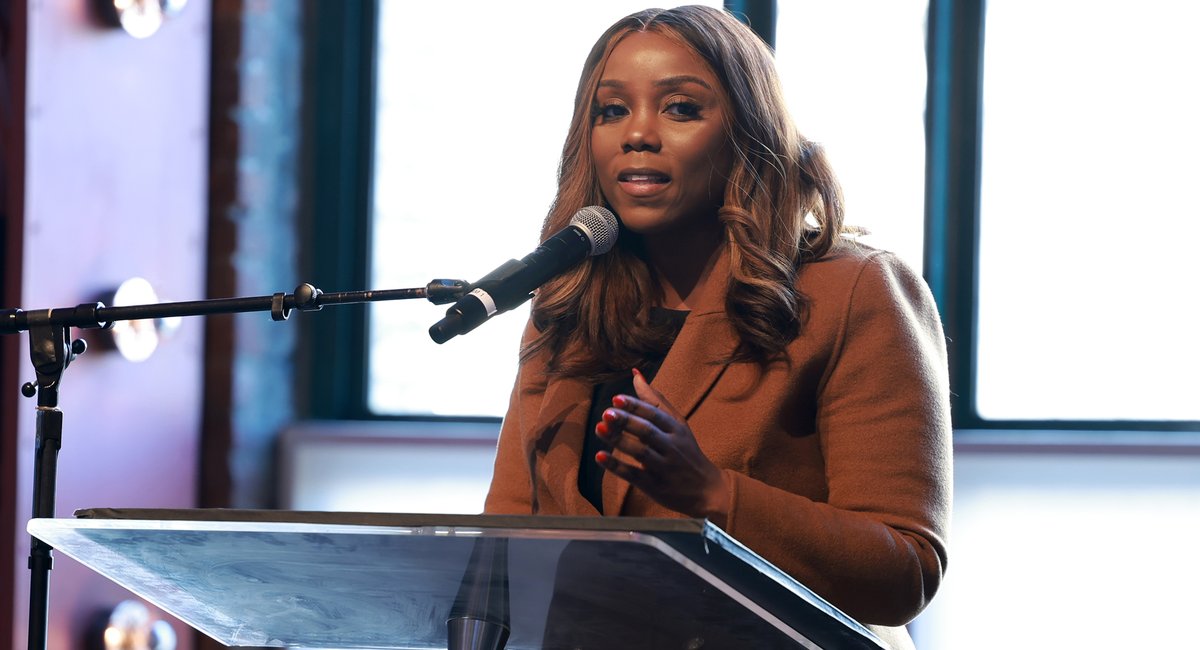
New York City Councilmember Farah Louis steered more than $450,000 in city funds over five years to BHRAGS Home Care Corp., the Brooklyn-based homeless shelter operator at the center of a federal corruption investigation, according to city documents.
A Gothamist review of dozens of City Council budget documents found Louis was the one responsible for directing the windfall through a pool of money overseen by the City Council speaker’s office. Previous reports suggested former Speaker Adrienne Adams had earmarked the funds, but a closer review of records shows it was Louis requesting the money for BHRAGS, every year from fiscal year 2021 through fiscal year 2025.
That made her by far the nonprofit organization’s most consistent benefactor on the Council. In total, the Council directed more than $500,000 in discretionary funds to the organization over that period, the bulk of it at Louis’ request, according to city records.
Federal authorities have not said whether the grants are part of their investigation into BHRAGS, a nonprofit that operates shelters across the city.
Federal agents raided Louis’ Brooklyn home and that of her sister, Debbie Louis, an aide to Gov. Kathy Hochul, in March, seizing their cellphones and breaking down a door to gain entry, according to Politico. The raids were conducted as part of the same investigation that led to the indictment of BHRAGS Executive Director Roberto Samedy and former board Chair Jean Ronald Tirelus on charges of embezzling more than $1.3 million from the nonprofit.
Neither of the Louis sisters has been formally accused of any wrongdoing but prosecutors have been examining their potential roles in securing contracts for a BHRAGS-linked security firm in exchange for bribes or kickbacks, according to a search warrant obtained by the Associated Press.
A spokesperson for Farah Louis did not respond to requests for comment.
A Council spokesperson said BHRAGS will not receive any Council funding while the federal investigation remains ongoing, and that they’re not aware of any flags that were raised during the vetting process at the time the grants were made.
City councilmembers can direct public funds to specific nonprofits without competitive bidding through what are known as discretionary spending awards. Unlike standard city contracts, such awards cover a single fiscal year. They are also reimbursement-based: Organizations spend their own money first, then submit receipts to the city before receiving payment.
Since her election in 2019, Louis has helped direct more than $10 million in discretionary funds to hundreds of organizations across her district and beyond, including legal aid groups, senior care providers, arts organizations, public health programs and immigrant support services. BHRAGS ranks among the largest recipients, according to a review of the records.
The funding came through several channels. The largest grants, three annual $100,000 awards for senior and youth mental health programming, came through the Speaker’s Initiative, a pool of funding the speaker’s office controls. Members can make requests from the speaker for grants that exceed what their individual allocations can cover. Though these grants came through the Speaker’s Initiative, city budget documents list Louis as the sponsor. A $75,000 grant in fiscal year 2022, cosponsored with the Black, Latino and Asian Caucus, also came through the Speaker’s Initiative, according to city records.
City records also show Louis as the sponsor for more than $70,000 in smaller grants, ranging from $1,000 to $15,000, to BHRAGS for senior services and, in one case, food pantry programming. Additionally, $26,000 from funds set aside for the Council’s Brooklyn Delegation went to BHRAGS over multiple years with budget lines specifying the money was intended for Louis’ district, the 45th Council District. Another $60,000 in mental health-related grants went to BHRAGS without attribution to any individual member.
The Department of Homeless Services first flagged concerns about BHRAGS to the city’s Department of Investigation in 2024 and placed the organization on a corrective action plan. Louis’ grants continued through that fiscal year, but then stopped.
Beyond the discretionary grants, the city has paid BHRAGS roughly $130 million through a series of emergency contracts with the Department of Homeless Services since 2022, most of which are set to expire this summer. The organization also won a $94 million shelter contract last year through competitive bidding. That contract, BHRAGS’ largest ever, is set to begin July 1 and the city has not said whether it intends to let that contract proceed.
BHRAGS did not respond to a request for comment. A spokesperson for Councilmember Rita Joseph, who cosponsored the fiscal year 2025 grant, likewise did not respond to a request for comment.
The discretionary spending system has a troubled history in New York City. For decades, the process operated with minimal transparency, and the Council speaker wielded near-total control over how funds were distributed.
But the system came under scrutiny in 2008 when it was revealed that Council speakers had routed millions of dollars to organizations that did not exist, allowing the funds to be distributed outside of the usual process. In response, the Council imposed new pre-clearance requirements, heightened disclosure rules and safeguards against the use of fiscal conduits.
A second wave of reforms followed in 2014, stripping the speaker of the authority to determine how much funding each councilmember was given. Instead, under the new rules, the money is divided equally with lawmakers in poorer areas receiving additional funds.
However, the speaker still controls a large pool of discretionary funding under what’s called the speaker’s list or, under former Speaker Adrienne Adams, the “Speaker’s Initiative to Address Citywide Needs.” Organizations can apply directly to the speaker’s office or members can make a request; sometimes they are funded, sometimes they’re not.
Adams, who served as speaker when the BHRAGS funding was approved, is now running for lieutenant governor. When asked for comment, Gov. Kathy Hochul’s campaign office offered a statement from Diana Ayala, the former City Council deputy speaker who served with Adams.
“[Adrienne Adams] would never approve designating funds to any organization that didn’t pass the council’s rigorous vetting process,” Ayala said. “At the time that the funding in question was approved, she and our legal team understood this organization to be providing quality services to New Yorkers after clearing that extensive process.”
The Council says every discretionary application undergoes vetting by its Office of General Counsel, including nonprofit business records searches, news article searches, social media reviews, tax warrant checks and reviews of prior contract performance. Organizations must also be prequalified through the city’s PASSPort procurement portal and cleared by the Mayor’s Office of Contract Services before any funds are released.
And because the system operates on a reimbursement basis, the risk of funds being misappropriated before services are delivered is theoretically reduced.
But the BHRAGS case illustrates the limits of those safeguards. The vetting process is designed to catch integrity problems that are publicly visible or already on record. It is less equipped to detect corruption that has not yet surfaced.
Susan Lerner, executive director of Common Cause New York, said the system had come a long way over successive reforms, but “it’s also subject to abuse.”
“If you eliminate discretionary funding entirely, there’s a real chance that smaller, less established local entities or initiatives will be overlooked,” she said. “On the other hand, there are constant questions raised about discretionary funding, about who gets it, how they get it, why they get it, and whether it is subject to abuse or undue influence.”
Put plainly, she said, “At what point does it become more of a honeypot for an elected official to dole out favors? We haven’t found a perfect solution yet.”
BHRAGS was not the only organization to which Louis directed significant city funding. Among the other large recipients listed in council budget documents were the Flatbush Development Corp. and the West Indian American Day Carnival Association, both established Brooklyn nonprofits.
Separately, Gothamist’s review identified a $600,000 discretionary allocation to Inclusive Community Wellness Inc., a small Brooklyn aquatics nonprofit, in the fiscal year 2026 budget, also secured through the Speaker’s Initiative at Louis’s request, according to budget documents. Until that point, the group had only received a $5,000 grant in fiscal year 2024.
The $600,000 grant, which is roughly four times the organization’s most recently reported annual revenue of approximately $159,000, was initially listed in budget documents under a purpose statement describing literacy support, homelessness prevention, food assistance, immigrant support and mental health services. Nearly nine months after the budget was adopted, a budget modification corrected the stated purpose to “provide funding to increase community access to swim instruction.”
In a statement, Inclusive Community Wellness said it had not yet received any payment from the city despite having already invested its own capital in anticipation of the funds. A spokesperson for the Department of Youth & Community Development, which administers the funds, says the contract is still being registered and confirmed that no funds had been disbursed.
Inclusive Community Wellness noted the allocation came at a time when then-Mayor Adams was pushing to expand swimming access across the city. In March 2025, Adams announced a $5.5 million expansion of free swim lessons, part of a wider effort that included a $1 billion investment in public pools.
The organization also says it plans to share a portion of the allocation with two other aquatics nonprofits, Rising Tide Effect and Swim Strong Foundation, as part of what it described as a broader swim coalition.
It did not specify how those funds would be divided up. City Council rules limit subcontracting to no more than 30% of a total allocation and require agency approval before any subcontractor begins work or receives payment.