
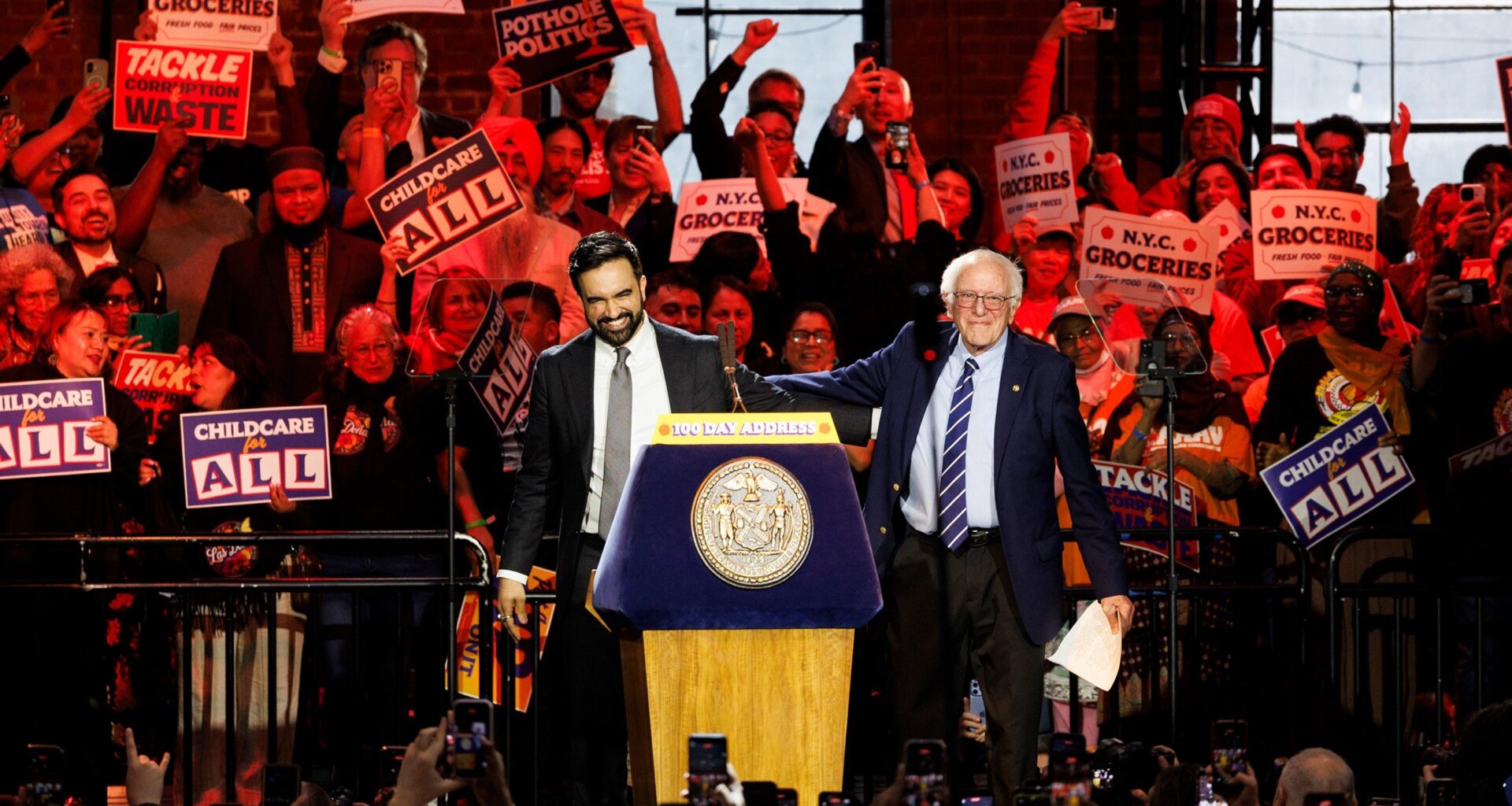
Speaking before a raucous crowd in a former door factory turned music venue, Mayor Zohran Mamdani used his 100-day address to argue that the path to solving New York City’s biggest problems starts with fixing its smallest ones—what he dubbed “pothole politics.”
“Over the past 100 days, we have showcased a new kind of approach to governing in our city,” he said. “Pothole politics. Delivering public goods coupled with public excellence. No problem too big, no task too small.”
The point, he suggested, is not only better day-to-day city services, but political credibility.
“Because if government can’t do the small things, how could you ever trust it to do the big ones?” Mamdani asked a crowd full of supporters and city workers. “How can we promise to transform our city if we can’t pave your street?”
The private event, which included a surprise appearance and brief speech from Sen. Bernie Sanders, reinforced that message.
Sanders, the former mayor of Burlington, VT, praised Mamdani’s administration for offering “hope and inspiration” beyond New York and argued that the mayor was showing “we can have a government that works for all of us, not just the oligarchs.”
“Freeze the rent” placards—a signature campaign slogan—were notably absent from the crowd and did not come up explicitly in his otherwise tagline-filled speech, but Mamdani did not shy away from his housing agenda.
“We’re taking on the biggest driver of the affordability crisis in our city—housing,” he said. “Rents are too high across New York City. And government can do more to address that.”
‘No problem too big, no task too small’
Pothole politics is a nod to Milwaukee’s “sewer socialists,” who, in the early-20th century, cleaned up the city with new sanitation, water, and power systems in the wake of pollution from the Industrial Revolution.
Sewer socialists rejected regulation alone as a force to tame industry, and focused instead on eliminating corruption and other abuses of power. That’s the tradition Mamdani is trying to invoke: not regulation as an abstract promise, but government proving its value through action people can see.
The event featured a “100 Day Address Museum,” with exhibits featuring what his administration framed as its key achievements.Allaire Conte for Realtor.comThe city’s push to fill more than 100,000 potholes in 100 days became the clearest symbol of Mamdani’s early governing approach. Allaire Conte for Realtor.comThe 100 Day Address Museum spotlighted the Rental Ripoff Hearings that heard testimony from more than 1,600 tenants across five boroughs.Allaire Conte for Realtor.com
He tied that logic to his administration’s work to fill more than 102,000 potholes since Jan. 1—the highest first 100-days total in 11 years, according to his office—and extended it to housing, casting the fight against landlord abuse as one of the clearest examples of what this style of governing looks like in practice.
He spotlighted his administration’s rental ripoff hearings, which Mamdani said were held across all five boroughs and drew more than 1,600 testimonies from tenants. He framed those hearings not as symbolic outreach, but as a way to put tenants “at the heart of our policies.”
That argument came into sharper focus through the testimony of Queens tenant organizers who described years of degrading but routine housing failures.
“For years, my neighbors and I have been drowning in silence. We’ve dealt with leaking ceilings, broken doors, and a landlord who just did not care,” one organizer said. “We’d sit in our building’s lobby and call 311 over and over again, turning our individual complaints into one collective voice.”
But since Mamdani took office, she said the city stepped up and stepped in, winning $2 million and forcing repairs in 4,000 apartments—exactly the kind of tangible result Mamdani is trying to point to with his pothole politics argument.
“My message to those tenants is keep calling 311,” she said. “Keep raising your voices because in city hall we now have a partner.”
How Mamdani says City Hall can lower the cost of living
Mamdani also used the speech to argue that the cost of living is not one problem but a pileup of everyday expenses that City Hall should try to bring down at once.
One of the night’s biggest announcements was a plan to open five city-owned grocery stores by the end of his first term.
“Since the pandemic, grocery prices have gone up, and they haven’t come back down. We feel it every single time we go to the store,” Mamdani said, adding that grocery prices in New York City increased by nearly 66% between 2013 and 2023.
The first such grocery store is set to open in East Harlem next year and will be an important test case as to whether the system can deliver cheaper prices—or whether it will struggle to compete with private retailers, as critics suggest.
Addressing these concerns, Mamdani said, “I look forward to the competition. May the most affordable grocery store win.”
He made a similar affordability argument on transit, casting faster buses as a cost-of-living issue in a city where time itself is expensive.
“We will speed up buses for more than 1 million New Yorkers across New York City,” Mamdani said, adding that “in a city where every minute counts, where time is money, it is unacceptable that some buses run as slow as 5 miles an hour.”
He said the plan would trim commutes by up to six minutes each way.
Can ‘pothole politics’ actually carry a housing agenda?
And while Mamdani did not announce a rent freeze, he used the speech to gesture toward one of the biggest upcoming tests of whether his affordability message can translate into housing relief: the Rent Guidelines Board’s decision on stabilized rents.
“And I know there are many New Yorkers who care about the work of the rent guidelines board. I am one of them,” he said.
He then pointed directly to the body that will help determine whether that promise takes concrete form, adding: “I am proud of the six new members I appointed to that independent board, and I look forward to the decision they will come to in just a few short months.”