
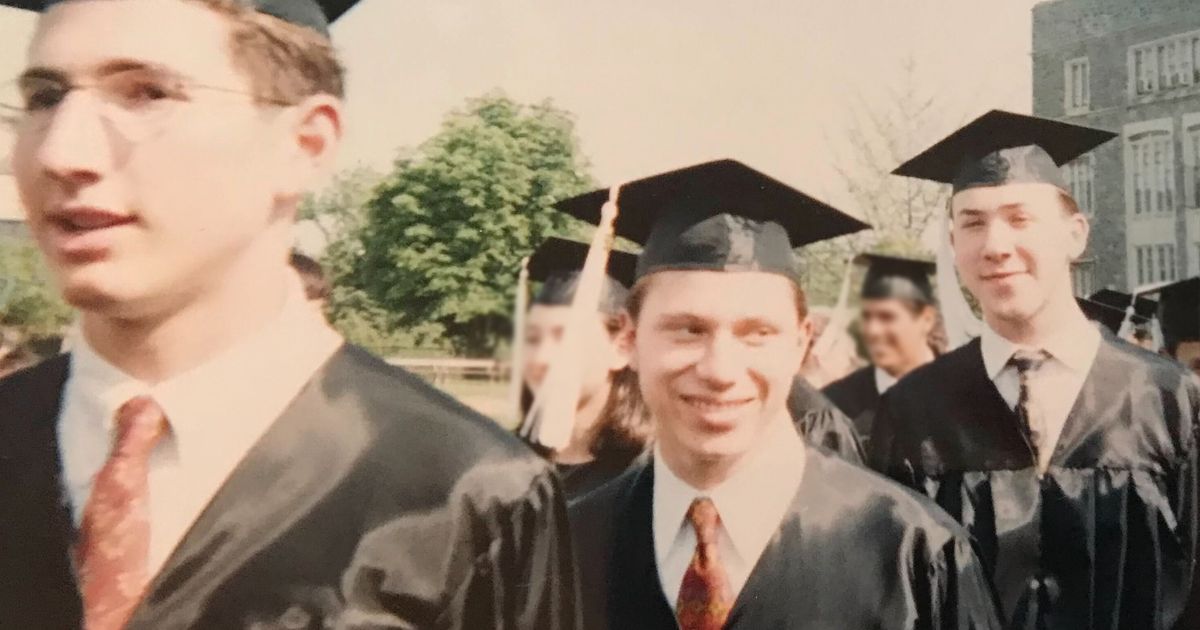
The author (far right) and two classmates.
Photo: Courtesy of the author
In June 1997, when I graduated from Horace Mann, one of New York’s most prestigious private schools, the New York Times published a story about our class that began as follows: “They were, by some accounts, the class of mediocrity.”
A reporter had tagged along with our valedictorian, Loren Easton, and found the freckled 17-year-old wrestling with disappointment, a sense that we hadn’t lived up to the school’s expectations. “All we cared about was getting into good colleges and we didn’t even do that well,” Easton told the reporter. The truth was that 44 percent of us had gotten into an Ivy League school. But for Easton, who spoke for at least some portion of our class — and who’d chosen the University of Pennsylvania after being rejected by his first choice, Dartmouth — it was less about the data and more about the feeling that we weren’t a particularly impressive bunch. “We’re not like last year’s senior class, which had so many geniuses, so many stars,” he lamented.
This obsession with achievement is familiar to anyone who has been in the orbit of an elite private school. Since time immemorial, or at least since the mid–20th century, affluent parents with soaring ambitions for their children have jockeyed for precious slots at schools prized for vaulting grads to the Ivy League and into illustrious careers. When the president of the class above mine got into Harvard, the only person visibly prouder than him was his mother, who immediately traipsed through the halls wearing a crimson sweatshirt emblazoned with the university’s crest.
My father, a corporate lawyer who often reminded his sons that “a man can never be too thin, too rich, or too well dressed,” worked his way up and out of the middle class without the benefit of brand-name schools. When he wrote the first of a handful of $15,000 tuition checks to Horace Mann (which now costs $68,700 annually, more than a Harvard undergraduate degree), I think my dad imagined I’d develop excellent posture while readying myself for a career as a Supreme Court justice, literary titan, or captain of industry.
Instead, after graduating from Pomona, a small liberal-arts school in California, I spent my early 20s playing in a series of ill-fated bands whose achievements — performing at Central Park’s SummerStage and various Verizon Wireless amphitheaters, signing a publishing deal — were thrilling but fleeting. I also spent a few years writing screenplays no one wanted. I did manage to wrangle $1,000 from William Shatner to rewrite a comedy he’d dreamed up, but he didn’t like my take and the movie never got made.
Meanwhile, after working as a reporter at a small newspaper for a couple of years, I bounced between jobs that felt embarrassing for someone with my privileged background: copyediting a yoga magazine, tutoring distracted teenagers, headhunting hospice nurses (which was every bit as ethically uncomfortable as it sounds). To me, these didn’t feel like the customary day jobs that most creative types take to pay the bills; they felt like daily reminders of my inability to make good on the advantages that had been handed to me.
By my mid-40s, I’d built a modest career doing communications for nonprofits whose missions mattered to me but whose dysfunction drove me bananas. My daily responsibilities hardly seemed to require a first-rate education. I wasn’t sure if I’d failed Horace Mann or if Horace Mann had failed me. In any case, whatever advantages my elite schooling had conferred, I was pretty sure I’d squandered them.
One day a few years ago, during a break from yet another funereal procession of Zoom meetings, I was complaining to Marc Bush, a friend from Horace Mann who’d been a model student: managing editor of the school newspaper, ardent water-polo player. In his yearbook photo, he stands proudly in a blue blazer, tie, and khakis, surrounded on the page by quotes from Plato and Shakespeare. Marc went to Yale and, when he was only 22, founded a nonprofit that packaged cross-country cycling trips as affordable-housing fundraisers. Now, in his mid-40s, after a stretch of unemployment, he was a demoralized part-time consultant for an educational-strategy company. Professionally, he seemed and felt lost.
As we commiserated, Marc suggested I revisit the Times story about our underperforming class, whose shadow seemed to be looming over the two of us. I needed to know if other classmates were similarly afflicted. Did the residue of unrealized potential linger in any of them the way it did me? I was less interested in what they’d accomplished than in how they felt about their work and the lives they’d built, especially when measured against the exalted aspirations of our youth. I decided to go searching for the class of mediocrity.
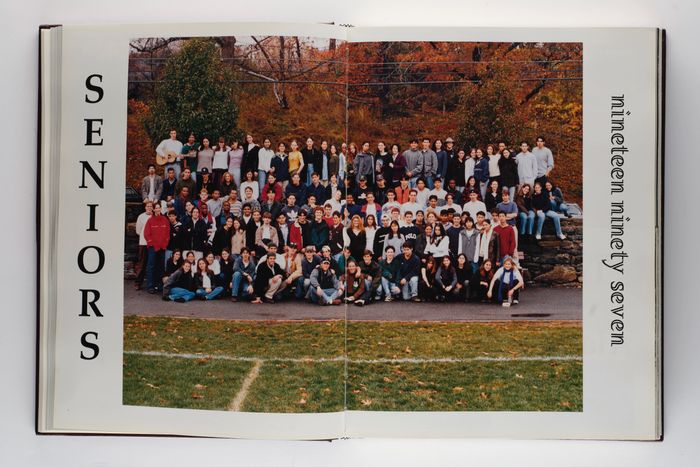
Photo: Hugo Yu
Easton, our valedictorian, now works in private equity. I reached out, but he didn’t want to talk. In the nearly 3,000-word Times article, Easton served as a kind of surrogate for our class, and the privileges he enjoyed, which were briefly documented in the Times story — weekends in the Hamptons, summer trips to Europe — were typical of Horace Mann students. The reporter captured plenty of the psychodrama of our senior year, including Easton’s reaction to being rejected by Dartmouth: “It’s not like it crippled me, but it was the first time anyone ever said no to me.” I called the reporter, Andrew Jacobs, who still works for the Times, and he seemed to have some regrets about probing adolescent Easton. “I think about him a lot,” Jacobs said. “I don’t know how we would have done that story today. I don’t think it was a horribly damaging story, but it probably felt like a betrayal.”
As for the rest of our class, Jacobs recalled being impressed. “All smart kids, strivers,” he said. But he was taken aback that everyone was “completely obsessed with their grades and the school they were going to.” “It was absurd,” he told me.
Nearly 30 years later, it’s fair to say our class has had no trouble succeeding in business. Ben Leventhal co-founded Resy, which was valued at $53 million when it was acquired by American Express. Ara Katz, a serial entrepreneur, several years ago closed a $40 million series-A-funding round for her probiotics company, which has since launched an AI-powered biological-research platform. Katz, whom I grew up with in Westchester County and followed to Horace Mann, was also an adviser to a high-end sneaker emporium co-founded by another classmate, John McPheters, who sold the company for $250 million and now runs a boutique investment firm.
Plenty of other classmates are lawyers, wealth managers, and Wall Street traders. A number have made small fortunes as real-estate developers. “I guess I had faith in myself that something would work out,” Scott Alter told me, recounting his decision to leave private equity in his late 20s to start a real-estate company with a friend. That company is now one of the 50 largest affordable-housing owners in the U.S. with over $6 billion in assets under management. “I’m really driven, and I thrive on that,” he said. His three daughters attend Horace Mann.
As Alter and I spoke, it quickly became clear that he shared none of my burdens. He didn’t feel, as I did, that Horace Mann had imposed on us a sense of specialness, creating monumental expectations that were extremely difficult to live up to. “I don’t look at it like that at all,” he said. “I looked at Horace Mann as just a great education.” He’d cherished our strenuous learning environment, whereas I’d viewed high school as a means to an end — an end that, for me, had come to seem unreachable.
When I suggested that he’d achieved the kind of success we’d been bred to attain, Alter took issue with my definition. “Success, to me, is finding purpose, finding community, finding ways to give back,” he said. If I’d heard those words from another prosperous executive, I might have rolled my eyes. But I knew Alter meant it. His company was tackling a genuine economic problem — the nation’s workforce-housing shortage — and his earnest and upbeat attitude was the same one he’d exuded back in high school.
I didn’t doubt Alter’s work ethic, but it’s tough to credit Horace Mann’s rigorous academic program for some of my classmates’ business success, which often owes at least as much to family money and high-value networks. As one classmate who has dabbled in real estate told me, “I mean, look — it’s not that complicated.” He recounted a story he’d heard about another classmate of ours who’s now a prolific real-estate developer in New York City: “He just put together a small fund and went to his family. He went to his parents and aunts and uncles and stuff like that and was able to pull together enough cash, along with a bunch of debt, to start buying things. If you’re coming from a family situation where they can afford to cut you a check for a few million dollars for something speculative, then that’s absolutely gonna get you moving.”
Researching my classmates, I found I wasn’t all that curious about those who’d taken predictable routes to success or accumulated tremendous wealth. I was more interested in the ones who had strayed from the conventional path of the elite-high-school grad.
“I hated the place since I was 2,” Ted Wallach said of Horace Mann. A gangly and restless teenager who, like most of our classmates, grew up on the Upper East Side, Wallach found the school’s demands oppressive. “You can’t do five hours of homework a night,” he said. “You can only do three or four.” To stay afloat, he haggled with teachers and did everything he could to “beat the system,” as he put it. A lingering resentment of systems, he said, got him fired from his first few jobs.
But around a decade ago, he said, he found his calling: coaching founders and executives. “Mostly people who’ve been really successful in round one and are trying to figure out round two,” he explained. “I teach people to sing the song they must before they die.” Since 2020, Wallach and his family have lived in his wife’s native Sweden.
Wallach spent a good chunk of his 20s and 30s making a documentary about kids from low-income neighborhoods training to be professional magicians. For much of that time, he relied on his wife’s income. Having family help out financially was a not-uncommon theme in my conversations with classmates. When my own wife and I found a house we loved in Pasadena that was out of our price range, I called my dad to help us cover the down payment. But while some of us are a little more comfortable thanks to our parents’ money, others have come to depend on it.
Henry Chromow stopped working in 2017 when his project-management gig at a division of Bloomberg ended. He spends some of his time helping out his aging mother, once a high-powered attorney, dividing his time between her Upper East Side apartment and house in Connecticut. “It’s three acres, it’s an older house — nothing fancy about it — but it’s got a bunch of woods in the back, flat land, and it’s just peaceful and quiet and I just like spending time there,” Chromow told me. “I have my computer. I have trees. I feed the birds. I’m perfectly content to futz around the house.”
Chromow’s decision not to return to work seems to stem less from laziness and more from relief at having finally overcome the depression that dogged him for years. “I’ve always had mental-health issues,” he said. “When I was in my early teens, I felt that pressure of like, Gotta get into the right school and do well there and get the right job. That was a big part of why I ended up in therapy. I was a mess until my very late 20s. I was fucking useless.” Last year, Chromow was the best man at the Lake Como wedding of another classmate, Joe Bernard. At 38, after stints as an assistant district attorney and strategy consultant, Bernard quit the white-collar world to make a go of acting. His parents, who by then had paid for high school, college, a law degree, and an M.B.A., footed the bill for a two-year acting-conservatory program. I imagined Bernard might feel self-conscious about all the career-hopping on someone else’s dime, but he didn’t. His parents, he said, had always encouraged him to pursue his passions. He was the one who’d resisted acting. “I was like, ‘Nah, I should do something serious,’” he recalled. “I should go to law school; I should go to business school. I don’t know whether I viewed acting as frivolous — it just didn’t seem like a serious long-term choice.”
Bernard said he finds a lot more meaning in making art than “trying to move a stock price.” Last year, a film he helped produce won the audience award at Cannes. His acting career, though, hasn’t taken off. “It’s all been slow going,” he said. Regardless, over the course of a few conversations with Bernard, I didn’t detect any of the anxiety that I’d been lugging around.
“The Horace Mann–ness of it,” he said, “the idea that you should be excelling — whatever the fuck that means — yeah, I’m sure that’s true, but I separated myself from that a long fucking time ago.”
Given Horace Mann’s intensive focus on academics, I was surprised that only a few of my classmates wound up working in academia. When I reached out to Demetra Kasimis, who teaches political theory at the University of Cambridge, I suspected she’d have trouble relating to the inadequacy and disappointment I’d felt for so long. But she described struggling to let go of the fantasy of building a life in New York. “I think for those of us who moved out of New York, that feeling of not measuring up might be stronger,” she said. “I always found it difficult to disentangle what it meant to excel at Horace Mann from being highly visible and impactful in New York City. So sometimes I’ve measured it in those terms: Why couldn’t I have just made it in New York?”
Kasimis was teaching at the University of Chicago when she took a sabbatical in Greece, where she has family. She bought an apartment in Athens. “I thought, Well, if a job in Europe ever opens up, I’m gonna apply.” Two months later, one did at Cambridge.
“I took a pay cut, but my life is now in Europe and I’m happier,” she said. During breaks from teaching, she returns to her place in Athens. “I’m making this career work in a way that suits my life rather than making my life subordinate to my career.”
I envied these classmates for living life on their own terms, for shedding the outlandish expectations of our youth. I called others — a psychiatrist, a quantitative researcher, a school psychologist, an environmental consultant who runs a nature preserve — but none felt plagued by unfulfilled potential. Ordinary midlife malaise hung over some of them. “I don’t think I ever found what I love to do,” a real-estate developer confessed, “but I do have things I’m good at.” A software engineer seemed resigned to his career: “This is what I know how to do, and this is what I do.” A journalist shrugged that while his education could’ve thrust him in any number of directions, “this is the direction I chose, which is fine.” The classmates I spoke with appeared to have accepted where they’d ended up. It seemed I was the only member of the class of mediocrity who still felt mediocre.
Midway through my Schadenfreudian quest for dissatisfied classmates, I left the company I was at and became an independent consultant. It’s not the esteemed or exhilarating career I’d once envisioned, but I’m grateful for it. I can be choosy about my clients, whose causes resonate with me and who aren’t mired in dysfunction. And working independently means no one’s looking over my shoulder. About a year ago, Marc Bush, the demoralized education consultant, decided to launch his own travel advisory firm. Working for himself, he’s more energized than he’s been in years.
The more I talked to my classmates, many of whom run their own companies, some of whom struggled under supervision — one told me, “I don’t like people telling me what to do or what to think … I’m a manager’s worst nightmare” — the more I wondered if that’s another consequence of our privileged upbringing: a need to be our own bosses.
“The word I’ll use is spoiled,” Danny Mishkin, another classmate, told me from his home on Long Island. “We were told we were gonna be the boss.” Mishkin wasn’t bad-mouthing any of us. He’s thought a lot about the psychology that shaped our adolescence, and he’s built a career out of trying to remedy its ill effects. After getting a master’s degree in Jewish education, he founded a surf camp rooted in Jewish spirituality. The camp’s mission is simple: teach kids from high-pressure homes to chill out.
“The research is overwhelming,” he said. “Teenagers are stressed out, they’re overprogrammed, the expectations on them are to be perfect. No missteps. And we’re like, ‘No. They need to learn whole-person education.’”
I’m not sure Mishkin and I ever exchanged a word in high school. He traveled in a tight-knit circle of confident kids who seemed to belong at Horace Mann. Many in that circle are now CEOs, finance executives, and the like who send their kids to the school. Mishkin remains close with them, but he has distanced himself from that world.
“I feel like I got out of spiritual poverty,” he said. “I don’t actually think of our upbringing as a leg up. We were around a lot of miserable people when we were kids. They were very, very wealthy, and they were pretty unhappy.”
Mishkin didn’t quibble with the excellence of our education — none of my classmates did — but he felt we were groomed for achievement at the expense of our development. “We were thrust into adulthood, in some ways, way before we should have been,” he said. “We didn’t get the chance to be carefree kids.”
This spring, thousands of anxious parents in New York City and across the country, eager to maximize their children’s potential, will enroll them in elite private high schools. Even as AI threatens to decimate the white-collar workforce, raising unanswerable questions about the purpose of elite education, these parents will write huge checks to schools that promise to push students to become the most outstanding versions of themselves. I wonder how many of these parents will get a return on their investment. I wonder how many of their children will have to unlearn much of what they absorb or struggle to discern their own desires amid so much pressure to succeed. I wonder how many will wind up regretting the countless hours spent trudging through suffocating volumes of homework, the nail-biting SAT prep, the tireless rumination over college applications that, perhaps, are not so determinative of their flourishing after all.
After a few years of tracking down classmates, and decades spent wondering how I might have turned out if I’d just stayed in public school, I was ready to close the book on Horace Mann. I reached one last time for the crimson yearbook I’ve kept on my desk to help with my research. I flipped through it and found the note from Ara Katz, the serial entrepreneur, who’d sung Horace Mann’s praises after enrolling there in seventh grade, encouraging me to follow her there. On the page, she’d written “Was it worth it?”
Related