
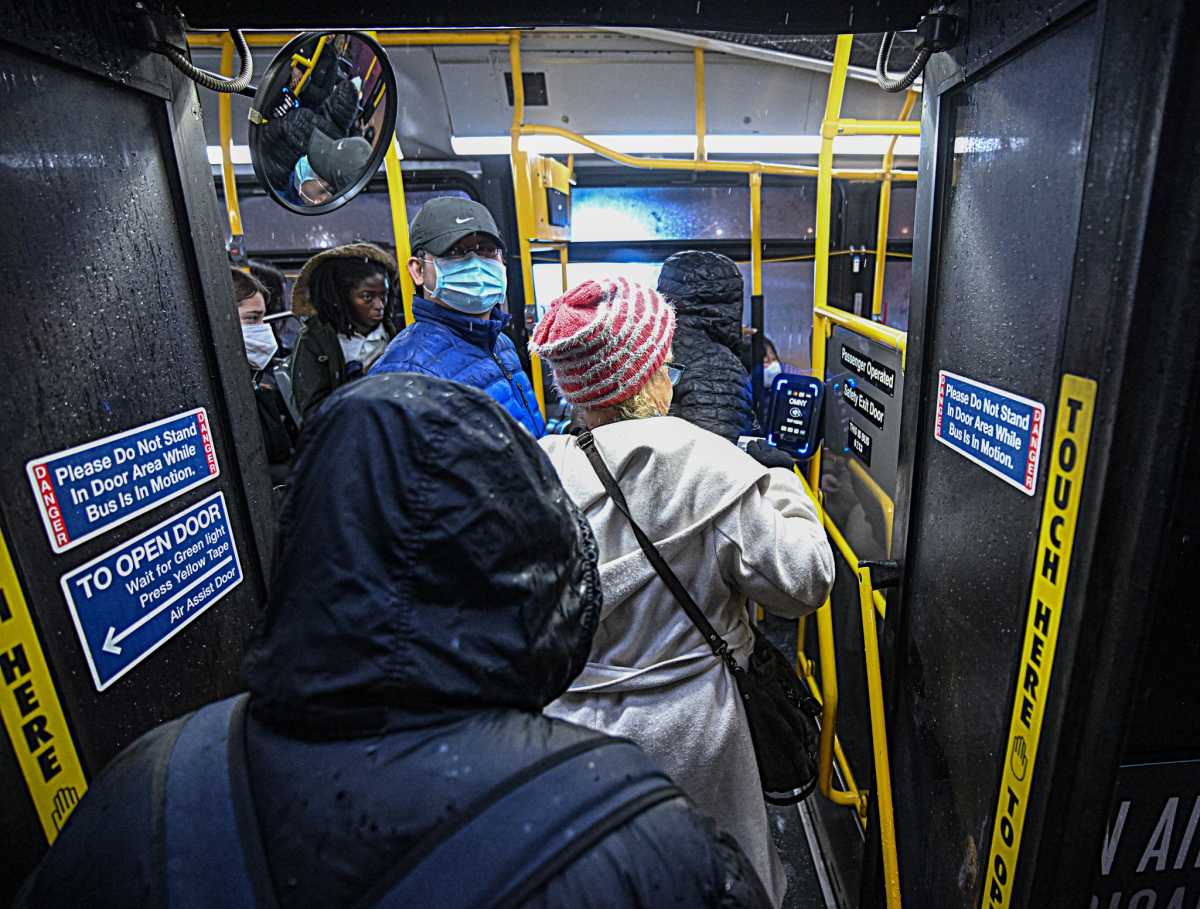
Riders board an MTA bus in Manhattan.
Photo by Dean Moses
Each day, millions of New Yorkers depend on our subways and buses to go to work, school, medical appointments, the grocery store, and back home. For most, the $3 fare is a routine cost. But for too many of our neighbors, spending over $100 a month on transit is a real burden.
In the midst of an affordability crisis, those on the tightest of budgets are forced to make impossible choices: between paying the fare and paying for groceries, between getting to a doctor’s appointment and making rent. No one should have to choose between these necessities.
This is why the City Council has proposed a significant expansion of the Fair Fares program, making the bus and subway completely free for one million of our lowest-income neighbors.
At a minimum, the Council’s proposal would provide free bus and subway fares for New Yorkers earning up to 150% of the federal poverty level — about $23,900 for an individual or $49,500 for a family of four. This would provide a crucial lifeline for so many of our neighbors, alongside broader efforts to ensure reduced fares reach New Yorkers earning up to 300% of the federal poverty level.
This budget proposal builds on the success of the current Fair Fares program which has provided half-price rides since 2019. As of January 2026, about 389,000 New Yorkers are enrolled, but the program only reaches about 40% of those who are eligible.
Making Fair Fares free is only half the solution. We also need to fix how people access it to make sure it reaches as far as possible. If someone already receives public benefits, they should not have to fill out a separate form to gain something they are already entitled to. Our city has this data and we should use it to provide as much support as possible through automatic enrollment.
The charge for fairer fares has been led by Speaker Julie Menin, and we are incredibly proud to support it. Not only because it is the right thing to do, but because it makes economic sense.
The case is easy to make. When someone cannot get to a doctor, a manageable health issue spirals and becomes an emergency room visit that costs the city even more. When they cannot get to a job interview, cycles of poverty deepen. Transit affordability is just as important as the asphalt beneath our buses and the tracks in our subway system.
We have a chance to make our city more affordable for over a million residents. We should not hesitate to do so.
Shaun Abreu is the City Council Majority Leader, representing Manhattan’s 7th Council District, and chair of the Committee on Transportation & Infrastructure. Crystal Hudson represents Brooklyn’s 35th Council District and is chair of the Committee on General Welfare.