
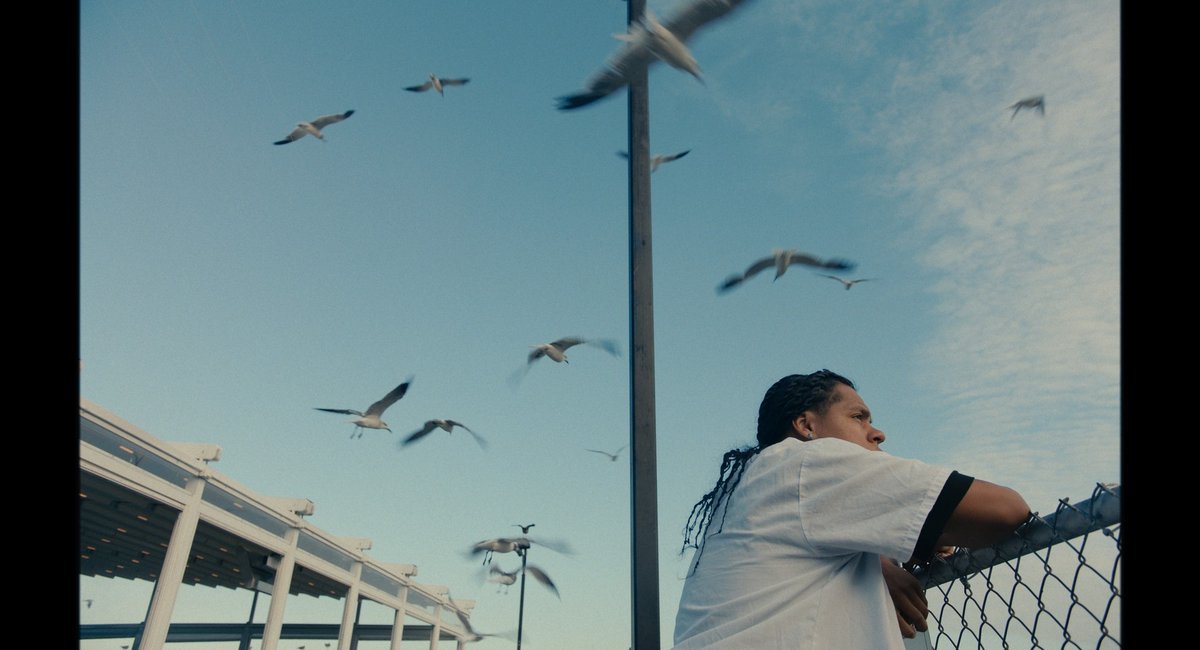
“Nutties! Nutties! Get your nutties!”
That’s the refrain of 19-year-old Rico, one of the main characters in the new film “Mad Bills to Pay,” who has, well, mad bills to pay. When the film opens, we see him selling nutcrackers, those sickly sweet drinks that are usually some potent mix of vodka, rum, tequila and Kool-Aid. He’s hustling, in part, because his 16-year-old girlfriend, Destiny, is pregnant. The revelation throws their already dysfunctional relationship into chaos. And still, it’s a love story.
From the filmmaker’s perspective, that love extends to the film’s location: the Bronx. Shot entirely in the borough, “Mad Bills to Pay” lingers in situations and with people who, according to the film’s writer and director, aren’t often given the space and the grace to figure themselves out.
Joel Alfonzo Vargas wrote and directed the film. He’s a Fulbright scholar who was born and raised in the Bronx. The film won the NEXT Special Jury Award for Ensemble Cast at the Sundance Film Festival and opens in New York City on April 17. He spoke about how the film came to be.
Gothamist: Tell us about Rico and Destiny as a couple.
Joel Alfonzo Vargas: They are in kind of a dysfunctional relationship. After they hook up and Destiny gets pregnant, she’s kicked out of her apartment by her mom. And, as the story goes, she then has to live with Rico and his family and navigate this pregnancy with him.
You credit your parents, who were also teenage parents, for inspiring the film. Why?
My mom became pregnant with my brother when she was 16. I’m 10 years younger than my brother. So when I was born, she was already in her mid-20s. But it was really challenging for her, as you might expect. My dad was a young father as well, although I don’t have a very close relationship with him. But I was just thinking back on the challenges that they must have faced and how difficult that must have been. So all these things were percolating in my mind and that’s what kind of led me here.
Rico and his sister grow up in a single-parent household. What did you want to say about the positives and negatives of that family dynamic?
You know, I never wanna frame it in terms of, like, lack. And I can only speak on my own experiences. I grew up in a single-parent household and my mom, in many ways, was a mother and a father to us. She was the breadwinner and provider and she had our backs 100% of the time. On the other hand, she had to work a lot and take up multiple jobs and not be around us as much. So the con of it was that we didn’t get to spend that much time with her. And, as we were coming of age, as adolescents, it just meant that there was less supervision. So we could go out and do all sorts of things and kind of get away with it. Luckily, my grandparents were great about rounding us up and putting boundaries in place.
Rico and Destiny have to act like adults in a lot of ways, but they’re also childlike.
That’s at the core of the film, I think, because in the context of the Bronx, you have people living on the margin of poverty and there’s just a lot of responsibility that they’re forced to take on. Especially if they’re coming from single-parent households. The tragic thing is that you have children essentially having to step up to these adult roles without really having that core part of the growing-up phase in life where you get to make mistakes and explore your identity. And I think that’s the source of a lot of the self-sabotaging behavior that I’m trying to explore.
Rico also struggles with when to “man up” and when to “man down.” What does that say about his role as a man and a soon-to-be father?
It says that he’s trying to figure it out as best as he can, I guess. I think it means that he’s very clearly going through the story without the tools he needs to be effective. I never approached the character of Rico, or the story, from a place of judgment. I think that what I’m looking for in terms of the audience’s response to the film is just patience, right? Patience with a person like Rico. Because, you know, this is a journey that he is figuring out on his own without a male sort of role model to steer him in the right direction.
Tell us how you cast the actors for the roles of Rico and Destiny.
It was a very rigorous casting process. We initially wanted to go the street cast route, so we started with flyering around parks and beaches. Through that process, we saw loads of people. I wanna say, close to 100. And all the while we were doing chemistry tests. Just trying to find the right pairing of not only Rico and Destiny but also family. We found Juan [who plays Rico] on Backstage. And we found Destiny [who plays the character Destiny] via TikTok.
She was doing these lip syncs to scenes in popular films like “Eternal Sunshine of the Spotless Mind.” What she could do with her face and her expression, it was just so captivating. Immediately, we just wanted to see her. She’s the only true non-actor. But she was just 100% natural. So long story short, it was a very rigorous search. Probably in part, too, because it’s very minimally scripted.
For some actors, that can be super intimidating. How did that go?
Yeah, they absolutely rose to the challenge. The first person we cast was Joanna Florentino, who plays Rico’s mother. She’s quite experienced. Her skill level was quite high. So we were looking for actors who could match that. But beyond that, with just the cast in general, we were looking for people who we could fundamentally and wholeheartedly trust because we knew that we were making this film with very little time, with very little resources and that our backs would be against the wall. We just needed to find the right people who would be able to kind of pull through with us.
Why not script it more?
I tend to not like to take a top-down approach to my filmmaking, at least in my work with actors. I may be rigid around the visual language, for example, the form and so on, but not in my work with actors. I’m an avid fan of hip-hop music and jazz music and that spirit of improvisation that is core to those genres of music. You know, Miles Davis used to write these sketches with the idea that his collaborators would be the ones to shade in the nuance. And I was thinking about “Mad Bills” in a similar way. I wanted for it to be elevated through the process of that collaboration.
The iconic Bronx scenes are just so lovely.
Thank you.
I’m thinking specifically of that scene with a man washing his car late at night under a streetlight. And of course, the beach scenes with Rico selling nutcrackers. What sort of an obligation did you feel to really capture the Bronx in those moments?
That’s the thing. Because I grew up in this community and I was trying to be as faithful to my lived experience and the experiences adjacent to me as possible. So I didn’t really think about it that much. It wasn’t like a concerted effort to portray it in a certain way. It was just like, I’m gonna portray it with the specificity that I know from growing up there. So it was very easy.
You’re from the Bronx. A lot of people say that they’re from someplace with the implication being that they’re glad to be gone. I’m assuming that’s not the case for you.
In many ways, the film is about the Bronx and not just this couple. I grew up in public housing. My family still lives in public housing in the Bronx and growing up, yeah, that was the narrative. It was just like, you wanna be anywhere but here. There’s no opportunity here. And there’s a lack. Everything was framed in terms of a lack.
And what you mean by that is… what’s missing, right?
Yes, exactly. So for a while I thought that was true. I ended up going to college in Pennsylvania. I studied abroad. I went to LA to study film at one point. I lived in London. But then I felt like my identity was a little bit fragmented and I missed home, to be honest. And especially as a storyteller, when I started to ask myself what kind of storyteller do I wanna be? What kind of stories do I want to tell? It was a no-brainer. It was obvious to me that I wanted to tell stories about how I grew up and kind of the people that I grew up around, who I’ve never seen on screen. So I wanted to come back. And a lot of this was happening against the backdrop of the 2016 presidential election, where the contributions and the value of people of color were being [marginalized]. And it still is the case today, obviously even more so. But that’s when I felt like that narrative really kind of took hold. And I wanted to utilize my skills as a filmmaker to speak on that. To offer up the counter-narrative or the more nuanced narrative.
For New Yorkers, a lot of this film is going to feel familiar. How do you think it exports to people who don’t live here?
I’ve never really thought about that in the film’s concept or execution. I wasn’t thinking about [the film] with any other audience in mind but the community in which I grew up. And I approached it from a place of wanting it to be as true to life as possible. The really surprising thing about that is that it resonates with many audiences. We’ve been to close to 100 film festivals with this film. Around the world. And people resonate with it. We’ve seen that first-hand, being on this journey.